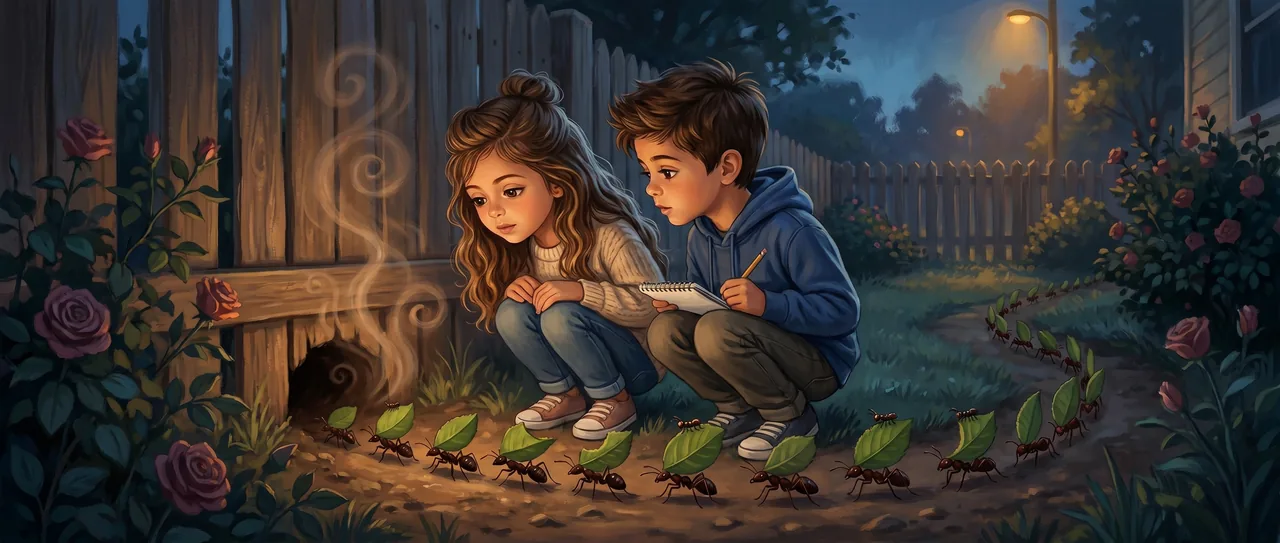
The Farm Nobody Planted
The ants had taken half the rose bush before Maya noticed they weren't eating it.
"Look," she said. She was crouched on the path with her knees in the dirt. "Every one of them is carrying a piece of leaf. Bigger than they are. And none of them stops to eat."
Soren got down beside her. The column ran from the bush across the bricks and disappeared under the fence, a green river flowing the wrong way, uphill, into the ground.
"Maybe they eat it down there," he said.
"Then why cut it so small?" Maya picked a fallen scrap off the brick. It was a half-moon, neat as scissors. "You don't shred your dinner before you carry it home."
"You might if you were going to cook it."
She looked at him.
"I don't know," he said. "I'm guessing. That's what guessing sounds like."
Maya followed a single ant with her finger an inch above its back, not touching, just tracking. The ant ignored her completely. It had a job.
"They all have the same job," she said. "No. Wait." She pointed at a bigger ant, slower, walking the line without a leaf. "That one's not carrying anything. It's just riding along on top of the leaf the little one's holding."
Soren leaned in until his nose nearly touched the column. "There's a tiny one too. On the leaf. Just sitting there."
"A passenger."
"A guard, maybe. Or a foreman." He pulled the notebook out of his back pocket and his pencil moved across the page, three sizes of ant, an arrow, a question mark.
"Okay," Maya said. She sat back on her heels. "So they cut the leaves. They carry the leaves. They cut them small on purpose. They don't eat them. There are different sizes of ant doing different things." She counted it on her fingers. "That's not a swarm. That's a crew."
Soren's grandmother came down the path with a hose and stopped over them. "You found my thieves," she said. "They'll take the whole bush by morning. They did it to my lemon tree two years ago." She shook her head, almost admiring. "Leafcutters. There's no stopping them. They don't even want the leaves."
"What do they want?" Maya asked.
"I never figured it out," Grandmother said. "I just replant." And she went off to water the part of the garden the ants hadn't reached, because that was a problem she could actually solve.
Maya watched her go. Then she turned back to the column.
"She said they don't want the leaves."
"They obviously want the leaves," Soren said. "They're carrying a thousand of them underground."
"They want the leaves for something. Not to eat." Maya pressed her lips together. "What do you do with a leaf if you don't eat it and you cut it really small and you take it somewhere dark and warm and wet?"
Soren stopped drawing.
"You're growing something on it," he said slowly. "That's what the small pieces are for. More surface. Like when Grandma puts the bread in the bag and it goes fuzzy faster if it's torn up."
"Fuzzy," Maya said.
They looked at each other.
"Mold," Soren said. "They're growing mold. The leaves aren't the food. The leaves are the field."
Maya was already up, brushing dirt off her knees, following the column to the place under the fence where it vanished. She put her face right down to the hole. Warm air came out of it. Not hot. Warm, like breath, like the inside of something alive.
"It's warm," she said. "Soren. The ground is breathing warm."
He got down next to her and felt it too, the faint steady heat rising out of the dark.
"That's the farm," he said. "Down there. It's a farm."
"The little passenger ants," Maya said. "What if they're the farmers? Too small to cut, but down there tending the" — she searched for the word — "the crop. The fungus."
They stayed bent over the hole, two heads together, the warm air on their faces.
"Here's the part I can't get past," Soren said quietly. "How does the fungus know to grow only for them? Mold's everywhere. Why this one, in this hole?"
"Maybe they brought it," Maya said. "Maybe they've always brought it. Every new colony, somebody carries a piece of the old farm to start the new one." Then his pencil started moving fast, and he was talking while he wrote.
"Then it never grows wild. Ever. There's no field of it out in the world. It only exists down there, in the holes, because they keep it. And they only exist because it feeds them." He looked up. "Neither one works alone. You couldn't find this fungus on Earth without finding the ants first."
"How long," Maya said.
"What?"
"How long have they been doing it. Carrying the same farm from hole to hole. Because if it can't live without them and they can't live without it, then it's been handed down. One colony to the next. Every single time. Without a gap. Or both of them would be gone."
Neither of them said anything for a moment. The column kept flowing past their knees, green and silent, ant after ant after ant carrying half-moons of rose leaf down into the warm dark, the way they had carried them down before there were roses, before there were gardens, before there was anyone aboveground keeping farms of their own and thinking they'd thought of it first.
"Millions of years," Maya whispered. "They've never stopped. Not once. Not even tonight."
The streetlight came on over the fence. Down in the hole the warm air kept rising, steady as a pulse, and the ants kept coming, and not one of them looked up at the two enormous faces watching the door of a farm older than people.
Read the interactive version, listen to the narration, and earn a gold star →
A science-verified short story for curious kids · Curiosity Land