The Edge That Leans
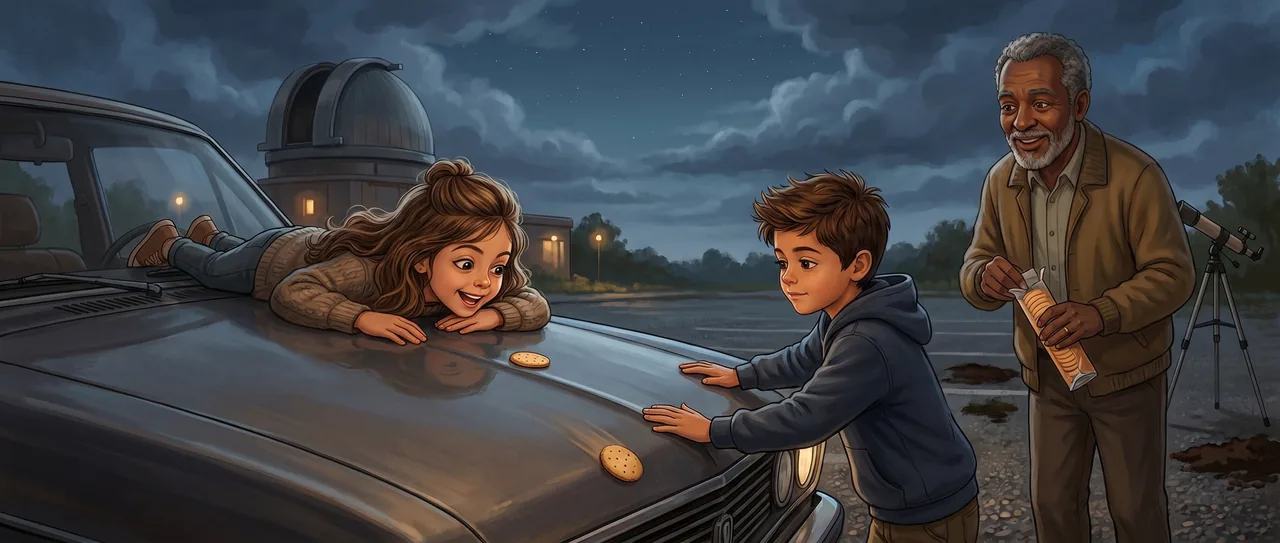
The clouds came in right as the meteor shower was supposed to start, so everybody packed up except Maya, Soren, and a man named Dr. Okafor who was eating crackers out of a sleeve and refusing to admit defeat.
"It'll clear," he said. "It always clears. Eventually."
Maya was lying on the hood of the car looking at the gray. Soren had his notebook open against his knee, though there was nothing to write yet.
"Where do the meteors come from?" Maya asked.
"Bits of comet," said Dr. Okafor. "Crumbs off the trail. Earth drives through the crumbs once a year."
"And where do the comets come from?"
He pointed his cracker out past the dark trees, vaguely upward. "The short ones, the ones that come back every few decades, those come from out past Neptune. There's a whole field of frozen things out there. The Kuiper Belt."
"How many things," said Soren.
"In the belt? Big ones, bigger than a hundred kilometers across? At least a hundred thousand."
Soren stopped. "A hundred thousand things bigger than a city, and nobody's at any of them."
"Nobody's even seen most of them," said Dr. Okafor cheerfully. "They're small and dark and stupidly far. We find a few more every year."
Maya sat up. "So the map's mostly empty."
"The map's mostly guesses."
She liked that. She lay back down and started building the belt in her head, a wide flat ring of dark stones turning very slowly around a sun that out there would look like just another bright star.
"Does it have an edge?" she asked.
Dr. Okafor chewed. "Funny you ask. It does. And the edge is the strange part."
"Strange how," said Soren, pen ready now.
"You'd expect the belt to just thin out. Lots of stuff, then less stuff, then nothing, fading like the edge of a town. But it doesn't fade. It stops. Sharper than it should. And some of the far objects out there, the way they swing, the long looping ways they go around the sun, they all lean the same direction. Like something lined them up."
Maya went quiet on the hood of the car.
"Lined them up with what," she said.
"That," said Dr. Okafor, "is the question that keeps certain astronomers from sleeping. Maybe nothing. Maybe a glitch in how we've looked. Or maybe there's a planet out there. Big one. Bigger than Earth. So far out it takes thousands of years to go around once, so faint we've never caught it."
Soren wrote: edge does not fade. it stops. He looked at the words. "You can't see it," he said slowly, "but you can see what it does to everything else."
"If it's there," said Dr. Okafor. "Big if. People have looked. People keep looking."
Maya wasn't listening anymore, not really. She was thinking about the crackers.
"Drop one," she said.
"Drop one what?"
"A cracker. On the hood."
Dr. Okafor, who clearly enjoyed strange children, set a round cracker on the smooth metal of the car hood. It sat there.
"It's not moving," said Soren.
"The hood's flat," said Maya. "Tip it."
Soren pushed down gently on the front of the hood with both hands. The cracker slid toward him and stopped against his thumb.
"Okay," said Maya. "Now I'm at the back of the car. I can't see your hands. I can't see you pushing. All I can see is the cracker." She crawled to the rear of the hood and put her eye right down level with the metal. "Slide it again."
Soren pressed. The cracker slid.
"It went toward something," Maya said. "I can't see the something. But the cracker leans, so the something's there." She looked up. "That's the whole trick. That's the planet. We never had to see it. We just had to find a hundred thousand crackers all leaning the same way."
Dr. Okafor had stopped eating.
"The far objects lean," Maya said, getting faster. "You said they lean the same direction. That's the hood tipping. Something heavy is down there at the low corner pulling everything toward it and we are at the back of the car where we can't see the hands."
"We can't see the hands," Soren repeated, and wrote it, and underlined it.
"It might be nothing," said Dr. Okafor, but he said it the way you say something you no longer fully believe. "It might be the way we collected the data. A real edge or a trick of the search."
"Then drop a cracker on a flat hood," said Maya. "If it slides anyway, something's pushing. If it just sits, you tilted your own table by accident." She was grinning now. "That's a thing you could test. That's a thing somebody's testing right now, isn't it."
"Right now," Dr. Okafor admitted. "Tonight. Telescopes are out there sweeping the dark corners of the sky for a slow faint dot that doesn't belong. Could be next year. Could be a person who hasn't been born yet."
Soren looked up from the notebook. "A hundred thousand things bigger than cities," he said, "and the most interesting one might be the one nobody's found."
"The one we only know," said Maya, "because of how it leans the others."
The three of them sat with that. Out past the clouds, past Neptune, the dark belt turned, and somewhere along its too-sharp edge the frozen stones went around in their long leaning loops, all tipped toward the same empty-looking place.
"It's clearing," said Dr. Okafor.
It was. A seam had opened in the gray, and through it a few stars showed, ordinary and patient.
Maya didn't look at the stars. She looked at the cracker, still resting against Soren's thumb where the hood leaned down.
"Take your hand away," she said.
Soren lifted his thumb. The cracker slid the last few centimeters on its own and dropped off the edge of the hood into the dark grass below.
Read the interactive version, listen to the narration, and earn a gold star →
A science-verified short story for curious kids · Curiosity Land