Neither One Thing
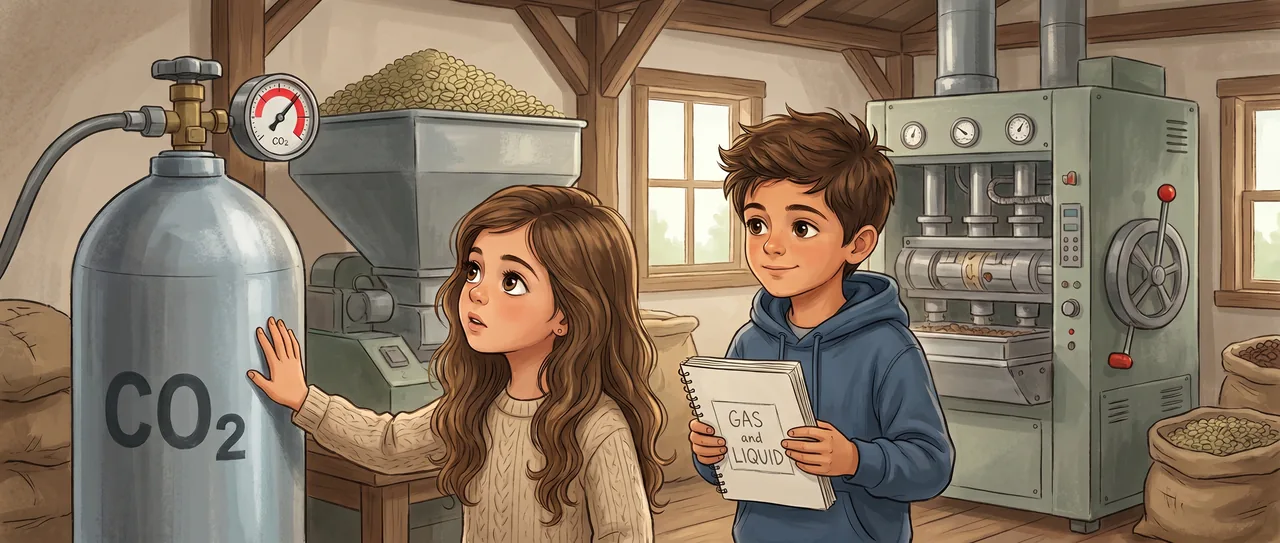
The sign on the steel tank said CO2, and Maya had been staring at it for two minutes, which Soren knew because he had finished his hot chocolate.
"Carbon dioxide is a gas," Maya said. "That's a tank for a gas."
"It says liquid on the gauge," said Soren.
They both looked at Aunt Reza, who was wiping down the long machine that hummed against the back wall. The roastery smelled like wet earth and something green, not like coffee at all.
"It's neither, right now," Reza said, not turning around. "Don't touch the valve."
"Neither what?" said Maya.
"Neither liquid nor gas. I'm pulling the caffeine out of those beans." She nodded at a hopper of pale green beans, nothing like the dark ones in the front shop. "Carbon dioxide does the work. But not gas carbon dioxide and not liquid carbon dioxide. Something in between."
"There isn't an in between," Maya said. "Things are one or the other."
Reza shrugged the shrug of a person with a batch to finish. "Tell that to the tank."
Soren had his notebook out. He drew a box and wrote GAS at one corner and LIQUID at another.
"Okay," he said. "Think about it. A gas is molecules flying around far apart. A liquid is molecules touching but sliding. Squeeze a gas hard enough, the molecules get close. Heat a liquid enough, they move fast."
"So you push from both directions," said Maya. She leaned over his shoulder. "Squeeze it and heat it at the same time."
"Until what?"
Maya didn't answer right away. She was watching the gauge needle, which sat in a red zone with a label too small to read from here.
"Until you can't tell anymore," she said. "Until close-and-sliding and fast-and-flying are the same thing."
Reza did turn around then. "That's the critical point. Above a certain temperature and pressure, the line between liquid and gas just stops existing. You get supercritical fluid. It fills the whole space like a gas. It dissolves things like a liquid."
"Both," said Soren.
"Both," said Reza. "It seeps into the beans like a gas would, into every crack. Then it grabs the caffeine and dissolves it out like a liquid would. Then I drop the pressure, and the carbon dioxide goes back to being a plain gas and floats off, and the caffeine is left behind. The beans never get scorched. No nasty solvents. Just air, squeezed."
Maya was quiet. Soren recognized the quiet and waited.
"Where's the line?" Maya asked.
"What line?"
"When you boil water you see the line. Bubbles. The top of the water. There's a place where liquid stops and gas starts." She tapped the steel. "In there, is there a line?"
Reza smiled for the first time. "That," she said, "is the strange part. There's a thing called a sight glass on the big research rigs. You watch carbon dioxide as you heat it toward the critical point. The line between the liquid and the gas, the surface, the meniscus, it gets fainter and fainter."
"And then it snaps?" said Soren.
"No. It doesn't snap. It just fades. The surface gets blurry, and dim, and then one second it's there and the next second you realize you can't say when it left. There was a line. Then there wasn't. And you never saw it go."
The machine hummed. Maya put her hand flat on the tank, then pulled it back because it was cold, not because Reza told her to.
"That's inside there right now," she said. "Something with no surface. Not a liquid with a top. Not a gas in a room. A thing that filled itself in."
"Forty grams of it," said Reza, "per liter, give or take. Heavy as a liquid. Loose as a gas. Soaking those beans."
Soren wrote, then stopped writing. "So when people say everything is a solid or a liquid or a gas."
"They're teaching you the easy version," said Reza. "Which is fine. The easy version gets you through breakfast."
"But it's not true," Maya said. She wasn't upset. She said it the way you'd say the sky's bigger than the window. "There's a whole other thing. And it's just in a coffee tank in a strip mall."
"It's how they dry-clean clothes without poison," Reza said, checking the gauge. "It's how they pull medicine compounds out of plants. Same trick. Squeeze a gas past the place where the words stop working."
"The place where the words stop working," Soren repeated. He liked that. He wrote it down, and his hand was a little fast.
Maya was still on the surface that faded. "Can you make it come back? The line?"
"Drop the temperature and pressure back under the critical point. The surface reappears. Out of nowhere. The fog clears and suddenly there's a top to the liquid again, like it had been there the whole time."
"But it wasn't," said Maya.
"But it wasn't," said Reza.
Maya looked at the tank, and then at Soren, and Soren knew what was coming because he was thinking it too.
"How many other lines do that," Maya said. "How many things we think are two things are just one thing we haven't squeezed hard enough yet."
Reza didn't answer. She was watching the gauge, and the needle was creeping, and she put one hand on a red lever and said, "Stand back from the hopper. I'm dropping pressure."
The machine's hum changed pitch. A sound came up through the floor, low, then a hiss as somewhere inside a fluid that had been neither thing remembered how to be a gas and let go of everything it had been holding.
The hopper clicked. Pale beans tumbled into the catch bin, all their caffeine left behind in a place the children couldn't see.
Maya crouched by the bin and picked one up. It was warm. She held it out on her flat palm so Soren could look, and neither of them said the obvious thing, which was that it looked exactly the same as before.
Read the interactive version, listen to the narration, and earn a gold star →
A science-verified short story for curious kids · Curiosity Land