The Word That Pointed Backward
Soren found the laptop first. Maya's sister had gone upstairs and left it open, with a small grid of glowing squares on the screen and a sentence typed across the top.
"Don't touch it," Maya said, sitting down and touching it.
The sentence said: The cat knocked the glass off the table because it was clumsy.
Under the words was a panel labeled attention. When Maya clicked on a word, threads of light reached out from it to other words, some bright, some dim.
"Click on it," Soren said.
Maya clicked the word it.
A thick bright line shot back to the word cat. A thinner line touched glass. The rest of the words barely glowed at all.
"Huh," Maya said. "It knows it means the cat."
"How does it know that?" Soren asked. He pulled his notebook out of his back pocket and set it on his knee. "There's no rule. It is just a word. It could mean the glass."
"Try it," Maya said.
Soren typed a new sentence. The cat knocked the glass off the table because it was fragile.
He clicked it.
The bright line swung. This time it pointed at glass. The thread to cat went thin and dim.
They both went quiet.
"Wait," Maya said. "Type the first one again."
Soren did. Clumsy. The line pointed at cat.
"And the fragile one." Fragile. The line pointed at glass.
"The only thing that changed," Soren said slowly, "is the last word. Clumsy or fragile. And the it moved."
Maya leaned in until her nose was almost on the screen. "It's not reading left to right. It read the whole thing. It saw clumsy and looked back and decided who could be clumsy."
"A glass can't be clumsy," Soren said.
"A cat can't be fragile. Well. Cats can be fragile." Maya frowned. "But more like the glass."
Soren wrote: it does not have a rule for it. it weighs the words. He underlined weighs.
"Okay, but how," Maya said. "How does it weigh them. Who told it cats are clumsy."
"Nobody told it," Soren said. "That's the part. My sister said this thing read like a billion sentences. Nobody wrote down cat-goes-with-clumsy. It just saw enough sentences where clumsy people knock things over."
"So it learned what points to what." Maya was bouncing her knee. "Every word is sort of reaching for every other word at the same time. And the reaching is the meaning."
"Try to break it," Soren said.
Maya grinned. She typed: The trophy did not fit in the suitcase because it was too big.
She clicked it. The line went to trophy.
Then she changed one word. ...because it was too small.
Click. The line jumped to suitcase.
"Same sentence," Maya whispered. "One word. Big means the trophy. Small means the suitcase. It knows which thing the size is about."
Soren stopped writing. "That's the same thing I do."
"What?"
"When I read it." He tapped the screen. "I don't have a rule either. I just know small is about the box. I never thought about how I know."
Maya sat back. "That's the weird part. You don't feel yourself doing it. It just happens. And this thing does it out loud where you can see the lines."
They looked at the bright thread on the screen, the one running backward from it to suitcase.
"My teacher," Maya said, "thinks I read too fast. She says I skip ahead. She says slow down, go word by word." She pointed at the glowing grid. "It doesn't go word by word. It looks at everything at once and lets the words pull on each other."
"And that's how it gets it right," Soren said.
"That's how I get it right," Maya said. "I always thought I was doing it wrong."
Soren wrote one more line and then put his pen down, because he wanted to watch instead.
"Type a hard one," he said. "A really hard one. Two its."
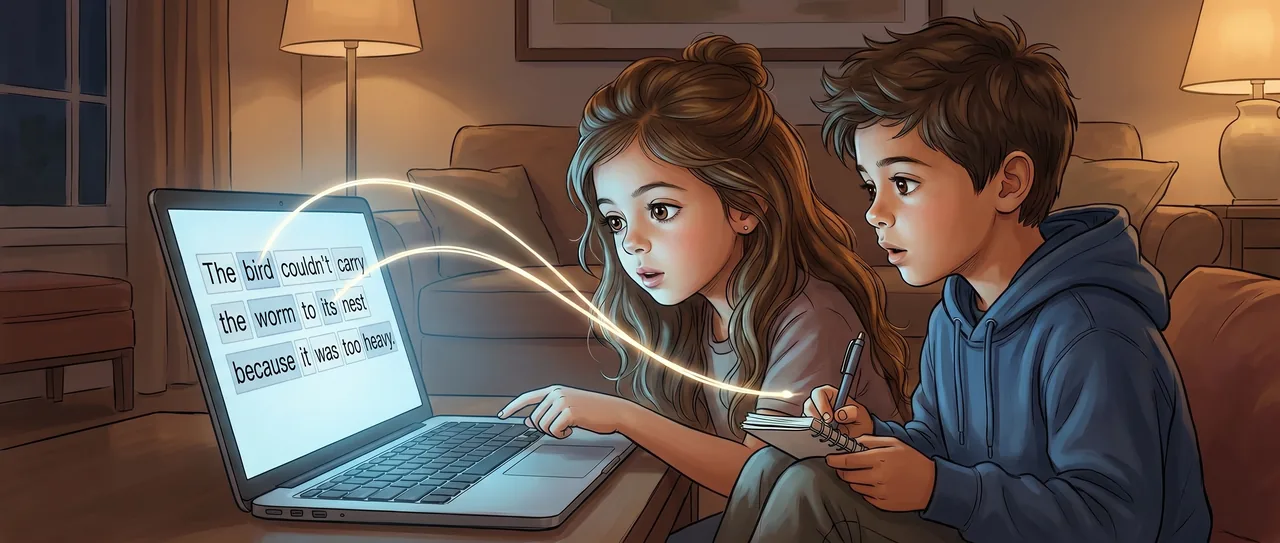
Maya thought, then typed: The bird couldn't carry the worm to its nest because it was too heavy.
Two its. They both stared.
She clicked the first it, the one in its nest.
The line went to bird.
She clicked the second it, the one that was too heavy.
The line went to worm.
"Same word," Soren said. "Twice. In one sentence. And it sent them to different places."
"Because the first one owns the nest and the second one is the heavy thing," Maya said. "Birds own nests. Worms get carried." She laughed, almost nervous. "It untangled them. Nobody taught it the difference between those two its. There's no it-number-one and it-number-two."
"It figured out there were two by what was around them," Soren said.
Maya clicked between the two words, back and forth, watching the bright line swing from bird to worm to bird to worm.
"Soren," she said. "It does this for every word. Not just it. All of them, all at once. Every word in the sentence is asking every other word how much do you matter to me."
"And the answers are the lines," Soren said.
"And the answers are the whole thing." "That's all meaning is, maybe. A whole bunch of words deciding how much to reach for each other."
Soren picked his pen back up, then stopped. "Do we do it the same way it does? Or does it just look the same from outside?"
Maya opened her mouth and closed it.
"I don't know," she said.
"Me neither," Soren said. He sounded happy about it.
Upstairs a door opened. Maya's sister called down that she was coming to take her computer back.
Maya didn't move yet. She typed one last sentence, slowly this time. She typed: The kid stared at the screen for a long time because it was strange.
She held her finger over the word it.
"Guess," she said.
"Screen," Soren said.
Maya clicked.
The bright line reached back, past was, past time, past long, and landed on screen, glowing, while every other word in the sentence dimmed around it.
Read the interactive version, listen to the narration, and earn a gold star →
A science-verified short story for curious kids · Curiosity Land