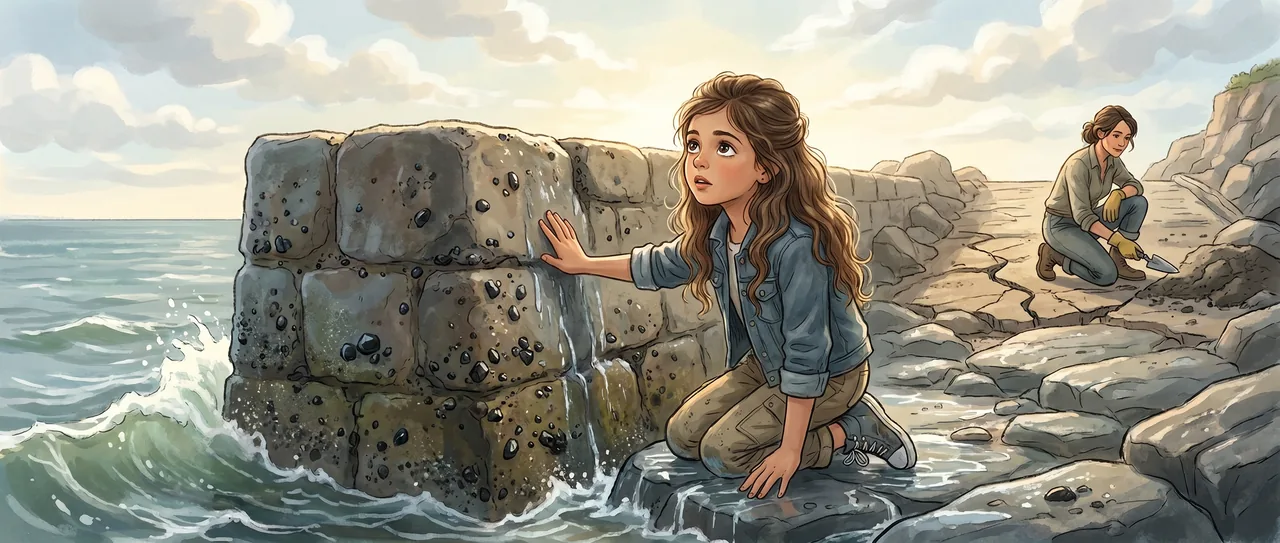
The Wall That Drinks the Sea
The new concrete went into the ramp like cake batter. Maya tilted the bucket and it slid, smooth and gray and easy, spreading itself flat without her doing anything. It felt good. It felt like the right amount of wrong.
Her aunt Dessa wiped her forehead with the back of a gloved wrist. "Too wet," she said. "I added too much water again. It pours nice. It won't last."
Maya crouched and pressed two fingers into the surface. Cool. Slick. It gave under her like wet sand at the tide line, the kind that fills your footprint back in before you lift your foot.
"Why won't it last?" she asked.
"Water leaves." Dessa knocked her knuckle against last summer's pour, the one she'd done the same lazy way. It made a dull sound, a sound with no bell in it. A crack ran across it like a dry riverbed. "Where the water sat, you get little holes. Air pockets. The water dries out and the holes stay. A wall full of holes is a weak wall."
Maya looked at her wet fingertips. Somewhere inside the gray slop she'd just poured were thousands of bubbles of water, lined up, waiting to evaporate and leave nothing where they used to be. She could almost feel them. The easy pour and the weakness were the same thing. The water that made it slide was the water that would betray it.
That bothered her in a way she couldn't put down.
She stood up and looked down the shore, the way she did when a thought got too big for where she was standing.
There was the old wall.
Everyone in the harbor called it the Roman wall, half a joke, because nobody believed it was really that old. It stuck out into the water at the far end, a low gray spine of stone the waves broke against. Boats tied up to it. Kids jumped off it. It had no business still being there. The tide had been hitting it twice a day for longer than anyone could count.
Maya walked down to it, her sneakers slipping on the rocks.
The wall was wet. The sea slapped it and ran off it and slapped it again. She put her hand flat against it where a wave had just pulled back. It was rough, full of little dark glassy grit, like someone had mixed sand and broken bottles into stone. It did not give. She pushed and it pushed back the way a mountain pushes back. There were no dry riverbed cracks. There were no dull spots. When she rapped her knuckle against it the sound came back hard and bright.
This wall lived in the water. Dessa's ramp would crack in a year, up here in the dry air, full of holes from water that left. This wall had been swallowing the sea for two thousand years and gotten harder. The two things would not fit together in her head. Water ruined concrete. The water made the holes. The holes made it weak. She had felt it herself, twenty minutes ago, the slick easy wrongness of too much water. And here was a wall that the ocean could not stop touching, soaked through every single day, and the water had not ruined it at all.
Unless.
She knelt down where a wave pooled in a hollow of the wall and looked close. The dark glassy bits. She'd thought it was broken glass. It wasn't smooth like glass. It was sharp and bubbled, like the cinders that came out of the barbecue, like rock that had once been on fire.
She scratched at the edge of one with her thumbnail. A wave came up and filled the hollow and she watched the water go into the stone, into all the tiny gaps around the cinders, the way water always went into things.
And this time the water didn't leave.
That was the difference. She didn't know the why of it yet, the chemistry of it, but she could feel the shape of the answer the way she felt rain coming before the clouds turned. In Dessa's ramp the water came in and dried out and left holes. In this wall the water came in and stayed and did something. The seawater wasn't the enemy here. The seawater was an ingredient. It soaked into the burnt rock and the two of them made something new in the dark, something growing, filling the gaps instead of leaving them empty. Every tide fed it. Every wave that should have worn it down was actually building it.
The wall got stronger from the exact thing that was killing the ramp.
Maya laughed out loud, alone on the rocks, because it was upside down and it was true. She had spent her whole life being told water and stone don't mix, that wet means weak, that the easy way is the wrong way. And here was a builder, dead for twenty centuries, who had looked at the sea and not seen an enemy. Who had thrown burnt mountain rock and saltwater together on purpose and made a thing that drank the ocean and never stopped getting harder.
Somebody had thought about it backward. Somebody had asked a question everyone else thought was already answered.
She ran back up the shore, slipping, catching herself.
"Dessa," she said. "What if the water staying isn't the problem. What if you just need the right thing for it to stay into."
Dessa was scraping her bad pour off the trowel. She stopped. "The right thing meaning what?"
"That." Maya pointed down the shore at the old wall standing in the surf. "It's wet all the time. It's the strongest thing on this whole beach. The sea's been hitting it since before there was a town here." She was breathing hard. "They put the burnt rock in. The glassy bits. The water goes in and it doesn't leave a hole, it makes more stone."
Dessa looked at the wall. Then she looked at her cracked ramp. Then she looked at the bag of plain gray cement at her feet and read the side of it like it had lied to her.
Maya was already walking back toward the wall, where the next wave was climbing the stone and sinking in, feeding it, the way it had fed it ten thousand times a year since before anyone she would ever know was born.
Read the interactive version, listen to the narration, and earn a gold star →
A science-verified short story for curious kids · Curiosity Land