The Tongue of the River
The boat had been out of sight of land for two hours when Maya tasted the spray.
It hit her cheek when the bow dropped, a fine cold mist, and her tongue went out the way it always did, before she decided anything. She waited for the salt. The ocean had been salt all morning, salt in her lips, salt drying white on the rail.
This spray was not salt.
She licked her lips again to be sure. River. It tasted like the river back home where her grandmother washed pans, flat and soft and green-tasting.
"Soren." She didn't turn around. "Taste the water."
Soren was sitting against a coil of rope with his notebook open, drawing the way the wake curled. He leaned over the rail, let the next burst of spray catch his hand, and put a finger to his mouth.
His eyebrows came together.
"That's wrong," he said. "We can't see land. We've been at sea for hours." He looked at his finger like it had lied to him. He tasted it again. "It's fresh."
The captain was up in the wheelhouse, a tall woman named Dona Ivete who had told them twice already that children who asked questions all day made the engine work harder. She had a way of answering only the question she wished you had asked.
Maya climbed two steps toward her. "The water tastes like river," she called up. "Out here. Why?"
"Because it is river," Dona Ivete said, not looking down, one hand easy on the wheel. "This whole stretch. You won't find the sea proper until tomorrow." And that was all. She thought the answer was finished. To Maya it had just cracked open.
Maya came back down to the deck fast.
"She says it's still river," Maya said. "But the river's behind us. We left the mouth this morning. I watched the land go."
Soren had his notebook flat on his knee, and his pencil was moving. He drew a wide funnel where the land had been. "So the river doesn't stop where the land stops," he said slowly. "It keeps going. Into the ocean. Like a tongue."
Maya crouched and put her own hand over the side, down toward the hull where the spray came up cleanest. The water was warm on top, almost bathwater. She had felt the open sea earlier and it had been colder than this. She said so.
"Warmer and fresher," Soren said. He wrote both down. "That's two things. If it were just ocean mixing, it would be one temperature, one taste, all blended. It isn't blended." He looked out at the surface. "It's sitting on top."
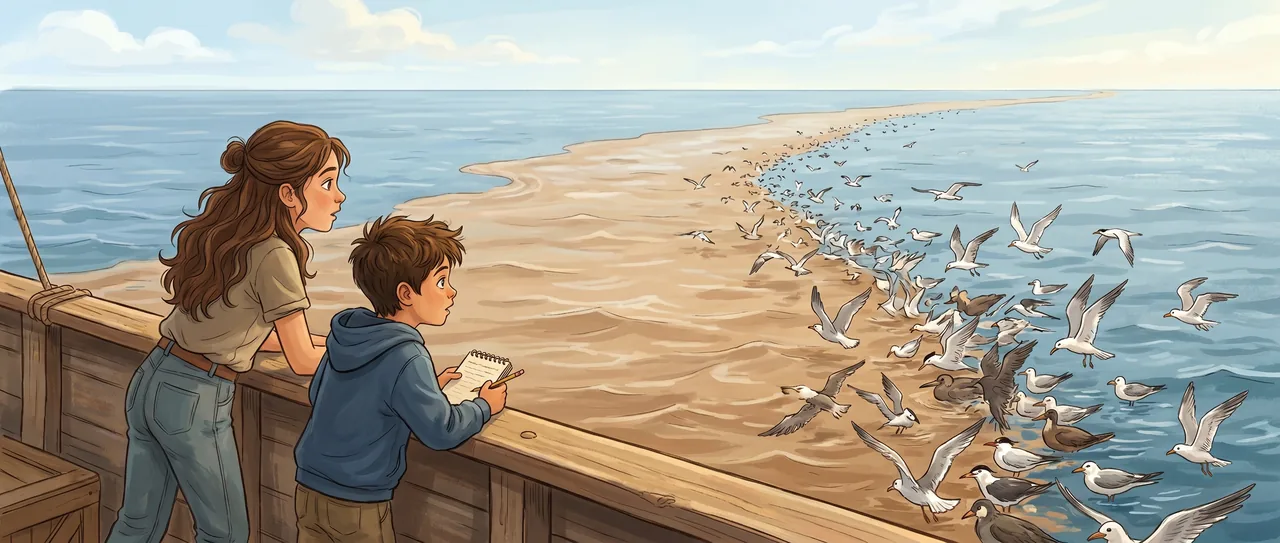
Maya stood up to see it the way he was seeing it. And once she was looking for it, she could not unsee it. There was a line out there. Not a sharp line, but a seam, a long brownish ribbon laid over the bluer water beyond, stretching from somewhere behind the boat all the way to the horizon ahead. The boat was floating in the brown.
"It floats," she said. "The river floats on the sea."
"Fresh water's lighter than salt," Soren said. "It does. It sits on top and slides out and doesn't sink in for a long, long way." His pencil stopped. "How long a way?"
That was the question that made the deck feel small.
Maya tried to do it in her head and the numbers got away from her. They had been moving since dawn. The boat was not slow. The captain said they would not reach proper sea until tomorrow. A whole day and a night, and still river. She thought of the mouth of the Amazon, which they had crossed at first light and which had been so wide she could not see the far bank, so wide it had stopped feeling like a river and started feeling like a country with a current.
And all of that water, that entire moving country, did not stop at the coast. It kept going. It pushed out past the land for hundreds of kilometers and floated there, on top of the Atlantic, brown and warm and soft, before the ocean finally took it.
"Soren," she said. "How much water has to be coming out, to do this. To still be itself this far out."
Soren looked at the brown seam running to the horizon and didn't answer right away. He was trying to make a number that would hold it. "More than I can write," he admitted. "More than all the rivers. My uncle said the Amazon is like a fifth of all the fresh water that goes into all the oceans in the whole world. I thought he was rounding up." He shook his head. "He wasn't rounding up. You can taste it out here. It's true."
Maya put her hand back in the water, in the warm brown skin of it, and tried to feel the size of the thing she was touching. A fifth of all the fresh water on Earth reaching the sea. Enough that it didn't even notice the coast. Enough that a whole boat could sail through it for a day and still be drinking the river.
"Birds," Soren said suddenly, pointing.
Ahead, where the brown seam met the bluer water, the surface was busy. Hundreds of birds were working that line, diving and lifting, exactly along the seam and nowhere else. The river fed things even here, even out of sight of every tree it had ever passed.
Maya leaned over the rail with her mouth open and let the next burst of spray land on her tongue, on purpose this time, and held it there.
Fresh. Still fresh. The river, two hours past the last of the land, sliding under the hull and on toward a horizon she couldn't see the end of.
The seam ran ahead of the boat, brown into blue, and the birds dropped along it one after another after another.
Read the interactive version, listen to the narration, and earn a gold star →
A science-verified short story for curious kids · Curiosity Land