The Thinnest Thing In The Drawer
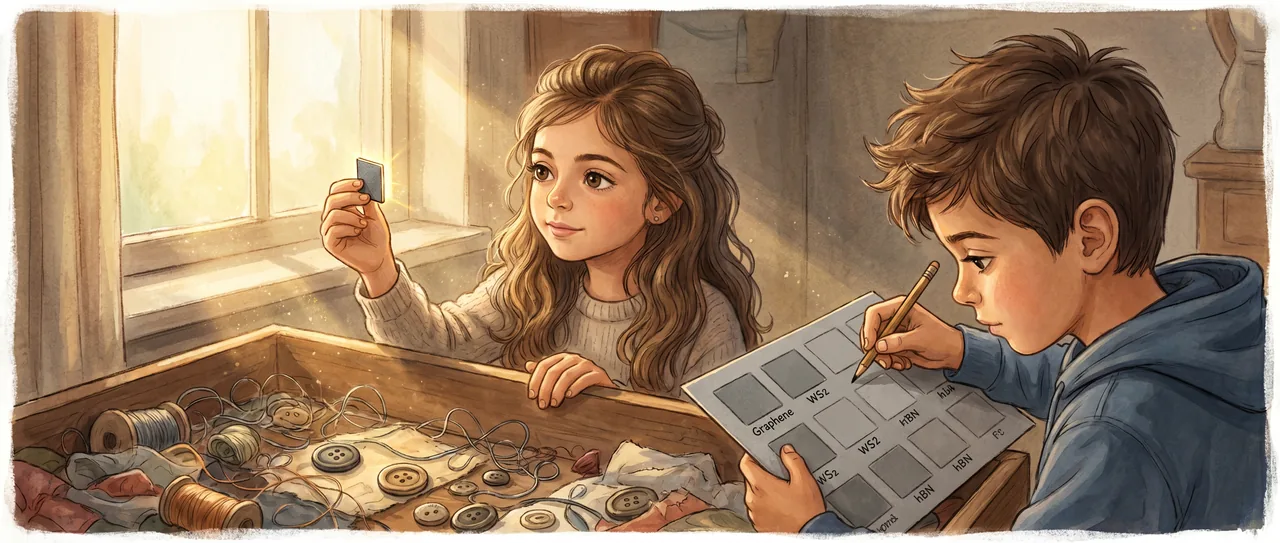
Soren's grandmother had been a chemist before she was a grandmother, and her sewing drawer proved it. Under the buttons and thread there was a flat card, gray and stiff, with little squares stuck to it. Each square had a tiny printed name.
"Molybdenum disulfide," Maya read, very slowly, like the word might bite. "Boron nitride. Tungsten diselenide. These aren't fabric."
"They're samples," Soren said. "Look, she labeled the thickness. This one says bulk. This one says one layer."
"Same stuff?"
"Says the same name."
Maya held the card to the window. "Then why are there two squares for each one? If it's the same stuff, you'd only need to show it once."
Soren didn't answer right away. He was reading the back of the card, where his grandmother's handwriting ran small and careful. He took out his notebook and copied one line, his pen pressing hard enough to dent the page.
"What's it say?"
"It says, the gray one does nothing. The thin one glows."
Maya put the card down. "Same stuff. One does nothing. One glows."
"That's what it says."
"That's not how stuff works." She picked it back up. "Gold is gold. A gold ring and a gold brick are both gold. You don't get a brick that glows just because it's a ring."
"I know."
"So she wrote it wrong."
"My grandmother," Soren said, "did not write things wrong."
Maya looked at him. Then she looked at the two squares of molybdenum disulfide, the bulk one and the single layer, sitting a centimeter apart on a card in a sewing drawer like nothing important was happening.
"Okay," she said. "Pretend she's right. Pretend the thin one glows and the thick one doesn't. What changed? Same atoms. Same name. The only thing different is how many layers."
"So thinness changed it."
"Thinness can't change what something is."
"Then how thin," Soren said, slowly, "would you have to get before it stopped being a brick and started being something else?"
They both stopped.
Maya counted on her fingers, not numbers, just thinking. "Cut a brick in half. Still gold. Half again. Still gold. Keep going."
"Keep going until you can't."
"You can always cut it in half."
"No," Soren said. "At the end there's one layer of atoms. You can't have half a layer of atoms. There's nothing under it."
Maya's mouth opened a little. "So the last cut isn't like the others."
"The last cut is the bottom of the world."
They sat with that. Outside a bus went by. Inside, two gray squares were apparently the bottom of the world.
"Try it the other way," Maya said. "Why would one layer be different at all? An atom is an atom. Stacking more of them on top shouldn't change the ones underneath."
"Maybe it's not the atoms. Maybe it's the room they have."
"The room?"
Soren tapped the thick square. "In here, every atom has neighbors above and below. Crowded. The electrons can go up, down, sideways, anywhere." He tapped the thin square. "Here there's no above. No below. Just a sheet. The electrons are trapped flat."
"Trapped flat," Maya repeated. "Like a marble that could roll anywhere in a box, and now you press the box until it's a tray."
"And the marble can only roll on the tray."
"Same marble."
"Different rules."
Maya stood up fast, which she did when something was getting bigger than the room. "So it's not that she made glowing stuff. It's that the flatness made it. The glow was hiding in there the whole time and you only get it when you take everything else away."
"You take away the up and the down," Soren said, writing, "and a new thing wakes up."
"How many?" Maya said.
"How many what?"
"How many things on this card are like that? How many squares are a brick that does nothing and a sheet that does something nobody expected?"
Soren counted the labels. "Eleven names. Some glow. The boron nitride one she wrote insulator next to. That one doesn't glow, it just refuses to let electricity through, perfectly, in one layer."
"So they're not all the same kind of different." Maya leaned over the card. "This one's a glower. This one's a blocker. This one she wrote bends light. Each thin sheet is its own brand new thing."
"Eleven brand new things," Soren said. "And these are just the ones she had in a drawer." "It's a whole second table."
"A what?"
"The periodic table. The one on the classroom wall. Every box is one kind of atom and what it does. Right?" She put her finger on the card. "But that table is for atoms standing in crowds. In bricks. What if there's a second table, a whole other wall of boxes, and every box is what that stuff becomes when you flatten it to one layer? Same atoms. New table. Nobody finished writing it."
Soren looked at the eleven little squares, and then at the empty space on the card below them, where his grandmother had drawn faint pencil lines for rows she never filled in.
"She started it," he said.
"She ran out of card."
"She ran out of card," Soren agreed, and his voice did something funny on the word.
Maya picked up the single-layer square and held it sideways to the window so the light came across it instead of through it. From the edge it was almost nothing. A line. A held breath of a thing.
"This is the thinnest thing in the drawer," she said. "And it can do something the whole brick can't."
"How many sit between thinnest and brick," Soren said, "that nobody's tried yet."
Maya turned the square a little more, until the line of it caught the sun and lit up gold along one impossible edge.
"Get a pencil," she said. "The good one."
Soren put his pen down and reached for his grandmother's pencil, the soft one, the one that could write on the gray card. He set the tip on the first empty pencil line below the eleven squares, and held it there, not writing yet, looking at all the rows after that one, going down and down past the bottom of the card to where the table kept going without them.
Read the interactive version, listen to the narration, and earn a gold star →
A science-verified short story for curious kids · Curiosity Land