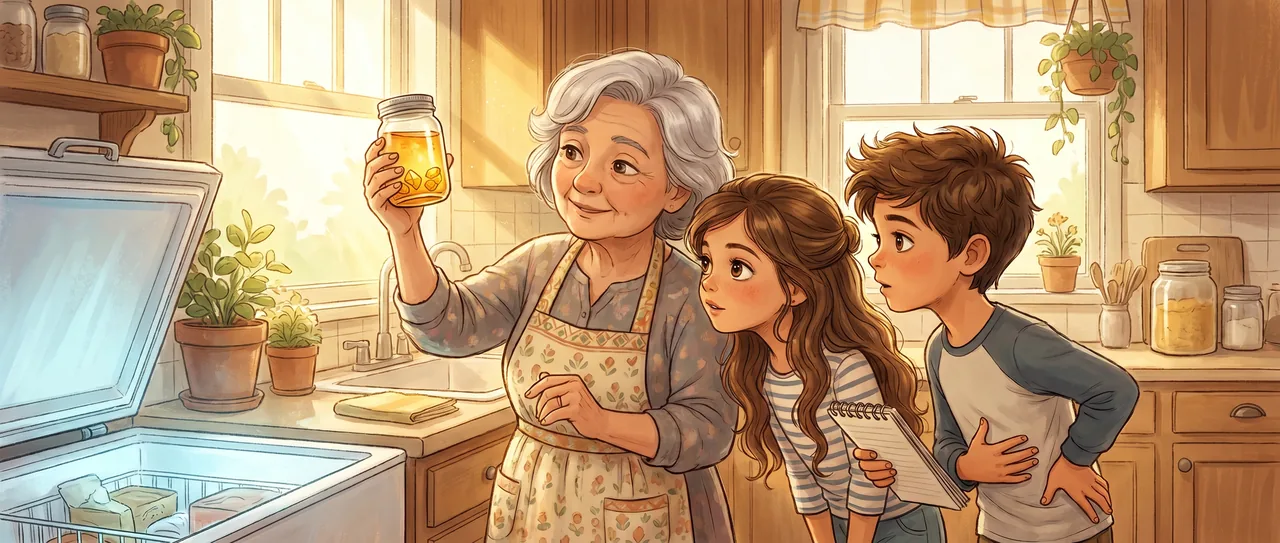
The Stone in the Jar
Grandma Ines kept things. That was the whole problem with cleaning her kitchen.
"What is this one," Maya said. She held up a tiny glass jar from the back of a drawer. Inside, in a little fingernail of cloudy fluid, sat three smooth yellow stones, each the size of a pea.
"Those are mine," Ines said, not turning from the freezer. "They took them out of me when I was thirty. The doctor offered to throw them away. I said absolutely not."
Soren took the jar and turned it under the window light. The stones were faceted, almost. Not round like river rock. More like something that had been built.
"They look made," he said.
"What were they doing in you," Maya asked.
"Causing me a great deal of pain," said Ines. "Now help me decide if this is a chicken or a brick."
Maya was already not listening. She was looking at the stones the way she looked at things that did not fit.
"They're too neat," she said. "Soren. Stones in a river get smooth because they bang around. These have edges. Edges mean they grew. Things only get edges like that when they come out of liquid slow."
"Like sugar on a string," Soren said. He had done that once, a jar of sugar water and a string, and waited eleven days for crystals.
"Yeah. Rock candy. But she didn't drink rock candy." Maya frowned at Ines's back. "Where were they? Inside."
"My gallbladder," Ines said. "Little green bag under the liver. They took the whole bag too. You don't strictly need it."
"A bag," Maya repeated. "A bag of what?"
"Bile," said Ines. "For breaking up fat. Bitter as anything. Now. Chicken or brick."
"Chicken," Soren said without looking. He had the jar close to his eye. "Maya, if it's a bag of liquid, where does a solid come from?"
"Same place the rock candy comes from," Maya said. "The water leaves."
They both went quiet. Outside a cow said something long and bored.
"Okay, think," Soren said. "Sugar water. Why does the candy form? Because there's too much sugar for the water. The water can only hold so much. If you take water away, the sugar has to go somewhere, so it comes out as crystals."
"So if the bag took water away from the bile," Maya said slowly, "on purpose, then the bile would get thicker and thicker, and then the stuff in it would have nowhere to go but out. Into stones."
"Why would a bag take its own water away," Soren said. "That's the part. Why dry out your own bile."
Maya turned to Ines. "Grandma. Did the bile go straight from the liver into you? When you ate?"
"Goodness, the questions." Ines straightened, a frozen something in her mitt. "No. The liver makes it all day. The little bag stores it up and waits. Then you eat something greasy and it squeezes the whole lot out at once."
Maya looked at Soren. Soren looked at Maya.
"It's a concentrator," Soren said. "It's not just a bag. The liver makes weak bile all day, and the bag, the gallbladder, it sucks the water back out so it can keep a lot in a small space. So when you need it, it's strong."
"It's making the rock candy syrup," Maya said. "On purpose. Every single day. That's its actual job. To dry the bile out so there's room for more."
"How much," Soren said. He had the notebook out now, pencil against the page. "How much water does it pull."
"We don't know," Maya said.
"We can guess," said Soren, and he wrote a number and crossed it out.
Ines set the brick-or-chicken down. "The surgeon told me something, when I asked why mine. He said the bag squeezes the liquid down to about a fifth of what comes in. Five times stronger going out than coming in."
Maya made a small sound, like she'd been poked.
"Five times," she said. "Soren. Five times. That's not a little drying. That's most of the water gone."
Soren wrote five times and underlined it twice.
"So here's the thing," Maya said, fast now, walking a little. "Every healthy gallbladder in the world is doing exactly what makes a stone. Every day. It's pulling the water out, thicker, thicker, right up to the edge of where the stuff would fall out of the liquid. On purpose. Because thick bile is the useful bile."
"And mostly it stops in time," Soren said. "Mostly it squeezes everything out before anything crystallizes. The eating empties the bag. Fresh weak bile comes in. It starts over."
"But if it sits too long," Maya said.
"Or pulls a little too hard," Soren said.
"Then the same job that makes you work makes a stone instead." Maya stopped walking. "It's the same thing. The healthy thing and the stone are the exact same process. There isn't a switch. There's just how far it went."
Ines came over and looked at the jar in Soren's hand like she hadn't really looked at it in years.
"Forty years I had those in a drawer," she said, "and nobody ever once told me they were rock candy."
"They're not," Soren said. "Rock candy is sugar. These are the other things bile carries. Cholesterol mostly, sometimes. Stuff that doesn't dissolve well to begin with. The water goes and it's the first to fall out."
"First to give up," Maya said. She was staring at the three yellow stones. "Grandma. Right now, while you stand here. The new one, the bag they gave you, you don't have it. But everybody else in this kitchen. Mine's doing it right now. Pulling the water out of the bile. Sitting right at the edge."
"Mine too," Soren said quietly. He put his hand flat below his ribs on the right side, where the little green bag would be, and held it there a second, feeling nothing, knowing it was working anyway.
"That's the part I can't get over," Maya said. "The body builds itself a thing whose whole job is to go right up to the line where it would turn solid. And then trusts you to eat in time."
Ines laughed, a short surprised one. She picked the jar out of Soren's hand and held it up so the kitchen light came through the cloudy fluid and lit the three stones like amber.
"Well," she said. "I'm keeping them. Now one of you tell me. This." She lifted the frozen lump. "Chicken, or brick."
Maya reached over and took the lump and turned it, the way Soren had turned the jar, looking for the edges.
Read the interactive version, listen to the narration, and earn a gold star →
A science-verified short story for curious kids · Curiosity Land