The Map of Strangers
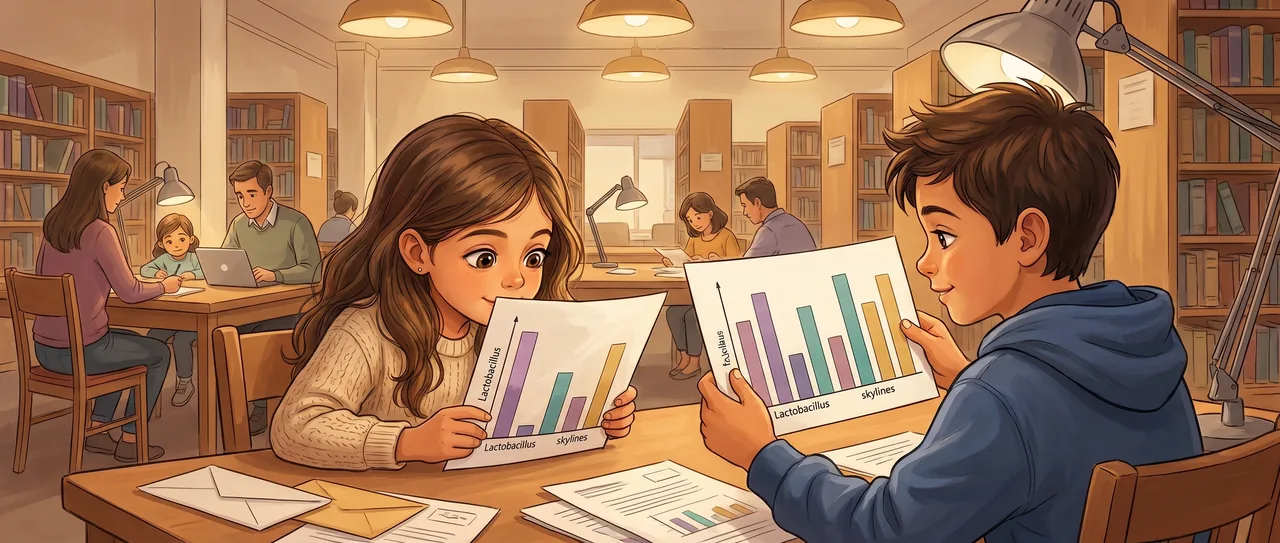
The library smelled like old carpet and new printer toner. The woman from the lab kept apologizing that the results weren't medical advice, just a fun survey, please don't panic about anything, and then she handed Maya and Soren each a paper envelope with their name on it.
"Mine has a bar chart," said Soren.
"Mine has a different bar chart," said Maya.
They traded. The colors were the same but the heights were all wrong, like two cities skylines drawn by two different hands.
"You have way more of the purple one," Maya said.
"Lactobacillus," Soren read. "You have almost none."
"Is that bad?"
"The lady said nothing is bad. She said it three times, so probably something is bad."
Maya laughed and then stopped laughing. "Soren. We eat the same lunch every day. We sat in the same dirt at recess for three years. Why aren't they the same?"
Soren turned his paper sideways, like the answer might be hiding along the edge. "Maybe the machine messed up."
"Both of ours? The same way?"
"No." He admitted it fast. "No, that doesn't work."
The lab woman drifted past, sorting envelopes, half-listening. "Oh, you two won't match," she said cheerfully. "Nobody matches. That's the whole thing. It's more unique than a fingerprint."
Then somebody else waved an envelope at her and she was gone.
"More unique than a fingerprint," Maya repeated. "That's a weird sentence."
"Fingerprints are already pretty unique."
"Right. So what's more unique than the most unique thing."
Soren got out his notebook. He wrote LACTOBACILLUS and circled it, and under it he wrote: where do you get one.
"You don't grow them yourself," Maya said. She was reading her sheet again, the small print under the chart. "It says here it's mostly set by the time you're three."
"Three."
"Three. So whatever's on this paper, we got it when we were babies. We can't even remember getting it."
Soren stopped writing. "That's the part that's weird. Not that we're different. That we were different before we did anything."
"Before we picked anything," Maya said. "Before we had opinions."
They sat with that. Around them parents were laughing, comparing charts, saying things like well that explains you to their kids.
"Where does it come from, though," Soren said. "It has to come from somewhere. Bacteria don't appear."
Maya flipped her sheet over. On the back was a paragraph in tiny type, the part nobody reads. She read it out loud, slow, because it mattered.
"It says the first ones come from how you were born. And then from what you ate when you were tiny. And then from your house. The air. The people who held you."
Soren wrote each one down. Born. Fed. Held.
"The purple one," he said. "Lactobacillus. I bet that's a milk one. Lacto."
"You had a lot of milk?"
"I don't know. I was a baby." He frowned. "I could ask my mom."
"Ask her now."
He called. He put it on speaker, quiet, against the table. His mom sounded surprised to be asked, then warm. Yes. A lot, actually, for a long time. Why, is everything okay.
"Everything's fine, Mom. It's a science thing."
Maya was very still, and then she said, "Call mine."
Maya's mom said Maya had been born early, born fast, the kind of birth where the doctors move quickly and the baby gets a course of medicine right away to be safe. Antibiotics, her mom said. A lot of them. You were so small. Why.
"Just a science thing," Maya said, and her voice came out smaller than she meant it.
They hung up. Neither of them said anything for a second.
"That's why your purple one is gone," Soren said finally. "The medicine that saved you cleared the slate. And then your house refilled it with whatever was in your house."
"And your milk filled yours with the purple one." Maya looked at her chart, and it was not a chart anymore. "Soren. This isn't a bar graph. This is a story. This is the actual first three years of my whole life, written down by things too small to see, and I can't remember a single day of it, but they remember."
Soren stared at his own paper. "Mine too. Mine is the story of every person who ever held me when I was a baby. They left some behind. They're still here." He pressed his hand flat on the chart, then took it off, fast, like the paper was warm. "There are people on this sheet. People I don't even remember. My grandmother died when I was two. She might be on here."
"She might be on there," Maya said softly.
The lab woman came back around with a recycling bin. "You can toss those if you want, they're just for fun."
Neither of them tossed it.
"How many," Maya asked her. "How many different ones can a person have?"
"Oh, thousands of species. Trillions of cells." The woman smiled the way grown-ups smile when they think they're done. "More of them than there are of you, really. You're outnumbered by your own passengers."
She moved on. Maya turned to Soren with her eyes too bright.
"Trillions," she said. "And no two maps are the same. Not in this room. Not in this town. Not anywhere."
"Eight billion people," Soren said. "Eight billion completely different maps. And every single one got drawn before the person could remember it being drawn."
Maya looked around the library, at all the families holding their paper skylines, every one of them carrying a crowd they'd never been introduced to.
"Everybody in here is a place," she said. "Everybody is somewhere nobody else has ever been."
Soren picked up both envelopes and held them side by side under the library light, two charts that would never match, not in a billion years, not for anyone.
Maya leaned in close to the purple bar that was almost gone from her own page, the gap where her first three days had quietly rewritten her, and she did not look away from it.
Read the interactive version, listen to the narration, and earn a gold star →
A science-verified short story for curious kids · Curiosity Land