The Ground That Breathes
The boardwalk was warm under Soren's hands even though the sun wasn't up yet.
He noticed it because he had sat down to wait, and the wood pressed heat into his palms the way a sidewalk does in July. But this was October, and his breath came out in clouds, and the planks under him were warm as a sleeping animal.
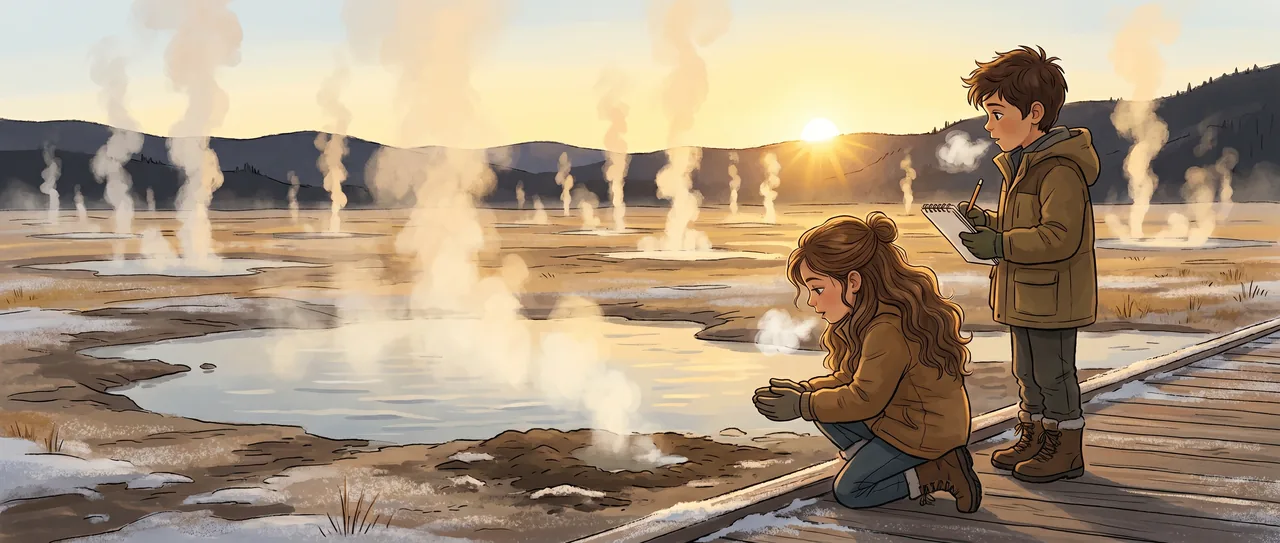
Maya was crouched at the edge where the boardwalk met the steaming pool. Mist rolled off the water in slow sheets and smelled like struck matches and boiled eggs. Somewhere behind them, her father swore softly at a yellow box on a tripod.
"It moved again," he called. "Three centimeters since spring. The whole bench mark moved."
"Is that bad?" Maya asked.
"It's annoying. Ground's not supposed to wander." He thumped the tripod leg. "I have to redo the whole baseline."
Maya pressed her hand flat to the planks beside Soren. He watched her go still, then watched her chase the warmth with her fingers toward the pool, then back the other way, away from it, where the boardwalk ran off across a meadow into the dark.
"It's warm over here too," she said. "Way far from the water."
Soren got up and followed the planks with his bare palm. Warm. Warm. He stepped down onto the dirt path at the end. The dirt was warm. He crouched and held his hand over a patch of bare ground with no spring near it, no steam, nothing, and felt heat lift off it like off the hood of a car that had been driven a long way.
"The ground's heating us," he said. "Not the spring. The ground."
Maya looked back at the steam, then out at the meadow, then up at the ring of dark hills standing all around them in the gray light.
"How far does the warm go?" she said.
They walked it. Bare feet would have been smarter but they used their hands, palms down on rock and root and frost-rimmed mud, and the heat did not stop. It was under the meadow. It was under the trees. They climbed a little rise to a sign her father had pointed at yesterday and ignored, and Soren read it out loud in the thin light.
You are standing inside a volcanic crater. The rim of the caldera is the ridge of hills around you. It is forty-five miles across.
Maya turned in a slow circle. The hills she had thought were just hills, just the edges of the valley, the ordinary far-away walls of an ordinary park, kept going all the way around. Forty-five miles of them. The crater was so big that standing inside it felt like standing in a field.
"We're in it," she said. "Right now. We're standing in the bowl."
Soren pulled out his notebook and his cold fingers fumbled the pencil. He drew the ring of hills. He drew two stick figures the size of dust inside it. Then under the figures he drew nothing, because he did not know how to draw what was under them, and the not-knowing made his chest feel strange.
"The warm," he said slowly. "That's it. That's what's under the dirt. There's a—" He stopped. "How big is the hot part?"
Maya was already reading the small print at the bottom of the sign, lips moving. She read it twice. Then she said it like she didn't quite believe her own mouth.
"The magma is ninety kilometers long."
Soren tried to make ninety kilometers into something his hands could hold and failed. He thought of the drive in. They had driven for an hour and the park had still not ended.
"That's the whole valley," he said. "That's everything we can see. The hot part is bigger than everything we can see."
"It's why the ground moved," Maya said. She turned back toward her father, small and far off now, bent over his stubborn yellow box. "His bench mark didn't wander. The ground breathed. It came up."
They stood very still to the cold-crusted, warm-bellied dirt and waited, the way he had waited at the aurora, testing. The heat came up steady into his palms. Not from the spring. Not from the sun, which still wasn't up. From below. From something so large it had a temperature the way an ocean has a tide.
The last time it had emptied itself out, the sign said, was six hundred and forty thousand years ago. The ash had fallen across half the continent. The sky had cooled for years.
"Six hundred and forty thousand years," Soren said. "That's nothing. That's not even—" He did the arithmetic out loud and got lost in the zeros and came out the other side. "The dinosaurs were sixty-six million. This is way after. This is practically now."
Maya wasn't scared. He watched her face to check, and she wasn't. She had her hand on the ground and her eyes on the hills and she was grinning the grin she got when something she'd been carrying around finally clicked into a shape.
"Everyone walks around on top of it," she said. "They think it's a park. They think the hills are the edge of the park. The hills are the edge of the hole the volcano made. And it's still warm. It's still breathing. It pushed his bench mark up three centimeters while we were asleep."
The sun cleared the eastern rim then and the whole caldera filled with flat gold light, all forty-five miles of it at once, and the steam from a thousand vents she hadn't noticed before stood up out of the meadow in pale columns, hundreds of them, scattered to the far hills, each one a place where the ground was letting out a little breath.
Soren counted the nearest columns and lost count and started over and lost count again.
Maya's father whistled at them to come back. He had the bench mark redone, the baseline reset, three centimeters subtracted, the numbers tidy again.
Maya cupped both hands over a small bare patch of warm earth, the way you hold your hands over a fire, and held them there, and felt the next breath come up.
Read the interactive version, listen to the narration, and earn a gold star →
A science-verified short story for curious kids · Curiosity Land