Fifty-Three Months
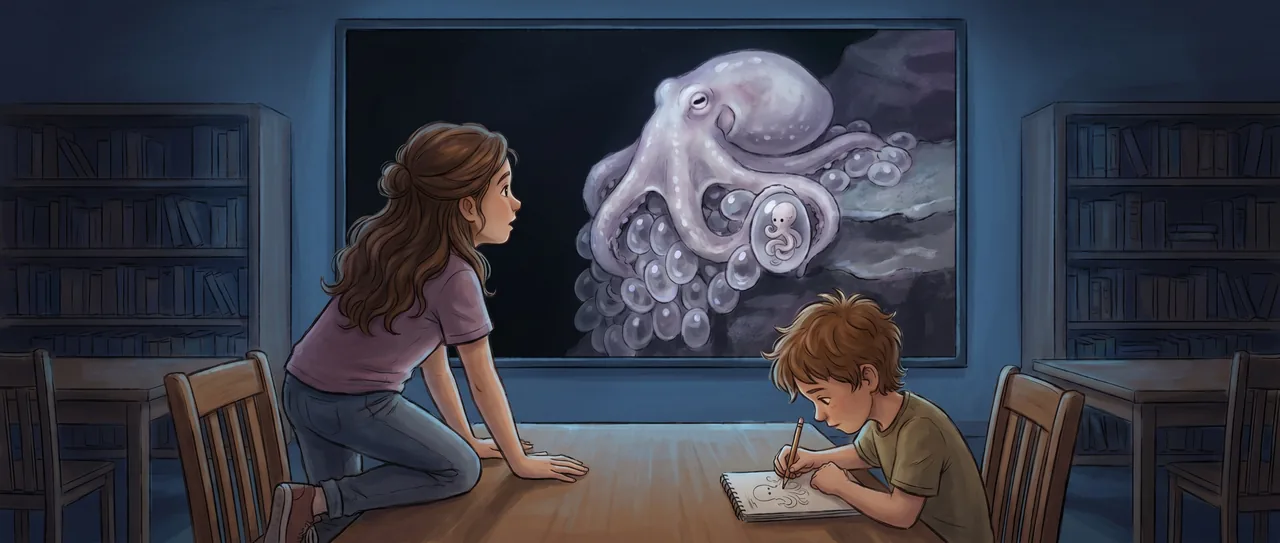
The library kept the science feeds on the back wall, where nobody sat. That was why Soren liked it. The screen showed an octopus on a rock ledge, eleven hundred meters down, off the coast of California. The water was the color of the inside of a closed eye.
Maya found him there on a Tuesday. She sat down without asking and watched for a while.
"How long has she been there," Maya said. Not really a question. She could see the date counter in the corner of the recording.
"This is from a research dive," Soren said. "They came back to the same spot. Over and over. The screen jumps from one visit to the next."
The octopus was pale purple, her arms curled inward like the petals of something closing instead of opening. Under her, a curtain of eggs hung from the rock. Hundreds of them, the shape of teardrops, the color of milk.
"She's guarding them," Maya said.
"Brooding," said Soren. "She keeps the water moving over them. She keeps them clean. She doesn't leave."
The counter at the corner said: visit one.
They came back the next Tuesday. Soren had the recording cued. He pressed the arrow and the screen jumped.
Visit four. Now the date was months later. The octopus was in the same place, in the same curl, over the same eggs. Maya leaned closer.
"She hasn't moved."
"She has. A little. Look at the arm on the left."
She had. A little.
"What does she eat down there," Maya asked.
Soren was quiet. On the screen a small crab walked across the ledge, right past the octopus, close enough to touch. The octopus did not take it.
"That's the part," Soren said. "She doesn't."
Maya looked at him.
"She doesn't eat," he said. "Not the whole time. The scientists watched. A crab came and sat by her once and she pushed it away. She won't leave the eggs even to hunt. So she just. Stops eating."
Maya watched the crab walk off the edge of the frame. The octopus stayed exactly as she was, her arms a basket over the milk-colored teardrops.
"For how long," Maya said.
"Keep coming," Soren said. "You'll see."
They kept coming. It became the Tuesday thing. Soren would press the arrow and the deep sea would jump forward in time, and each jump was months, and each time the octopus was thinner.
Visit nine. Her skin had loosened. The color was draining out of her, purple going to gray going to the white of paper held up to a window.
Visit fourteen. Her eyes had clouded. Her arms had pulled in tighter, as if she were holding something that wanted to leave and was not ready to let it.
Maya stopped talking during the jumps. She sat with her knees up on the library chair and watched the counter climb. Forty-six months. Forty-eight.
"That's almost four years," she said finally. "On one rock. Not eating."
"Fifty-three," Soren said. "That's where it ends. Fifty-three months. It's the longest of any animal. Anywhere. Nothing broods longer than her."
"Longer than a whale."
"Longer than anything. They checked."
Maya pressed her lips together. On the screen the octopus barely held a shape anymore. But the eggs under her had changed. Soren noticed it first. "Look at the eggs," he said.
They were bigger. They had gone from milk to glass. And inside the nearest one, pressed against the wall of it, was a curl of arms. A tiny one. A perfect tiny coil of an octopus no bigger than a grain of rice, with two black points for eyes, already curled the exact way its mother was curled above it.
Maya put her hand flat on the table and didn't say anything for a long time.
"She spent her whole life," Maya started, and stopped. "All of it. Four and a half years of not eating. So that would happen."
"They hatch as she dies," Soren said quietly. "That's how it goes. The last thing she does is fan clean water over them. And then they come out, all of them at once, hundreds, and they float up. And she's gone by then. The scientists came back and the ledge was empty and there were egg cases. Just the empty cases."
Maya watched the tiny curled octopus inside the glass egg. It was the same shape as its mother. The exact same shape. A body folded around nothing yet, waiting to be folded around the deep sea instead.
"Nobody told her to do that," Maya said.
"No."
"She just did. For fifty-three months. In the dark. Where nobody was watching except for one camera that came back sometimes."
"And now us," Soren said.
Maya thought about that. One animal, on one ledge, eleven hundred meters under the surface, in cold and black so complete that the research lights were the first light those eggs had ever known. Doing the longest patient thing any creature on the planet does. And almost no one would ever see it. It had not needed to be seen.
"There are probably others," she said. "Right now. Down there. Doing it right now."
Soren had already taken his notebook out of his bag. He opened it on the table and looked at the screen and his hand moved, copying the curl of the tiny octopus inside the egg, the two black eyes, the arms folded the same as the mother's arms.
"Right now," he agreed. "All over the deep ocean. On ledges nobody's found."
Maya leaned toward the screen. The recording had reached its end. The frame held on the eggs, glass now, lit, each one with its small folded passenger waiting in the cold.
"Play it again," she said. "From visit one."
Soren reached over and pressed the arrow. The screen jumped back to the beginning, to the purple octopus with all her color still in her, curling her arms over the milk-white teardrops for the first time, eleven hundred meters down, in water the color of the inside of a closed eye.
Read the interactive version, listen to the narration, and earn a gold star →
A science-verified short story for curious kids · Curiosity Land