Faster Than the Light in Here
The water was so clear it didn't look like water at all. It looked like a hole in the floor that went down forty feet and never got dark.
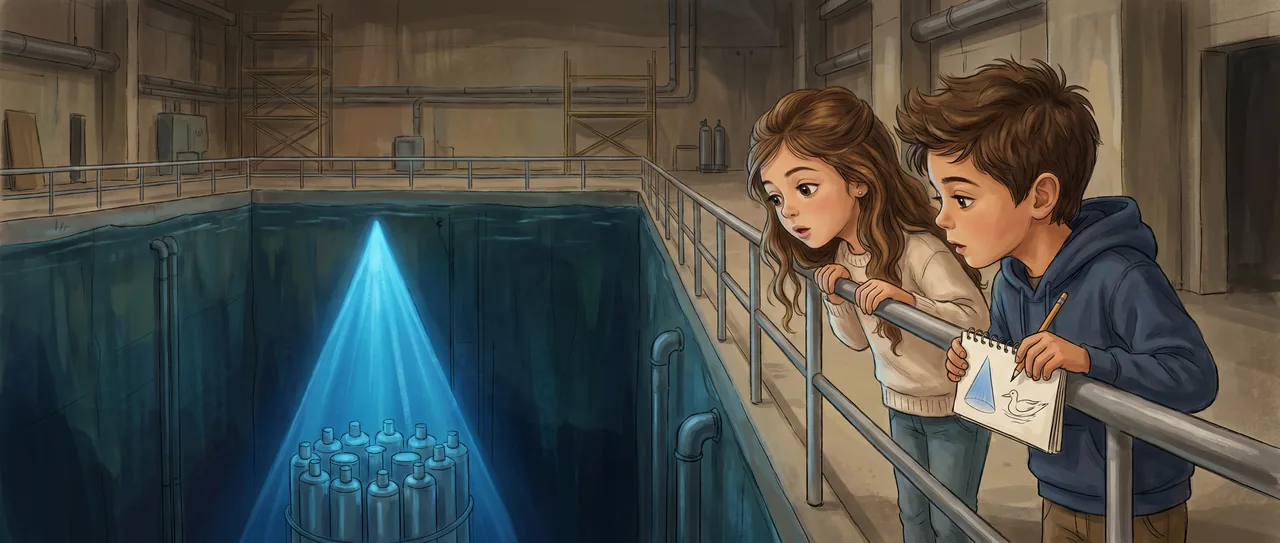
Maya leaned over the rail until her stomach pressed the cold metal. Down at the bottom, behind thick glass and deeper than a house, sat a stack of metal cylinders. The cylinders glowed. Not warm, like a lamp. Cold and blue, the blue at the very bottom of a flame, the blue you only see for half a second before it turns yellow.
"It's not supposed to be on," Soren said. He had read the panel by the door three times. "It says decommissioned. It says the fuel is spent."
"Then why is it blue."
The sign said NUCLEAR LEGACY POOL and below that a paragraph nobody had finished reading, because the museum wasn't open yet. A man in a yellow vest was up a ladder fixing a light somewhere behind them. He was the only adult around, and he was humming, and he had not looked down once.
Soren got his notebook out and held it against the rail and drew the shape of the glow. The blue didn't come off the cylinders like heat. It hung in the water around them, a halo, brightest in a cone that pointed up and out, fainter at the edges.
"Feel the rail," Maya said.
It was just cold metal. Not buzzing. Not warm.
"So it's not electricity glowing. It's not hot." She squinted down. "The water's doing it. Or something in the water is doing it."
Soren wrote spent fuel and underlined spent. Spent meant used up. Used up meant it should be quiet down there. But the cylinders were spitting something invisible, and the water was answering in blue.
"My dad said light is the fastest thing there is," he said. "Nothing beats light. That's the whole rule."
"Then nothing's breaking the rule," Maya said, "and it's still blue, so we're wrong about something."
She said we like it was the best news she'd had all week.
The man on the ladder called down without looking. "You kids can't be past the barrier."
"We're going," Maya said, and did not move.
Soren stared into the cone of blue. It really was a cone. Sharp at the point, opening upward, like the wake behind a boat but standing still in the dark water. He had seen that shape before. On a river, last summer, a duck paddling, and the V spreading out behind it across the flat water.
"Maya. It's a wake."
"A what?"
"A boat wake. When a boat goes faster than the waves can move out of the way, the water piles up into a V behind it. That cone is a wake." His pencil was already moving, drawing the duck, drawing the V. "Something down there is going faster than the waves it makes."
"Waves of what."
He stopped. The pencil stopped.
"Of light," he said slowly. "What if those are waves of light."
Maya pressed harder against the rail. "You said nothing beats light."
"Nothing beats light in space. In nothing. In a vacuum." He was talking faster now, lining the steps up. "But this is water. Light goes slower in water. It has to push through all of it. You've seen a straw look bent in a glass, the light bends because it slows down going in."
"So light is slow in here."
"Slower. Not stopped. Slower." He looked at her. "And if something else, some tiny piece coming out of those cylinders, is going faster than light goes in water, then it's the boat. And the light is the waves it can't get out of the way fast enough. And they pile up."
"Into a cone," Maya said.
"Into blue," Soren said.
They both looked down again, and the glow was not just pretty anymore. It was a race, frozen, forty feet under their feet. Pieces too small to ever see, flung out of the used-up fuel, tearing through the water faster than the water's own light could travel, and the light heaping up behind each one and spilling out as that cold, that exact cold blue.
"The water's slow enough that something can win," Maya said. "Faster than the light in here," Soren said. He wrote it down exactly like that. Faster than the light in here.
Maya laughed, one short laugh, the kind that comes out before you decide to make it. "They're cheating."
"They're not cheating. They're just somewhere light is slow." He looked at the cone again, the sharp bright point of it. "There are places where light is slow. And in those places you can outrun it. And when you do, it shows."
The man on the ladder had stopped humming. He was looking down at them now, and at the pool, like he was seeing it for the first time too.
"That blue," he called, "the engineers told me that blue is the most dangerous thing in the building. I never asked why it's blue."
"It's blue because something's winning," Maya called back.
Soren wasn't listening. He had turned to a clean page and was drawing it again, the cylinders, the cone, the water that looked like a hole in the floor. He kept thinking about the word slow. Light was slow in water. Light was slower in glass. He thought about his own eye, the wet jelly of it, light crawling through that. He thought about a window. He thought about a diamond, where light crawled slowest of all, and what it would take to outrun light inside a diamond, and whether anyone ever had, and what color that would be.
"Soren," Maya said. "What's the slowest you could make light go?"
He stopped drawing.
Because if you could make light slow enough, almost stopped, then almost anything could beat it. A thrown ball. A walking person. You, walking across a room, faster than light, if only the light were slow enough, and the whole room would fill up behind you with that cold blue wake.
Far below them, in the still and silent water, the blue cone poured upward out of the dark and did not move.
Read the interactive version, listen to the narration, and earn a gold star →
A science-verified short story for curious kids · Curiosity Land