The Word Nobody Spelled the Same
Maya's grandmother typed with one finger and trusted nobody, especially not the tablet.
"It guesses what I want to say," she said, holding it out like a fish that might bite. "How does it know I want to say recipe before I say recipe?"
Maya took it. The keyboard app suggested three words above the letters. Her grandmother had been typing a message about empanadas, and the little gray box offered dough, then masa, then a word in Tagalog that her grandmother did not speak.
"That last one's wrong," Maya said.
"It is always a little wrong," her grandmother said. "Yesterday it wanted me to spell my own name with a y."
Maya tried it herself. She typed I'll be home by and the app guessed five. Then six. Then dinner. She had never typed any of those things into this tablet. The tablet was three weeks old.
She wrote the question on the inside of her wrist with a pen, where she kept things she did not want to lose: how does it know words I never taught it.
That night she did the obvious test. She turned off the wifi. She turned off the cell signal. She typed a strange sentence, one she was sure nobody had ever typed in the history of the world: the badger apologized to the lamp. She put the tablet on the windowsill and went to sleep.
In the morning the wifi was back on, because her grandmother could not stand a tablet that could not check the weather. Maya typed the badger apologized to the. The app guessed lamp.
She sat with that for a while.
She had assumed the tablet sent everything she typed to some enormous building full of computers, and the building read it, and the building learned. That was the only way she could picture it. Somewhere a machine was reading her grandmother's messages about empanadas and her own messages to her friends, the embarrassing ones, the ones at two in the morning. The thought made her feel watched in a way she did not like.
But the badger sentence bothered her. She had typed it with the signal off. Nothing had left the tablet. And yet the app had gotten better at it overnight, after the signal came back.
She found her grandmother's neighbor, Mr. Okafor, who fixed phones at a kiosk in the mall and was the only adult she knew who answered questions with the right amount of seriousness.
"Does my words go to a big computer somewhere," she asked. "When the keyboard learns."
Mr. Okafor was eating his lunch and only half listening. "The model goes to you," he said. "Not the other way. Mostly."
"What does mostly mean."
He waved a fork. "Your phone does a little math at night when it's charging. Figures out where it guessed wrong. Then it sends the math. Not the words. The correction." He went back to his rice. "It's clever. I don't fully follow it."
Maya followed it The tablet had not sent her badger sentence anywhere. It had kept it. In the night, while charging, it had looked at every place it guessed wrong and worked out a small nudge, a little correction, the direction it should lean to be less wrong tomorrow. And it had sent only the nudge. Not the sentence. Not the badger. Not the lamp.
So the nudge had nothing in it. That was the part that made her sit up on the bus the next morning, holding the pole, not getting off at her stop.
A nudge with no words in it. You could not read it back into a sentence. You could not look at the correction and know a badger had apologized to a lamp. The words stayed on the windowsill. Only the lean left the building.
But then how had the app learned dinner. How had it learned five, six, the rhythm of a kid coming home. She had never typed those into this tablet either.
She asked Mr. Okafor one more thing, on the way home, leaning over his kiosk.
"If my words never leave," she said, "and your words never leave, then where does it learn dinner."
Mr. Okafor put down his fork all the way this time.
"From everybody's nudges," he said slowly, like he was finding it as he said it. "Mine and yours and a million others. They add them all up somewhere. Not the words. Just which way everybody leaned. Then they send the better keyboard back down to all of us."
Maya stood very still at the kiosk.
A million people she would never meet had typed I'll be home by at the end of a million different days. Tired people, people in other countries, people typing in languages she could not read. Every one of them had kept their own day to themselves, the specific home, the specific person waiting. None of those days had left any windowsill. And yet all those private evenings had leaned the same direction, toward dinner, and the leaning had added up into something true, and the something true had come back down to her grandmother's three-week-old tablet and guessed correctly that a kid would be home by dinner.
The machine had learned the shape of a million evenings without ever being allowed to look at one.
That was the part that would not sit flat in her head. The keyboard knew something real about people, something they all shared, and it had built that knowledge out of corrections so empty you could not read a single secret back out of them. The badger stayed hers. The lamp stayed hers. The lean was everyone's.
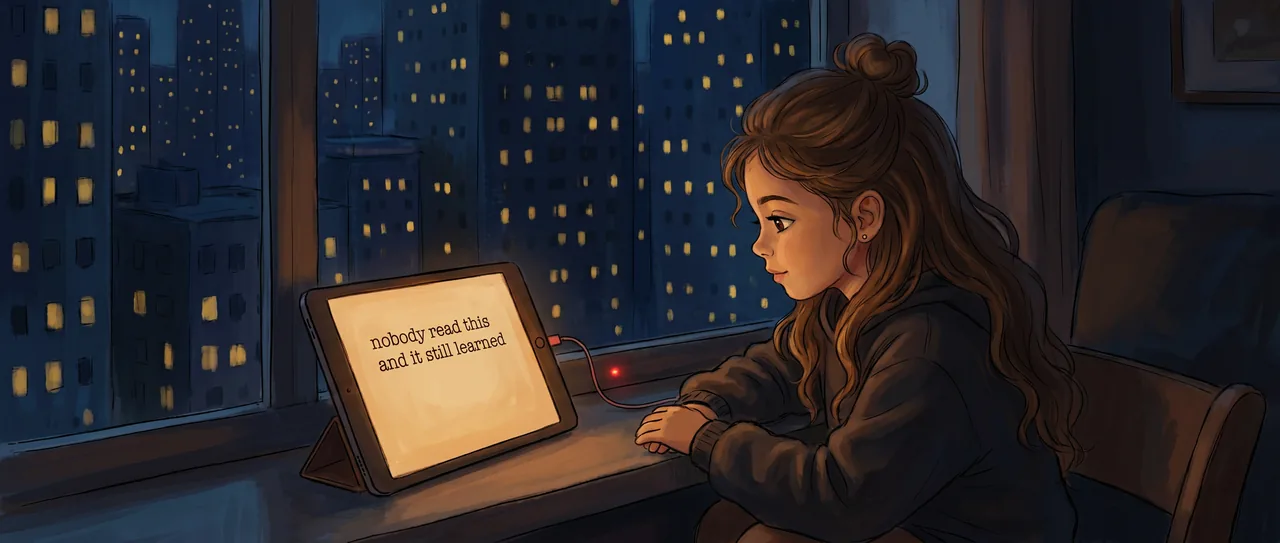
She got home before her grandmother and picked up the tablet and turned off the wifi again, on purpose, and typed: nobody read this and it still learned.
Then she turned the signal back on and set the tablet on the windowsill, charging, where it would spend the night doing its small private math in the dark, leaning a fraction of a degree toward being right, the way a million other tablets on a million other windowsills were leaning too, none of them telling.
The screen dimmed. The little charging light came on. Maya watched it pulse, slow and steady, and did not go to bed for a while.
Read the interactive version, listen to the narration, and earn a gold star →
A science-verified short story for curious kids · Curiosity Land