The Three-Day Flash
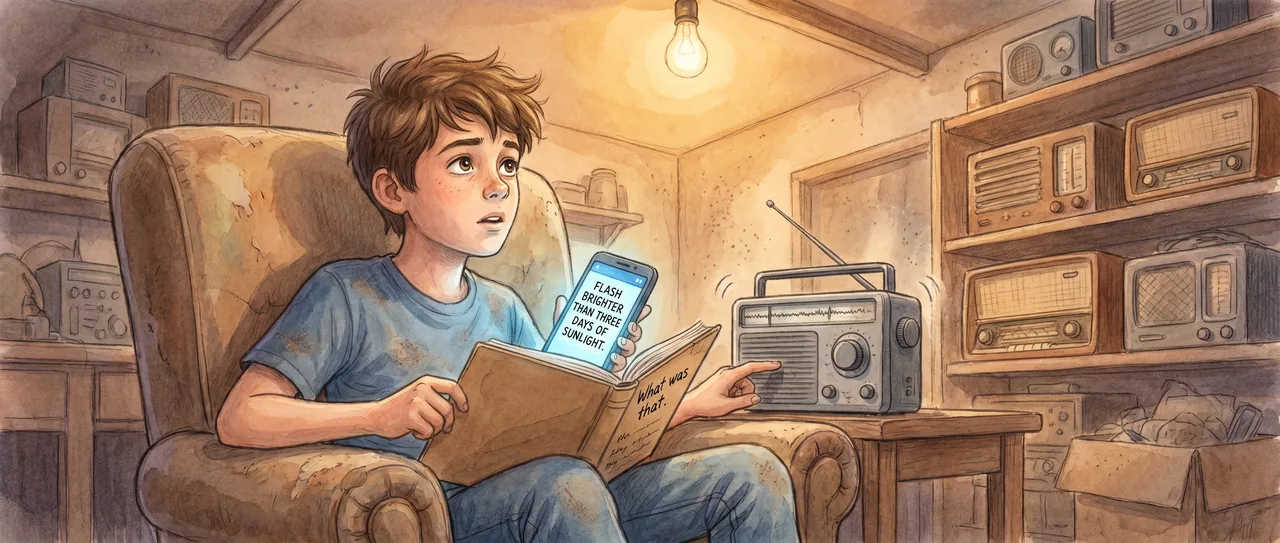
The garage smelled like dust and solder. Soren's grandfather had built radios his whole life, and now the building was full of them, dead and silent on every shelf, their dials frozen at numbers that meant nothing to anyone left.
Soren's mother was sorting tools into boxes marked KEEP and SELL. She had given Soren the back corner, the part she called junk, and told him to throw out anything that did not turn on.
Most of it did not turn on. But there was a logbook.
It was a cheap notebook, the cardboard kind, and his grandfather had filled it with dates and times and long strings of numbers. Frequencies. Soren knew that much. At the top of one page, underlined twice, his grandfather had written: LISTENING FOR THE SKY.
Soren turned pages. Most entries had a small note beside them. Airplane. Storm. Neighbor's fence. His grandfather had been trying to figure out where every sound came from. He had been crossing things off, one by one, the way Soren crossed things off when he was sure of them.
Then, near the back, one line had no note at all. Just a date, a time, and three words.
What was that.
Not a question. There was no question mark. Just the words sitting there, heavy.
Soren found the radio it connected to, a gray box with a hand-wound antenna, and to his surprise it hummed when he turned the knob. The speaker breathed static, the soft ocean sound that fills the space between stations.
He sat with it for a long time. Static does not do anything. That is the whole point of static. It is the sound of nothing in particular, everything at once, averaged out into a hiss.
His grandfather had written What was that next to a hiss.
Soren opened his own notebook and copied the date. Then he looked it up on his phone, the way he looked up everything, and found that the date was nothing special. No famous storm. No rocket launch.
But the word listening stayed in his head, so he searched for the thing his grandfather might have been hoping to catch. He searched for the strongest radio flashes in the sky.
The screen filled up.
Fast Radio Bursts. They lasted a thousandth of a second. Less than the time it takes to say the word burst. And in that thousandth of a second, one of them released more energy than the sun pours out in three entire days.
Soren stopped.
He read it again. The sun. Three days of the sun. All of that light and heat the sun makes across three full days, every sunrise on every beach, all of it, squeezed into a flash too short for any human ear to catch.
And for years, nobody knew what made them. The bursts came from far away, from other galaxies, from distances Soren could not hold in his head. They arrived, they flashed, they were gone, and they left no return address.
He looked at the gray radio. It could never have caught one. It was too small, too simple, a hobbyist's box in a garage. His grandfather had been listening for the sky with a fence wire and a dream. The real bursts were found by telescopes the size of buildings.
But his grandfather had written What was that anyway.
Soren kept reading, because that was the only way he knew to settle a thing that would not settle. He read down through years of mystery, scientists arguing, nobody sure. Then he reached the year twenty twenty.
That year, one of the bursts came from close. Not another galaxy. Inside our own. Inside the Milky Way, the same swirl of stars Soren's grandfather had pointed at on summer nights.
And this one, the close one, they traced. They found the source.
A magnetar. A dead star's leftover core, a city-sized ball so dense that a spoonful of it would weigh more than a mountain, wrapped in a magnetic field so strong it would scramble the atoms in a human hand from farther than the moon. One of those had flickered, and flung out a flash, and for the first time in history people knew where one came from.
Soren put the phone down.
He thought about his grandfather sitting in this exact chair, in this exact dust, hearing a hiss he could not explain and being honest enough to write that he could not explain it. Crossing off airplane. Crossing off storm. Leaving one line uncrossed because he refused to pretend.
The gray radio hissed on. Soren listened to it the way he had never listened to static before. Somewhere in that hiss, mixed into the ocean sound, were photons that had crossed the whole galaxy. Light from the magnetar's neighborhood. Light from older things. The hiss was not nothing. It was everything that was too far and too faint to pick apart, all arriving at once, averaged into a whisper.
His grandfather had heard the whisper and known it was not nothing.
Soren turned the dial slowly across the band. The hiss rose and fell. None of it was a burst. He understood that. To catch a real burst he would need a dish bigger than the house, and luck, and to be pointed at exactly the right speck of sky in exactly the right thousandth of a second.
But the bursts were out there right now. While he sat in the dust, somewhere a dead star was building up to a flash that would outshine three days of the sun and last less than a blink, and it would race across space for thousands of years and arrive at some receiver, somewhere, as a single line that made a person sit up.
Most of them, nobody would ever catch. They would flash and fade with no one listening.
Soren wrote the date in his notebook, then below it he wrote his grandfather's three words, and left the question mark off, the way his grandfather had.
He carried the gray radio to his mother's table and set it down on top of the SELL box. Then he moved it to KEEP.
The speaker was still hissing when he turned back to the shelf, and he left it on.
Read the interactive version, listen to the narration, and earn a gold star →
A science-verified short story for curious kids · Curiosity Land