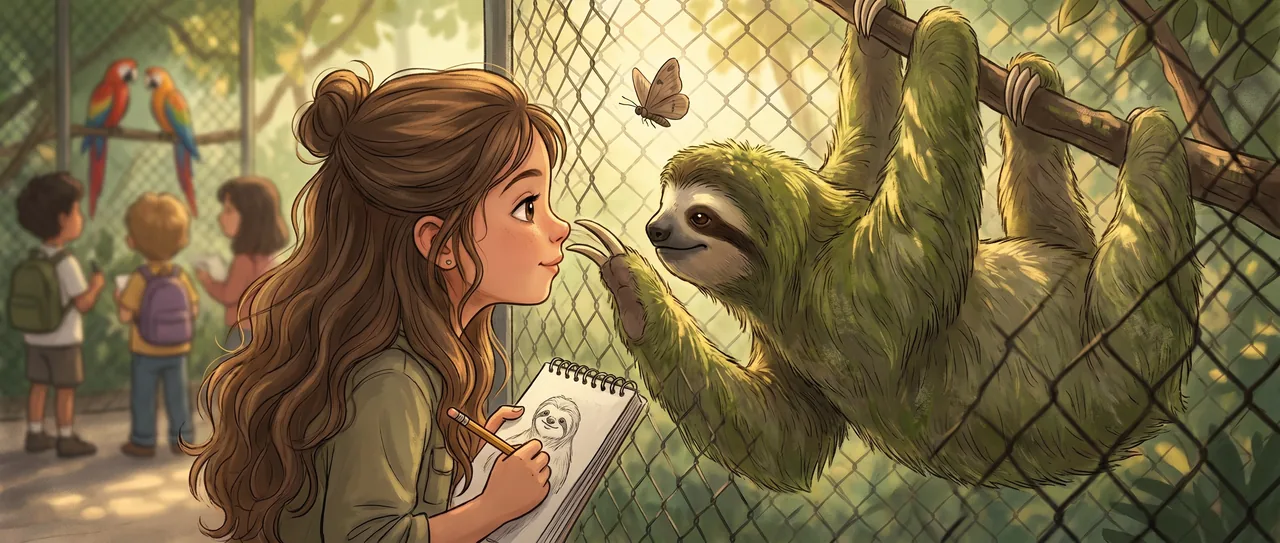
The Slowest Garden
The sloth smelled like wet leaves and something older underneath, like the bottom of a pond.
Maya stood close to the mesh with her sketchpad open and her pencil not moving. Everyone else had already drifted toward the macaws, which screamed and flapped and made good photographs. The sloth did none of those things. It hung from a branch by three long curved claws and turned its head toward her at the speed of a clock's minute hand.
It was green.
Not painted green, not lit green. The fur itself held a faint mossy color, deepest along the back where the light barely reached. Maya leaned in until her nose nearly touched the mesh. Up close the green broke into something stranger. Each long hair had tiny cracks running down it, fine grooves, and the green sat inside the grooves like rainwater caught in the seams of a sidewalk.
Something small moved in the fur.
She held still. A moth, the dusty grey-brown of bark, crawled out from between two hairs, paused on the green, and tucked itself back in. Then another. She counted four before she stopped trusting the number, because they kept disappearing into the coat and she could not tell if she was seeing new ones or the same ones twice.
"That one's got passengers," said a keeper named Devi, walking past with a bucket. She didn't stop. "Sloth moths. They live in the fur. Don't ask me to get them out, they're supposed to be there." And she was gone toward the macaws, where the noise was.
Maya wrote moths in fur on her page and underlined it. Then she did the thing she always did, which was to ask the question that came next instead of the question she'd been given.
What do moths eat.
Not the fur. Moths that ate fur would have eaten the sloth bald. She watched the green and watched the moths and felt the two facts sitting beside each other refusing to connect. The green was a plant. Algae, she was nearly sure, the same stuff that turned ponds and old fountains green. Algae needed light and water and something to feed on. The grooves in the hair held the water. The light came through the canopy in pieces. But algae needed more than that. It needed nitrogen. Growing things always wanted nitrogen. Her father said it every spring with his hands in the garden soil.
So. A garden growing on a back. A garden needed feeding.
The sloth shifted one arm. The whole movement took longer than it took Maya to think all of this, and she had the sudden dizzy sense that she was thinking at a completely different speed than the animal she was watching, that to the sloth she was a blur, a hummingbird, a thing that came and went before it finished a single breath.
The moths fed the garden. They had to. But moths didn't make nitrogen out of nothing either. They came from somewhere. They went somewhere to lay eggs. Caterpillars needed something to grow up in, something rich, something rotting.
Maya stopped breathing for a second.
Devi came back with the empty bucket.
"It comes down," Maya said. It wasn't a question. "To the ground. Doesn't it. Even though it's slow and that's the most dangerous thing it could do."
Devi slowed this time. "Once a week," she said. "Climbs all the way down to the forest floor to go to the bathroom. Takes forever. We don't know exactly why it bothers, it could just go from up high. Half the people who study them argue about it."
"The moths lay eggs in it," Maya said. "In the dung. That's where the babies live. The caterpillars."
Devi looked at her properly for the first time.
"And then they grow up and fly back up into the fur," Maya went on, faster now, her pencil tapping the page without writing. "And they live there, and when they die, they break down, and that's the nitrogen. That feeds the algae. The green." She pointed at the back of the sloth without touching the mesh. "The whole thing is a circle. The sloth carries the garden, the garden gets fed by the moths, the moths get fed by the sloth coming down once a week. It's all one thing."
"Some of the researchers think the sloth eats the algae," Devi said slowly. "Licks it. Gets extra nutrition out of its own coat. There's even a paper saying it absorbs some of it straight through the skin."
Maya turned back to the animal.
It did not look like one animal anymore.
It looked like a forest. A slow, hanging, breathing forest, with weather inside its fur and seasons in the grooves of each hair, with creatures that were born on the ground and lived in the sky of it, with a green that was alive and feeding and being eaten. The sloth was the soil and the sky and the gardener all at once, and it did the one slow dangerous thing every week, the climb down, the climb that exposed it to everything that wanted to eat it, and it did it so the moths could finish being moths.
Nothing in there knew it was part of a circle. The algae didn't know. The moths didn't know. The sloth, turning its old patient face toward the light, did not know it was a planet.
But it was.
Maya thought about every dog she had ever petted, every cat, the hair on her own arms. She thought about how a thing could look like one thing and be a hundred things wearing the shape of one. She looked at her own wrist, at the fine hairs there catching the light, and for one cold thrilling second she wondered what lived close enough to her skin to call it home, what she carried that she had never once thought to feed.
The sloth began, very slowly, to reach for the next branch.
Maya did not move to follow the rest of her class. The macaws screamed behind her. She watched the long arm travel through the air toward the branch, the claws opening, the green of its back catching a slice of afternoon sun, and a single moth lifting off the fur and circling once before settling back down into the garden that was riding through the trees on the back of something alive.
Read the interactive version, listen to the narration, and earn a gold star →
A science-verified short story for curious kids · Curiosity Land