The Pull Test
"It won't snap," Soren said. "I've been trying for ten minutes."
He had the yellow thread looped around both fists, pulling until his knuckles went pale. The thread didn't even stretch. It just sat there between his hands, thin as a hair, refusing.
Maya took the spool. "Aunt Reet uses this for sails?"
"For the seams. She said the wind can't tear it."
Maya wound a length around a pencil and yanked. The pencil bent. The thread did not. She tried sawing it against the edge of the workbench, the way you'd cut a string. It slid back and forth and stayed whole.
"Scissors," she said.
The scissors worked. One clean snip. She held the cut end up to the light from the garage window and squinted.
"That's weird," she said.
"What is."
"It cuts fine sideways. But it won't pull apart end to end. Same thread. Same direction the scissors went, basically." She pinched the cut end. "Why is one way easy and the other way impossible?"
Soren found the little paper card the spool came on. He read it twice. "It's called aramid. There's a longer word under it." He got out his notebook and copied the longer word, letter by letter, then sat with the pen still on the page.
"Read me the part that isn't the name," Maya said.
"It says the fibers are spun. The liquid gets pushed through tiny holes and stretched while it's setting."
Maya was already twisting two strands together. "Stretched which way?"
"Long way. The way it comes out."
She stopped twisting. "Okay. So picture spaghetti."
"I'm picturing spaghetti."
"Dry spaghetti in the box. All the pieces lying the same direction." She laid two threads side by side on the bench, perfectly parallel. "You can snap one piece. Easy. But can you pull the whole box apart by the ends?"
"That's not the same. The spaghetti isn't stuck together."
"Right." Maya tapped the bench. "So ours is. Something's holding the strands to each other. Sideways."
Soren looked at the card again. "Hydrogen bonds. It says the chains are held to their neighbors by hydrogen bonds."
"Are those strong?"
"One of them? No. They're weak. They're the same thing that holds water drops together." He frowned at his own sentence. "That can't be the whole answer. Water's weak. This isn't weak."
Maya was quiet. She picked up the parallel threads and pressed them flat against each other with her thumb.
"How many," she said.
"How many what."
"How many of the weak ones. If the chains are all lined up straight, side by side, the whole length of them, then every little bit of one chain is holding hands with the chain next to it. The whole way down."
Soren put the pen down. "So it's not one bond."
"It's a million tiny ones. All in a row." She pulled the two threads in opposite directions, slow. "To pull them apart you don't have to break one. You have to break all of them. At the same time."
Soren picked up a single thread and held it the way he'd held it before, fists pale, pulling end to end. "And when I pull lengthwise," he said slowly, "I'm not even fighting the sideways bonds. I'm fighting the chain itself. The actual chain. Which is just. Strong."
"Both ways are locked," Maya said. "Pull it long, you're fighting the chain. Pull it apart, you're fighting a million handholds. There's no easy direction."
"Except sideways with scissors."
"Because scissors don't pull. They shear. They push past." She mimed it, one hand sliding over the other. "That's the one move it didn't plan for."
They sat with that. Outside the wind was coming up, rattling the garage door in its track, the gale Aunt Reet had promised.
Soren turned the spool over in his hands. "The aligning is the whole thing," he said. "If they spun it slow, or didn't stretch it, the chains would be a tangle. Like cooked spaghetti. All curled around. The bonds would still be there but they'd point everywhere."
"And a thing that points everywhere is weak everywhere," Maya said.
"It's the lining up that makes it strong." He wrote that down. His hand moved fast now. "The molecules aren't stronger than anything else. They're just pointed the same way."
Maya was looking at the thread differently now. She held one strand up to the window again. The wind shoved the glass. The thread caught the gray light and looked like nothing, like a scratch on the air.
"There's a whole crystal in there," she said. "Not like a gem. Like, the molecules are stacked in order. Marching. The whole length of this stupid thread there's a parade going on that we can't see, and every single one is holding hands with the one beside it, and that's the only reason it won't break."
"In every direction at once," Soren said.
"In every direction at once."
The garage door banged hard against its track. Maya looked at it, then at the spool, then at Soren.
"Get the kite," she said.
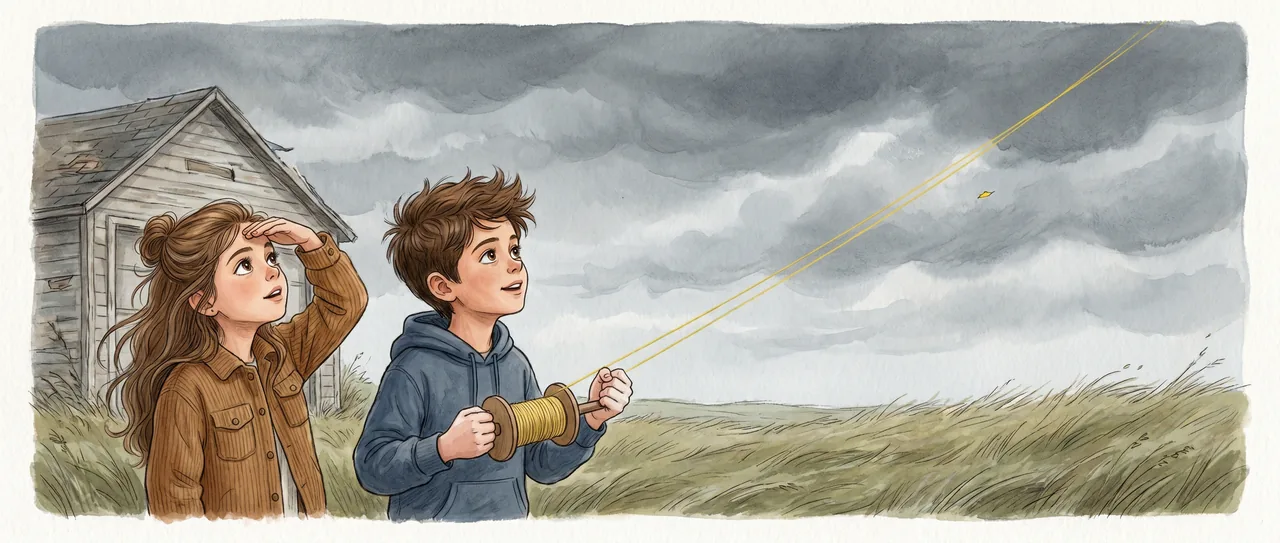
They strung the spar bridle with the yellow thread, doubled, the way you'd do a sail seam. Soren tied the knots because his were the ones that held. Maya carried the kite. They went out into the field behind the garage where the grass was bent flat and screaming sideways.
The wind took the kite out of Maya's hands before she meant to let go. It went up steep and hard, the way a kite goes up only once in a year of trying, and the line snapped taut with a sound like a plucked string.
Soren had the spool. He felt the pull come down the thread into his fists, the same pull he'd tried to make himself an hour ago and couldn't. Now the whole sky was doing it. The thread went rigid and thin and gray against the clouds and it did not stretch and it did not snap.
Maya stood beside him with her hand cupped over her eyes. The kite climbed until it was a yellow speck and then a smaller one.
"Don't let go," she said.
Soren didn't. The thread hummed in the wind, every invisible hand in it holding on at once, and the spool turned slow against his palms as the kite asked for more.
Read the interactive version, listen to the narration, and earn a gold star →
A science-verified short story for curious kids · Curiosity Land