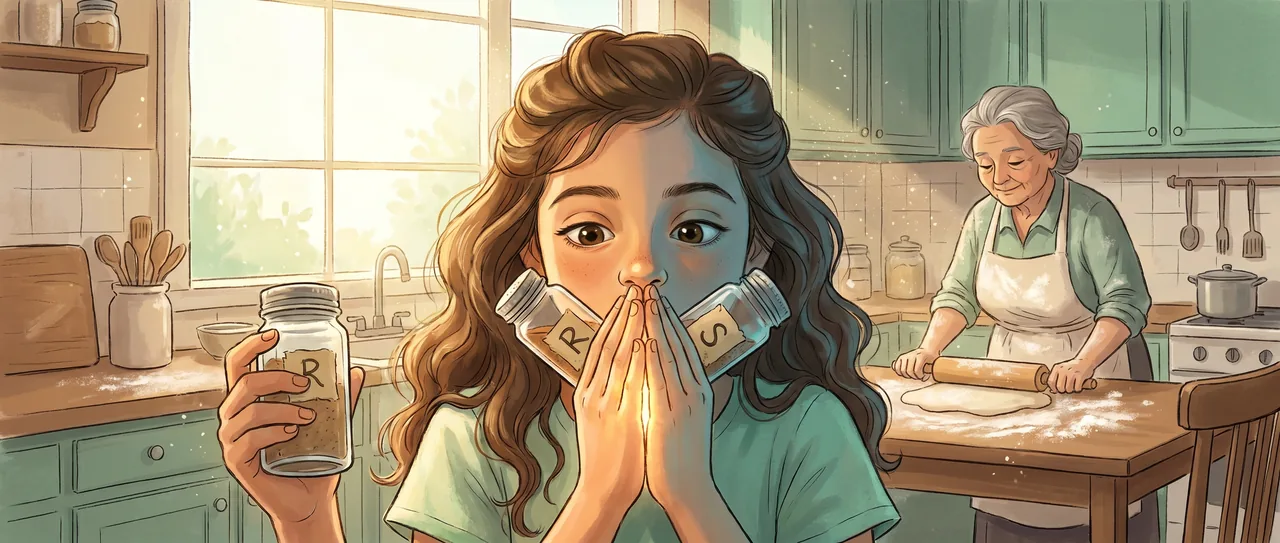
The Left-Handed Smell
The two jars sat side by side on the counter, and Maya could not make them agree.
Both labels said the same word. Carvone. Grandmother had ordered them from a chemistry supply catalog because the regular spice shop had closed, and she wanted to know if the cheap stuff was as good as the real thing for her seed cake.
Maya unscrewed the first lid. Spearmint. Cool and green, the smell of gum and toothpaste, the smell that made the back of her nose feel like winter.
She unscrewed the second lid. Rye bread. Warm and brown and a little bitter, the smell of the dark loaves at the bakery, of caraway seeds crushed between her teeth.
She screwed both lids back on. She sat down. She opened them again, in the other order this time, in case her nose had gotten confused.
Spearmint. Rye.
"They're labeled wrong," she said.
Grandmother was rolling dough and did not look up. "They came from the same company. Read it again."
Maya read it again. The same word on both. Underneath the word were some numbers and symbols, a cluster of letters and lines that meant nothing to her except that they were identical. Letter for letter. Line for line. The exact same chemical name on a jar of winter and a jar of bread.
She held one under each nostril at the same time. Her face did two things at once. The left side of her went cold and the right side went warm, like standing in a doorway between two seasons.
"They can't be the same," she said. "Smell them."
"I'm covered in flour."
Maya carried both jars to the window where the light was good, as though she could look at a smell. She tilted the spearmint jar. A few crystals slid across the glass. She tilted the rye jar. The crystals looked exactly the same. Same size. Same color. Same nothing.
There was one tiny difference printed on the labels, so small she had skipped over it. A single letter in front of the matching names. One jar had a little R. The other had a little S.
"What does R mean," she said. "And S."
Grandmother shrugged with her elbows, hands still in the dough. "Right and left, I think. Your grandfather would have known. He was a pharmacist. He used to say a molecule could have a left hand and a right hand, and they were not the same, no matter how you turned them."
Maya looked at her own hands.
She pressed them together, palm to palm. They matched. Every finger landed on its twin. But that was the trick of it, wasn't it. They only matched when they faced each other, like a thing and its reflection. She laid them flat on the counter side by side instead, both palms down. Now they did not match at all. The thumbs pointed opposite ways. No matter how she slid them, turned them, spun them, she could not make her left hand sit exactly on top of her right.
Same fingers. Same bones. Same everything. And you could never lay one onto the other.
A glove for the left hand did not fit the right. She knew that the way she knew her own name.
She looked at the two jars. Spearmint and rye. The same molecule built two ways, the way her two hands were the same hand built two ways. A left-handed smell and a right-handed smell.
And her nose could tell.
That was the part that made her sit down again. Not that the molecules were mirror images. That her nose, the soft wet inside of her own nose, was somehow built to feel the difference between a left hand and a right hand. Something inside her was shaped like a glove. The spearmint molecule slid into it. The rye molecule could not, the same way her grandfather's words could not slide into the empty chair where he used to sit.
The smell-glove only fit one hand.
"Grandmother," she said slowly, "does it work like that for everything? Not just smells?"
Grandmother finally turned around, wiping her hands. "There was a medicine," she said. "Before I was a mother. It was supposed to help women who felt sick when they were expecting a baby. One hand of the molecule did that. Helped them." She paused. "The other hand hurt the babies. Very badly. And the medicine had both hands mixed together, and nobody understood yet why the same chemical could do two opposite things."
The kitchen was very quiet. The oven ticked.
"They were the same," Maya said. "On the label. They would have looked exactly the same."
"Exactly the same," Grandmother said. "Except for which way they were folded. That is the whole reason chemists count fingers now. Right hand. Left hand. They learned to ask."
Maya looked back at the jars. Spearmint that her body welcomed in. Rye that it pushed away into a different shape entirely. Both of them harmless, both of them just smells. But underneath them was the bigger thing, the thing that did not stay in the kitchen. Every medicine she had ever swallowed. Every flavor. The sugar in the cake. All of it built out of little hands, and her whole body a room full of gloves waiting to find out which hands fit.
She pressed her palms together one more time, then pulled them apart and held them up to the window light, and the sun came through the gaps between her fingers, and she turned them slowly, left then right, watching the one shadow refuse to become the other.
"I want to be a chemist who counts fingers," she said.
Grandmother went back to her dough. "Your grandfather would have liked you very much."
Maya carried the rye jar to the counter and tipped a few caraway-smelling crystals into the seed cake batter, on purpose, because a left-handed smell was exactly what bread was supposed to taste like. Then she held the spearmint jar to her nose one last time and breathed in winter, and tried to feel the moment the glove closed.
Read the interactive version, listen to the narration, and earn a gold star →
A science-verified short story for curious kids · Curiosity Land