The Two Browns
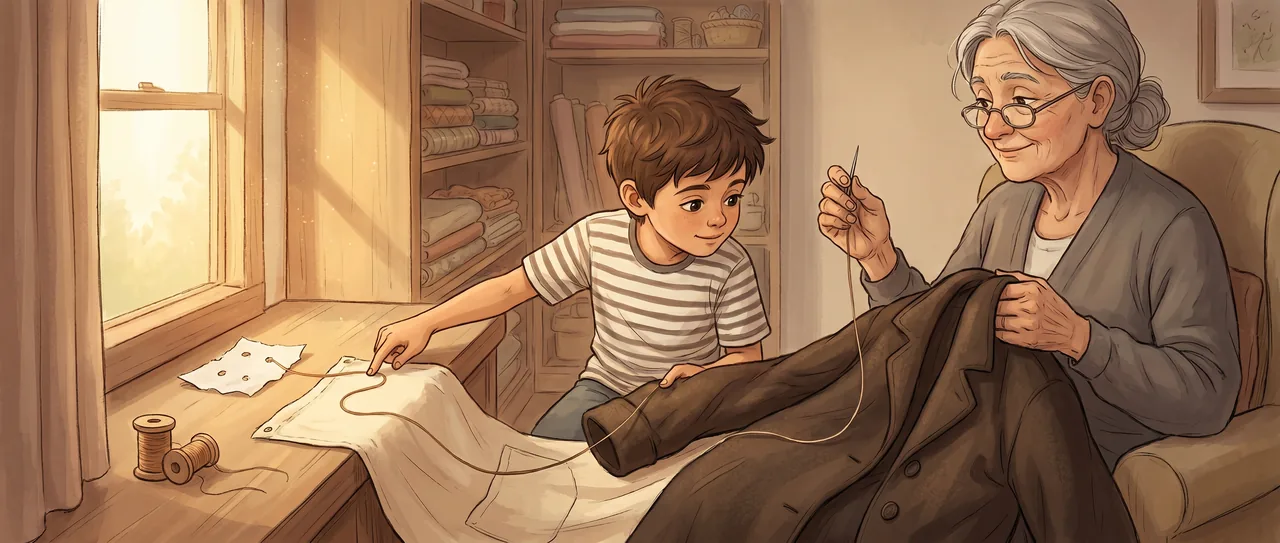
Soren's grandmother was matching thread to a torn coat, and she would not let him help, because the last time he helped he had wound an entire bobbin backward.
So he sat at the window with the button tin and waited.
The coat was brown. She held a spool against the cuff and frowned. She held another spool against the same cuff and smiled. Then she did something that stopped Soren mid-button.
She held both spools side by side. They were the same brown.
"Those are the same," he said.
"They are not," said his grandmother. "This one's too warm. This one's right."
He got up. He looked. Against the dark wool of the coat, the right spool looked like coffee with milk. The warm one looked like dirt. But she had just been holding them together, and together they had been one color. He was sure of it.
"Hold them apart again," he said.
She sighed the sigh of a woman who only wanted to fix a coat. But she did it. Warm spool on the dark wool. Right spool on her pale apron. And the two browns split apart like two different animals.
"They changed," Soren said.
"Thread doesn't change. Light's just going funny at this hour." She bit the end off a length and held it up to her needle.
Soren did not think the light was going funny. He thought something stranger was happening, and he wanted to catch it doing the thing.
He took both spools to the window. He laid them on the white sill, touching. One color. He laid one on the brown coat and one on the white apron. Two colors. He moved them back to the sill. One color again.
The thread was not changing. The thread could not change. It was wound and dyed weeks ago in some factory and nothing about it knew where his grandmother's apron was.
So it was not the thread.
He found a scrap of white paper in the button tin and tore two small holes in it, the size of the spool ends. Then he laid the paper over the coat so only the warm spool showed through one hole, and laid it over the apron so only the right spool showed through the other.
Through the two little holes, framed in white, the two browns were the same brown again.
He pulled the paper away. Different.
Paper on. Same.
Paper off. Different.
"Grandma." His voice came out odd. "The thread isn't doing anything. It's the stuff around it."
"Mm," said his grandmother, who was threading the needle and not looking.
"No, really. When I hide the coat and the apron, the two browns are the same. They're sending the same light into my eyes the whole time. Every time. The light from the spool never changes. So my eyes are getting the exact same thing, and I'm seeing two colors."
He held the paper up between them like a small flag.
"So which one is the real color?" he asked.
His grandmother finally looked up. "The right one," she said. "The one that matches the cuff."
"But the cuff is making it look right. Put it on your apron and it looks wrong. The spool isn't right or wrong. It's just brown. You're deciding it's wrong because of what's next to it."
She set the needle down. He could tell she was actually thinking about it now, the way her mouth went still.
"I've been sewing forty years," she said slowly, "and I always match the thread against the cloth I'm fixing. Always against. Never on its own. Because on its own it lies to me."
"It's not lying," Soren said. "You are. Sort of. Your brain is."
He wasn't trying to be rude. It had just arrived in him all at once and he had to say it.
The light from the warm spool was a fact. So many waves of red, so many of green, leaving the thread, crossing the room, landing in his eye. That part was physics, fixed and honest. But somewhere behind his eyes, in the wet dark where he lived, that honest light got handed to something that looked around first. Something that checked the coat. Checked the apron. Checked the window. And only then decided on a color and showed it to him like it had been the truth the whole time.
He had never seen the deciding. You never could. You only got the answer, already finished, feeling like the world.
"My whole life," he said quietly, "I've never seen a color. I've seen what my brain guessed the color was."
"That's a frightening thing to say to a person who's trying to match thread," his grandmother said. But she was smiling a little, the careful way she smiled when she found a knot she could undo.
Soren went back to the spools. He wanted to test the edges of it. He laid the warm spool half on the coat and half on the apron, so one thread crossed the border.
Down its length, the single strand of thread went from coffee to dirt and back, with nothing changing but the cloth beneath it.
He ran his finger along it. The thread under his finger was all one thing. His finger said so. His eyes said something else, and his eyes were the ones lying, and they would not stop, no matter how long he stared, no matter how hard he knew.
That was the part that made his arms go cold in a good way. He could know it completely, every step of it, and his brain would still hand him two browns. The trick didn't break when you understood it. It just kept working, right there in his grandmother's hands, in everyone's hands, all the time, forever.
He picked up the warm spool and held it against the white sill, where it told the truth, and then against the dark coat, where it lied, and back, and forth, watching the one brown become two and the two become one.
Read the interactive version, listen to the narration, and earn a gold star →
A science-verified short story for curious kids · Curiosity Land