The Throwaway Pile
The science club had emptied out an hour ago. Mr. Okafor was at his desk grading lab reports, half-listening, the way a person listens to a radio in another room.
Maya and Soren had the open dataset up on the club laptop. It was real. That was the whole reason they had wanted it. Millions of particle collisions from a detector overseas, free for anyone to poke at, with a small AI helper that sorted them.
"It already did the work," Soren said. "It flags the interesting ones. We're supposed to look at the interesting ones."
"What happens to the boring ones?" Maya asked.
"Discarded. Noise."
"That's a lot of boring," she said. The counter at the bottom said the detector recorded data faster than any human could ever read it. Most of every second got thrown away before a person ever saw it. There was no other way. You could not keep an ocean.
Soren typed a question to the helper, because you could ask it things. Why was this event discarded.
The answer came back in plain words. Low energy. No match to known signal patterns. Sorted as noise.
"Okay," Soren said. "Reasonable."
"Ask it to show you the throwaway pile," Maya said.
He looked at her. "That's a billion events."
"Not all of it. The ones it threw away last. The ones it was least sure about."
Soren liked that. The helper did keep a confidence number. He asked for the discarded events the AI had been least confident about discarding. The screen filled with little ghost-collisions, gray instead of bright, each one a spray of lines the machine had decided meant nothing.
They scrolled. It was genuinely boring. Maya did not mind boring. She had a list in her head of things that did not make sense yet, and she was patient about adding to it.
Then she put a finger on the screen.
"These four."
"What about them."
"They look the same."
Soren leaned in. They did not look the same to him. Different angles, different energies. "They're not the same."
"Not the picture," Maya said. "The shape underneath. Pull up the numbers."
He pulled up the numbers. Four discarded events. Each one weak, each one tossed for being too quiet to matter. But when Soren lined the numbers up in a column, his finger stopped moving.
"They decay the same way," he said slowly. "The angle between the two tracks. It's almost identical. All four."
"How identical."
He measured. He did it again, because he did not trust the first time. He did it a third time. "Within the error bars. Same opening angle. Same split of energy, fifty-fifty."
Maya sat back. "The AI threw them out one at a time. It looked at each one alone."
"And alone, each one's just a weak event," Soren said. "Too small to flag."
"But together."
They both looked at the four gray ghosts.
The helper had not been wrong, exactly. Each event really was too faint to mean anything by itself. The machine judged them the way it was built to, one at a time, fast, fairer and quicker than any human. But it had never been asked the question Maya had asked. It had never been told to wonder whether four nothings might be four pieces of the same something.
"Ask it," Maya said. "Ask if there are more like these four. Same opening angle. Same energy split. In the whole discard pile."
Soren's hands were not quite steady. He wrote the question carefully. Search all discarded events. Find clusters with this signature.
The little bar crawled. The detector's whole thrown-away ocean, the part no human would ever read, ran behind that crawling bar.
It stopped. A number appeared.
Nineteen.
Nineteen events, scattered across the noise, each one tossed out as boring, each one carrying the exact same fingerprint. Nineteen weak whispers that nobody had heard because nobody had stood far enough back to hear them as one voice.
"Mr. Okafor," Soren said. His voice came out strange.
"Mm," said Mr. Okafor, not looking up.
"The AI threw away nineteen events that match each other."
"It throws away billions, Soren. That's its job. They're noise."
"They're not random noise," Maya said. "Random noise doesn't agree with itself nineteen times."
That made him look up.
He came over. He was a chemistry teacher, not a particle physicist, and he said so. He looked at the column of nineteen. He frowned at the matching angles the way a person frowns at a coincidence that is refusing to be a coincidence.
"It could still be nothing," he said. "Some detector quirk. A glitch in one part of the machine that fakes the same shape." He was being honest, not dismissive. "That happens. That's real."
"Then how do we tell," Soren said. Not arguing. Asking.
"You'd check where they landed," Mr. Okafor said. "On the detector. A glitch comes from one spot. A real particle comes from anywhere."
Maya was already reaching for the laptop.
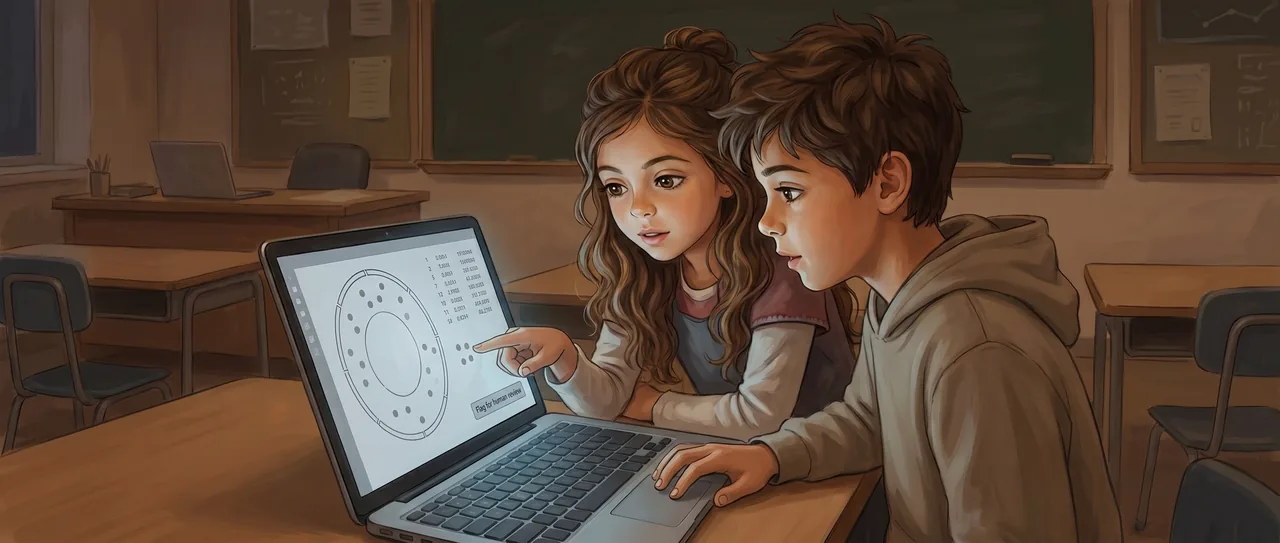
They mapped the nineteen onto the detector's ring. Soren read the positions out and Maya placed them, dot by dot, around the circle.
They were not in one spot.
They were everywhere. Top, bottom, both sides, front, back. Nineteen identical whispers, born all over the machine, agreeing with each other across the whole great ring of it.
Nobody said anything for a moment. Mr. Okafor straightened up slowly.
"That's not a glitch," he said quietly. "I don't know what that is."
Maya looked at the gray dots she had placed, the ones the machine had been so sure were nothing.
"It only ever asked, is this one event special," she said. "It never asked, are these events talking to each other."
Soren was already pulling up the form. The open dataset had a button for exactly this. Flag for human review. A real one. A message that would go to people overseas who actually ran the machine, people who would know in a way he and Maya could not yet, whether nineteen matching whispers were a famous particle, or an unknown one, or a beautiful mistake.
His cursor hovered over the button.
"What do we tell them," he said.
Maya read it out while he typed, the two of them deciding the words together.
We think you threw something away. It comes from everywhere on the detector. It always decays at the same angle. There are nineteen of them, and the machine called every one of them noise.
Soren pressed send, and the nineteen gray ghosts sat glowing on the screen, waiting for someone on the other side of the world to look.
Read the interactive version, listen to the narration, and earn a gold star →
A science-verified short story for curious kids · Curiosity Land