The Sponge That Counts
The shoebox came with a little paper packet that said DO NOT EAT, which Maya read as a personal challenge to find out why.
She did not eat it. She shook it instead. Inside were tiny glassy beads, dry as sand, rattling like sugar.
"Same stuff as the cat litter," Soren said. He was sitting on the laundry room floor with the giant bag wedged between his knees, reading the side. "Look. It says it absorbs odor."
"It says it absorbs odor," Maya repeated. "Not all of it. Some of it."
Soren looked up. "How do you know?"
"Because the room still smells like detergent." She pointed at the open soap bottle. "That's a smell. The crystals didn't grab it. They grabbed the cat smell. So they're picking."
Soren wrote picking? in his notebook and underlined it. The inside of his head felt too small for a thing that could choose.
They ran a test, because Maya could not stand a sentence that ended in a question mark.
She poured a handful of beads into one jar and a handful into another. In the first jar she dripped water. In the second she dripped a little of her dad's after-shave, the sharp green kind. Then they capped both jars and waited, and waiting was the worst part, so they timed it with the microwave clock and argued about whether argon was a smell.
When they opened the water jar, the beads had gone warm. Not warm like a stove. Warm like a hand. Maya pressed two fingers against the glass and felt it.
"The water went in," she said. "And it made heat."
"Things give off heat when they fit somewhere," Soren said slowly. "Like, when something snaps into the place it's supposed to go."
The after-shave jar was different. The sharp green smell was weaker but not gone. Some of it had vanished into the beads. Some of it had not.
"Picking," Maya said again, and this time it wasn't a question.
They took the strange beads to the kitchen, where Maya's mother was grading lab reports with a red pen and the air of a person who did not want to be a science teacher at home as well as at work.
"They're zeolites," her mother said, not looking up. "Molecular sieves. Now please let me finish."
"A sieve has holes," Maya said. "You can see the holes in a sieve."
"You can't see these." Her mother circled something in red. "They're too small. Smaller than a wavelength of light."
"Then how do they pick?" Soren asked.
Her mother sighed the sigh of someone who has answered eleven emails and would like to answer no questions. "By size and shape. The holes only let in molecules that fit. That's all I've got tonight. There's a book on the shelf."
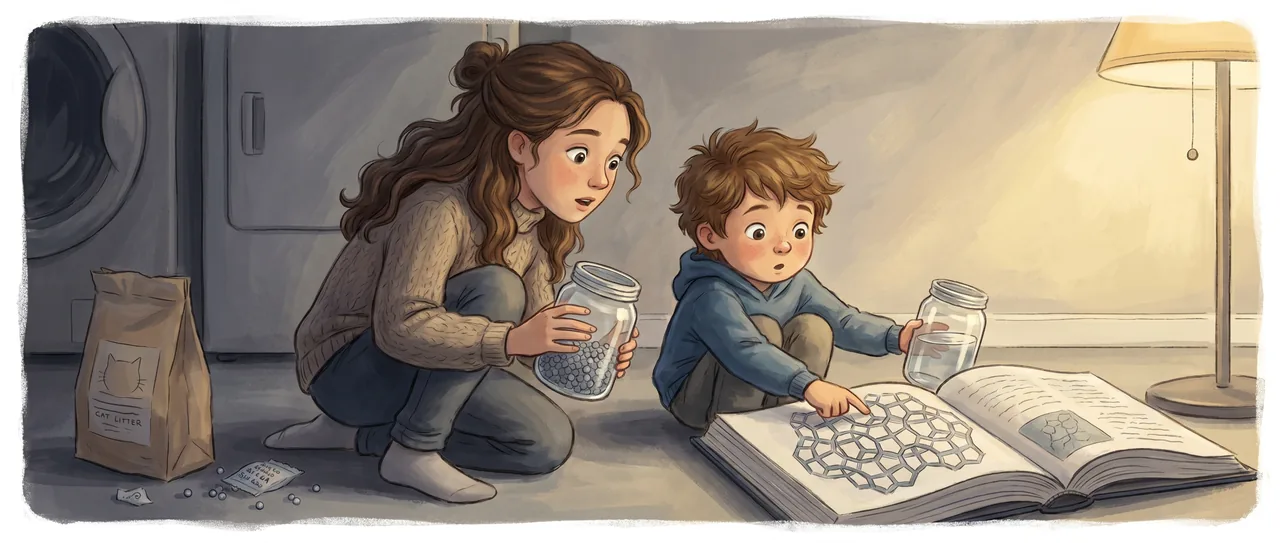
There was a book on the shelf. It was about minerals and it was boring in the front and not boring in the back, and the back had a picture that made both of them stop talking.
It was a model of a zeolite. Not a blob. Not a sponge. A cage. A lattice of struts and openings, repeating, perfectly even, like scaffolding that went on forever in three directions. Every window in the cage was exactly the same size as every other window.
"Every hole is the same," Soren said. "Exactly the same."
Maya put her finger on the picture. "That's why it picks. The water molecule's little. It fits through the window. The after-shave"
"is bigger," Soren finished. "Or the wrong shape. So it can't get in. It just bounces off the outside."
They looked at each other.
"It's not absorbing," Maya said. "It's measuring. Every single one of those beads is measuring every molecule that comes near it, and only letting in the ones that match."
Soren tried to picture the number. One bead. He had poured a handful. Inside one bead were more of those identical windows than he could write zeros for. Each window the size of a few atoms. Each one checking the shape of whatever drifted past, billions of times a second, in the dark, in a jar, on a laundry room floor, while nobody watched.
"It does it without electricity," he said. "It does it without anything. It just is the right shape, so the right shape happens."
Maya was already somewhere else. "They use these to clean water. Mom said. And in gas. If you can make the windows one size, you separate one gas. If you make them a tiny bit bigger, you separate a different gas. You'd be sorting the air." She held the jar up to the light. "Somebody decided how big to make the windows. Somebody chose."
That was the part that got into Soren. The book said chemists could grow zeolites and tune the pore size on purpose. Build the cage to fit exactly the molecule you wanted to catch, and let everything else go free. A net woven so finely that the holes were a designed thing, a decision, a number you picked before you started.
"You could build one for anything," he said. "Anything that has a shape. You just have to know the shape, and then you make the window."
"There are millions of shapes," Maya said.
"There are millions of windows you could make," Soren said. "Most of them haven't been made yet."
The laundry room felt different now, going back in. The bag of cat litter on the floor was not a bag of gray pebbles. It was a quarry of cathedrals, each one full of identical windows, each window counting, sorting, choosing, all the way down past where light could reach.
Maya unscrewed the water jar one more time. The beads were cool again now, finished, full. She poured a few into her palm and they sat there, ordinary, gray, silent, doing in the dark of every pore the one exact thing they were shaped to do.
She tilted her hand and let them roll back into the jar, one by one, and counted out loud as far as she could before they all ran together.
Read the interactive version, listen to the narration, and earn a gold star →
A science-verified short story for curious kids · Curiosity Land