The Question the Machine Hadn't Been Asked
The clouds came in at eight and did not leave, so the telescope on the roof was useless and everyone went home except Maya, whose ride was late, and a graduate student named Priya, who was eating cold noodles in front of a laptop and clearly wished she were eating them somewhere else.
"You can wait inside," Priya said. "It's warm. Don't touch the array controls."
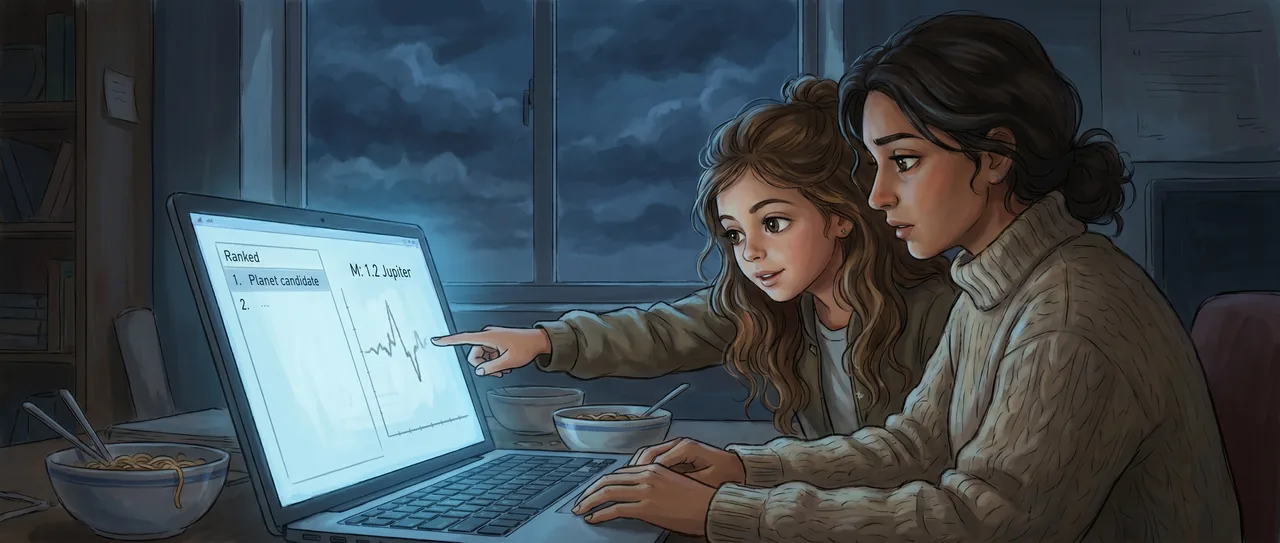
Maya pulled a chair over. On the screen, a graph wobbled. A line that should have been flat kept dipping and rising, dipping and rising, a tiny ragged heartbeat.
"What's that."
"Star wobble," said Priya, not looking up. "When a planet orbits a star, the star wobbles too. They tug each other. The star moves toward us a little, away a little. We see it in the color of the light. The model hunts for the pattern."
"A whole star moves because of a planet?"
"A tiny bit. Big planets, big wobble. Small planets, almost nothing." Priya poked the noodles. "This star's been watched for thirty years. The model found two big planets in the data. It's confident. It's done."
Maya looked at the heartbeat line. "It doesn't look done."
"That's leftover noise. Stars are messy. They have spots, flares, breathing. The model already accounted for the planets it's sure about."
Maya watched the line. Two planets had been pulled out, Priya said. Subtracted. But the leftover wiggle was not flat. It was not random either. It had a shape that came back, came back, came back. Smaller than the big tugs. Patient.
"What's it looking for," Maya asked.
"Planets it's confident about."
"No." Maya leaned in. "What did you tell it to look for."
Priya finally looked at her. "Signals above a confidence threshold. We set it high so we don't announce planets that turn out to be sunspots. False alarms are embarrassing."
"So if a planet was small," Maya said slowly, "and its wobble was tiny, and the star was noisy, the model would find it but not be sure, and you told it to throw away anything it wasn't sure about."
Priya set down the noodles.
"You didn't tell it to find planets," Maya said. "You told it to find planets it could be confident about. That's a different question."
The heating system ticked. Outside, the clouds did not move.
"It's the same question," Priya said, but she said it the way you say a thing to hear whether it's still true.
"It's not, though." Maya put her finger near the screen, near the leftover heartbeat. "It threw the unsure stuff in a pile and called it noise. But noise doesn't have a shape. That has a shape. It keeps coming back at the same beat."
Priya pulled the laptop toward herself. Typed. "Okay. Okay, slow down. The model can tell us its low-confidence candidates. We don't usually look at them because there are thousands of stars and most of those candidates really are spots and flares. Filtering them out is the whole point."
"But you have decades of this one star," Maya said. "Thirty years. A spot heals. A flare is once. A planet keeps its beat for thirty years."
Priya stopped typing.
"So don't ask it which signals are strong," Maya said. "Ask it which weak signals stayed."
For a moment Priya didn't move. Then her hands went fast across the keys, and she was talking half to Maya and half to nobody. "I can do that. I can tell it to forget confidence and just rank the leftover by how stable the period is across the whole baseline. Persistence instead of strength. It's the same data. I'm just asking it a different thing."
The model ran. A bar filled. The cold noodles were entirely forgotten now.
Maya watched the screen and felt the room change size around her. The machine had been trained on more starlight than any person could hold in a lifetime, signals so faint and tangled that no human eye could ever sort them. It had been sorting them this whole time. It had seen the small patient wobble. It had measured it, weighed it, and set it aside, not because it was wrong but because nobody had asked it the question that made it matter.
The answer had been sitting in the pile the whole time, waiting for someone to ask differently.
The model finished. One candidate rose to the top of the leftover. A period. A mass estimate beside it.
Priya read the number twice. "That can't be right."
"What is it."
"The mass." Priya's voice had gone careful and quiet. "If this is real, if this beat is a planet and not the star breathing, it's small. Maya, it's about one Earth mass. The wobble would be barely a walking pace. We don't usually believe wobbles that small. That's why the threshold's set where it is."
"But it stayed for thirty years."
"It stayed for thirty years," Priya repeated.
They both looked at the line. The patient heartbeat. A star, somewhere out in the dark, leaning a little toward them and a little away, tugged by something the size of the ground under Maya's feet.
"It's not proof," Priya said. "You understand that. I have to check the spot activity, the instrument changes, I have to rule out everything boring first. It might still be nothing."
"I know," Maya said. She did know. "There are thousands of stars in this archive," Priya said slowly. "Every one of them with a leftover pile we never asked about this way."
"Thousands," Maya said.
Priya looked at her. "How did you know to ask that?"
"I didn't. I just kept looking at the part you said wasn't anything."
A car horn sounded outside. Maya's ride, finally, headlights smearing through the cloud.
Maya stood, then stopped at the door. On the screen the single candidate still glowed at the top of a list that, an hour ago, no one had bothered to sort. She reached over Priya's shoulder and tapped the keyboard, and the model began to chew through the second star's leftover pile, and the third, all on its own, asking the new question of every star it had ever watched.
Read the interactive version, listen to the narration, and earn a gold star →
A science-verified short story for curious kids · Curiosity Land