The Place the Ocean Won't Say
Soren's grandmother lived at the end of a road that the ocean was slowly buying back.
She didn't say it like that. She said the tide came up further than it used to, and pointed at a paint mark on the seawall, faded, from before he was born. Soren liked the mark. It was a measurement somebody had made on purpose and then trusted enough to leave alone.
After supper he sat on the porch with the tablet and opened Tideline, the Earth science companion his class used. It had eaten everything. Two hundred years of tide gauge readings from harbors all over the world. Satellites that measured the height of the sea to the width of a finger. Ocean temperatures going down and down into the cold dark.
"Show me here," Soren said, and tapped the coast outside the window.
Tideline drew a map. Most of it was calm color, blue fading to green, every stretch of coast given a number and a small range around it. By the year twenty seventy this much higher, give or take a little. The give-or-take was a faint gray band, thin as thread, hugging each prediction.
Except in one place.
North of the harbor, where the coast bent in around a wide shallow bay, the gray band swelled. It bulged out like a held breath. Everywhere else Tideline said this much, probably. There it said something between a little and a lot, and would not narrow it down.
"Why is it fat there," Soren said. He talked to the tablet the way he talked to himself.
"That region has the highest predictive uncertainty on this coast," Tideline said.
"I can see that. I asked why."
Tideline paused the way it did when the honest answer was long. "My confidence comes from agreement between data sources. Where tide gauges, satellite measurements, and temperature models agree, my range is narrow. In that bay, they disagree."
Soren got his notebook. Not for school. For the room inside his head, which had gotten too small.
He pulled the three sources apart, one at a time, the way you'd lift the lid off three pots to see which one was boiling.
The tide gauges first. There was an old one in the bay, a real instrument bolted to a real pier, sending numbers since before his grandmother was small. Its line went up, steady, believable.
The satellites next. They measured the open sea beautifully. But Soren noticed they got shy near the shore. "Why do the satellite numbers stop short of the bay," he asked.
"Satellite altimetry loses accuracy close to land," Tideline said. "The radar reflects off the coastline and the shallow bottom. In a wide shallow bay, the signal is contaminated. I trust it less there."
So the eye in the sky squinted exactly where Soren's grandmother lived. He wrote that down.
The temperature models last. Water expands when it warms. The models knew the deep ocean well. But the bay was shallow, and the rivers fed into it, and the warm and the cold and the fresh and the salt all argued in a small space the big models smoothed over.
Three sources. The pier gauge said one thing, clear and local and old. The satellites threw up their hands near the shore. The temperature models averaged a place that refused to be averaged.
Soren sat with that. The uncertainty wasn't a flaw in the bay. It was three honest instruments that could not all see the same small place at the same time.
"Tideline," he said slowly. "The gray band isn't because the ocean is confusing there."
"Go on."
"It's because that's the one place where your three eyes don't overlap. The satellites can't get close. The gauge is close but it's only one point. The temperature model is everywhere but it's blurry up close." He looked at the bay on the map, the fat gray breath of it. "You're not unsure about the water. You're unsure about each other."
Tideline was quiet for a second longer than usual.
"That is correct," it said. "My uncertainty there is not the ocean's. It is mine." The machine knew oceans. It did not know which question to be embarrassed about. That part was still a person's job.
"What would make the gray band thinner," Soren asked.
"More measurements inside the bay, close to shore, where my eyes currently disagree. A new gauge. Repeated local readings. Even a single careful observer over time would reduce my uncertainty in that region more than a thousand satellite passes over open water."
Soren looked up.
Through the window, past the porch, the seawall caught the last light. The paint mark his grandmother had left. A measurement somebody made on purpose, in exactly the place where the smartest model on Earth went blurry.
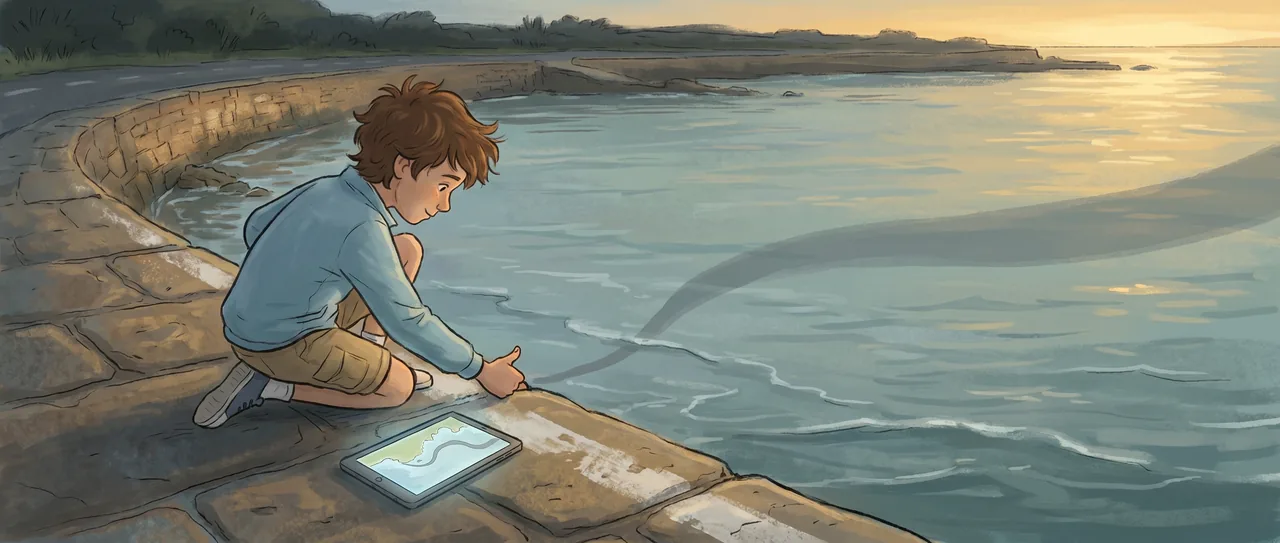
He carried the tablet out to the wall. The tide was coming in over the flats, filling the shallow bay that no satellite could read cleanly, lapping toward a faded line that one stubborn person had decided, decades ago, was worth marking.
Soren held his thumb against the new water and the old paint, measuring the gap, and the gray band in the model was waiting for a number only the bay could give.
Read the interactive version, listen to the narration, and earn a gold star →
A science-verified short story for curious kids · Curiosity Land