The Missing Thing
The pond was wrong before Maya could say why.
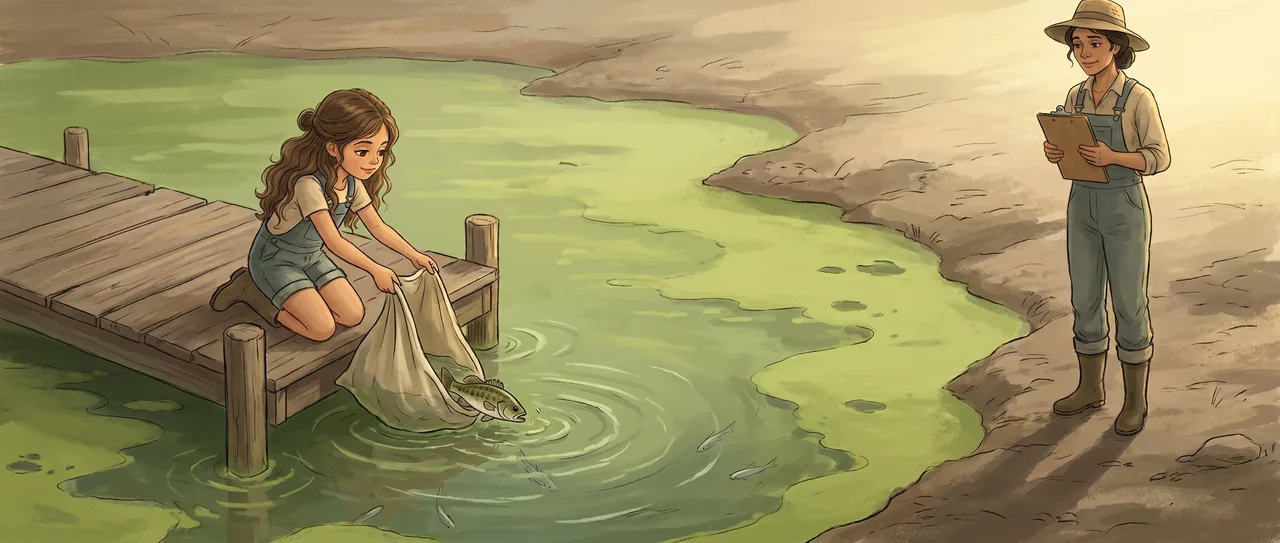
She stood on the dock with the net dripping in her hand and looked at the green. The water was the color of pea soup, thick with it, and the edges where the cattails used to be were just mud now.
"Same as last week," said Aunt Reyes, writing on her clipboard. She managed the little farm pond for the county, measuring it twice a month. "Algae's up again. I'll add more chemical."
"What lives in it?" Maya asked.
"Minnows. Thousands of them now. Used to be a few." Aunt Reyes frowned at her own numbers. "That part I don't get. More minnows, you'd think more food getting eaten, cleaner water. It's backwards."
Maya dragged the net through the shallows and lifted it. Silver. Dozens of tiny silver bodies flipping in the mesh, more than the net should hold. She tipped them back and they vanished into the green like spilled coins.
"Where's the big fish?" she said.
"What big fish?"
"Last summer. The big bass. I saw it from here. It came up and ate a frog whole." Maya remembered the swirl, the size of it, a shadow as long as her arm.
Aunt Reyes shrugged. "Somebody caught it, probably. Kids fish off this dock all the time. One big bass, who'd miss it."
Maya didn't answer. She had started a list in her head, the way she always did, and at the top of the list was: one big fish gone, ten thousand small fish here. That did not feel like nothing. That felt like the whole thing.
She walked the edge of the pond while her aunt mixed the chemical. The mud was bare. Last year this bank had been thick with reeds and water bugs, the kind that skated on the surface, the kind that hummed at dusk. Now nothing skated. Nothing hummed.
She crouched and looked into the shallows for a long time.
Minnows everywhere. And the surface, where the bugs should be, empty.
"Aunt Reyes," she called. "What do the minnows eat?"
"Bugs. Larvae. Little stuff in the water."
"And the little stuff. The larvae. What do they eat?"
Aunt Reyes capped her bottle. "Algae, mostly. They graze it. Why?"
Maya stood up fast.
She could see it now, the whole chain of it, laid out in the green water like a sentence she had only just learned to read. The bugs ate the algae. The minnows ate the bugs. And the big bass, the one shadow as long as her arm, had eaten the minnows. Kept them few. Kept them careful.
Take away the bass, and the minnows did not stay few.
"It's the fish that's gone," Maya said. "That's why the water's green."
Aunt Reyes laughed, not unkindly. "The green is algae, Maya. The big fish never touched algae in its life. Wrong end of the pond."
"No." Maya shook her head, fast, the words coming faster than she could line them up. "The fish ate the minnows. So there weren't many minnows. So the bugs got to live. So the bugs ate the algae. The bugs kept the water clean. Not the fish. The fish kept the minnows down so the bugs could."
Aunt Reyes stopped writing.
"Take the fish away," Maya said, "and the minnows go crazy. Ten thousand of them. And they eat every bug. And you said it yourself, there's no bugs left, the surface is empty. And now nothing eats the algae. So it just grows."
The pond sat there, green and quiet, proving her.
"The thing that's missing is at the top," Maya said. "But the problem shows up at the bottom."
Aunt Reyes was very still. She looked at her clipboard, at the column of numbers that had been backwards all summer. More minnows. Worse water. The two facts that would not fit together had just fit together, and not in the place she had been looking.
"I've been adding chemical for the algae," she said slowly. "All summer. To the bottom of the problem."
"And it keeps coming back."
"It keeps coming back."
Maya looked out at the silver flashing under the green and felt the pond get bigger. Not bigger in size. Bigger in connection. Every silver minnow was tied to a bug she couldn't see, and every bug to a strand of algae, and all of it tied up to one shadow that wasn't there anymore. Pull one thread at the top and the whole net moved. The pond was not a bunch of separate things in the same water. It was one thing, and she had been looking at the pieces. "So how do we fix it," Aunt Reyes said. It wasn't really a question to Maya. But Maya answered anyway.
"Put the top back."
Aunt Reyes set down her clipboard. She looked at it like a person looks at a map they'd been holding upside down.
"There's a hatchery," she said. "County hatchery. They've got bass." She rubbed her forehead. "I've been buying chemical by the gallon and the answer is fish. A few fish."
"Big ones," Maya said. "Hungry ones."
Aunt Reyes laughed again, but it was a different laugh, a little shaky, the laugh of someone who has just felt the ground change shape under a thing they thought they understood.
They drove to the hatchery the next morning. The man there gave them six young bass in a bag of water that bulged and shifted in Maya's lap the whole way back, the fish turning and turning, dark and quick.
At the pond Maya knelt on the dock and lowered the bag into the green until the water inside matched the water outside. Then she opened it.
The first bass hung in the murk for a second, deciding. Then it tipped its nose down toward the flashing silver below and disappeared into the pond, into the top of everything, where the missing thing had been.
Read the interactive version, listen to the narration, and earn a gold star →
A science-verified short story for curious kids · Curiosity Land