The Left Half of the Clock
Grandpa Ferris ate only the right half of his lunch.
Maya noticed it the way she noticed everything, before she understood it. Half the peas gone, half the peas untouched. The roll on the right side of the tray was a ruin of crumbs. The roll on the left sat whole and forgotten, like he had never seen it.
She slid the tray two inches to the left.
The forgotten roll arrived in front of him, and he picked it up and ate it like it had just appeared. Maya sat very still. She had not added food. She had only moved the world.
"He's doing better," her mother said, in the bright tired voice she used here. "The doctors say the stroke was on the right side of his brain. They say he might get the left side of things back."
The left side of things. Maya rolled the phrase around. It was a strange way to lose something. Not your memory, not your words. A direction.
"Grandpa," she said. "Can you see me?"
"Course I can, Pea." He smiled. She was sitting slightly to his right.
She got up and walked around the bed and stood on his left side, close, where he could not possibly miss her.
He kept looking at the empty chair on his right. He did not turn. His eyes did not search. To him there was nothing on the left to search for. Not darkness. Not a blind spot. Just no left at all, the way there is no behind your own head that you feel the lack of.
Her skin went cold and electric. His eyes worked. The nurse had told her his eyes worked perfectly. The light went in. Somewhere the picture got built. And the part of him that built the picture had stopped building the left half.
"Maya?" her mother said. "You've gone quiet."
Maya had a clock on her wrist, the round kind her dad gave her because she liked gears. She unbuckled it and set it on the blanket on Grandpa's left side.
"Grandpa, what time is it?"
His hand fumbled across the blanket. Found nothing. "Lost my watch," he said, untroubled.
She moved the clock to his right. His hand landed on it at once. He held it up and squinted.
"Twenty past," he said. "All the way around to the twelve."
But he had not read all the way around. Maya leaned in. The clock face had numbers from one to twelve. He had said the hands, he had said the right-side numbers, and his voice had simply trailed off where the left side of the dial should have been, the way a road trails off where the map ends.
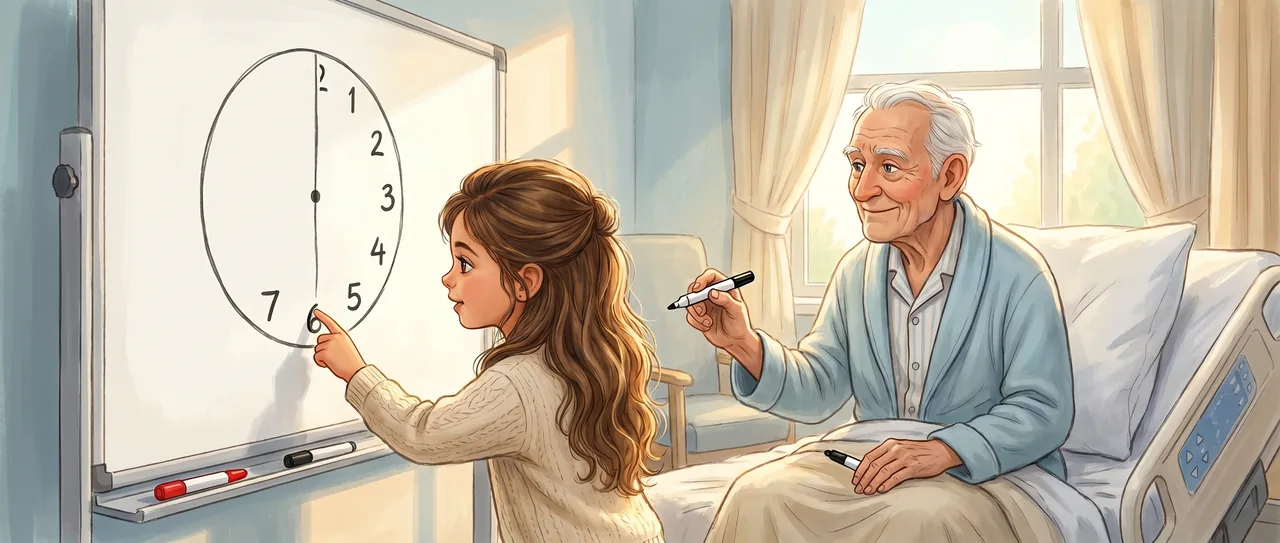
There was a whiteboard by the bed for visitors to write messages. Maya took the marker and drew a big circle and asked him to fill in the clock numbers. He hunched over it, careful, an engineer his whole life, proud of being careful.
He wrote twelve at the top. One, two, three, four, five, going down the right. Six at the bottom.
Then he stopped. He looked at his circle. To him it looked finished. All twelve numbers, evenly spaced, a perfect clock. But they were all crowded on the right half, one through six, and the entire left side of the circle was bare.
"There," he said, satisfied. "Good as new."
Maya's mother made a small sound and looked away. Maya did not look away. She was somewhere far inside the strangeness of it.
He wasn't lying. He wasn't confused about clocks. He had built a complete picture of a clock in his head and handed it to her, and his complete picture was missing half of itself, and he could not feel the hole because the part of him that would feel the hole was the part that was hurt.
There is a piece of the brain, up and back, behind the ear, that does nothing but stitch space together. It takes left and right and near and far and your own arm and the roll on your tray and weaves them into one seamless world that feels like simply looking. You never thank it. You never feel it working. Maya was feeling it now, by its absence, the way you feel a missing tooth with your tongue.
Which meant her own left side, right now, the chair to her left, her own left hand, the window on her left full of afternoon, all of that was not just out there being itself. It was being built. Quietly. Constantly. By a fold of her that she had never once noticed, because it had never once failed.
She looked at her own left hand and could not stop seeing the construction in it.
"Grandpa," she said gently. "I'm going to try something."
She didn't tell him the left side was missing. You couldn't tell him. There was no him on that side to tell.
Instead she put her finger on the whiteboard, on the bare left curve, and she made it move. She tapped, slow, drawing his hand toward it. Therapists do this. She didn't know that. She only knew that moving things had worked before, that motion was a thing his eyes still chased even when stillness disappeared.
His gaze caught on her moving finger. Followed it. Crossed the middle. Arrived in the empty left of the circle.
He blinked.
"Huh," he said slowly. "Forgot the rest."
And he wrote a seven. Then an eight, a nine, frowning now, working, hauling the numbers up out of nowhere into a space that had not existed for him ten seconds ago. Ten. Eleven. The clock closing itself, hour by hour, like a moon filling.
He set down the marker, tired and pleased, and the clock on the board was whole.
Maya stayed by his left side, the side he couldn't keep, and she lifted her own left hand into the window light and turned it over, watching the afternoon land on a palm that some quiet hidden part of her had decided, just then, to show her.
Read the interactive version, listen to the narration, and earn a gold star →
A science-verified short story for curious kids · Curiosity Land