The Ledger in the Roof
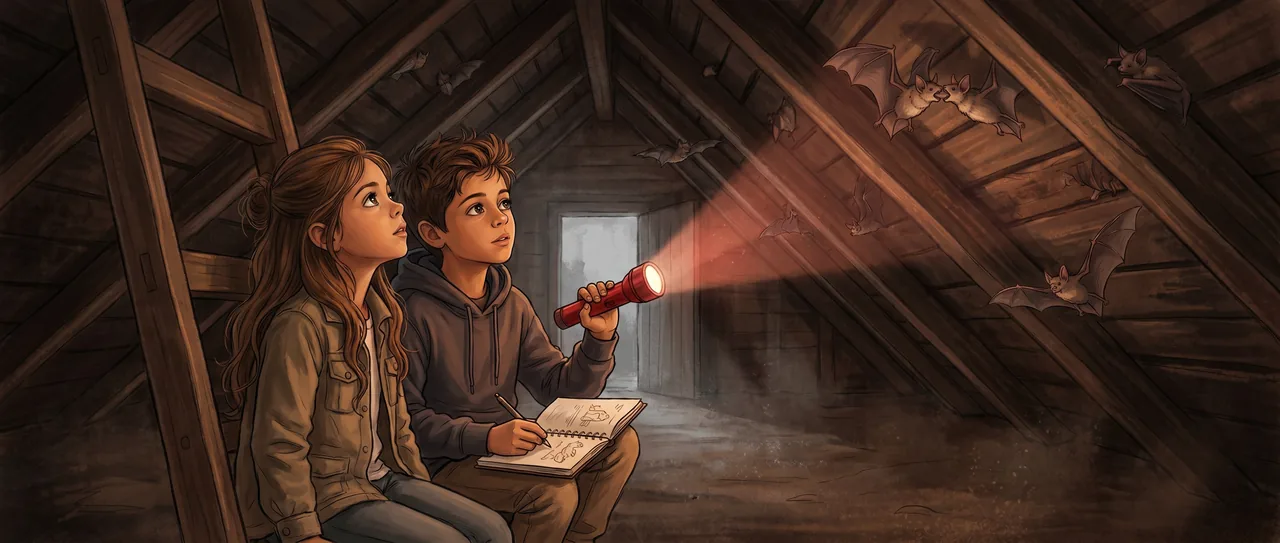
The barn smelled of dust and warm animal. Soren stood on the ladder with a red flashlight, because his aunt had said white light would scare them, and pressed his face close to the gap under the roof beam.
"There are dozens," he said. "Maybe a hundred."
Maya was already counting the ones near the edge, the ones hanging in a loose cluster like dark wet leaves. "That one's fat," she said. "That one's not. Look. The skinny one keeps climbing toward the fat one."
Soren wrote the time in his notebook. Aunt Lucía had told them the bats came back near dawn and that some nights a bat came back with nothing. She raised cattle and she did not love the bats, but she had watched them her whole life, and she said one strange thing before she went back to the house.
"The hungry ones beg," she said. "And sometimes they get fed. By bats that aren't even their family. I never understood it. Don't fall off the ladder."
That was the thing Maya could not put down.
"Why would it," she said. "Why would a fat bat give food to a stranger."
"Maybe they're related," Soren said. "Maybe Lucía's wrong."
"Maybe." Maya did not sound like she believed it.
They came back the next three evenings. Soren made a chart. He gave the bats names by the marks on their wings, a torn edge, a pale patch, and he tracked which ones hung where. Maya watched behavior. She was faster at it. She could tell a hungry bat from a fed one across the whole roost, by the way a hungry one moved, restless and low.
On the second night they saw it happen.
A thin bat, the one Soren called Torn, climbed up to a rounder bat and pressed its mouth against the other's mouth. Soren held his breath. The round bat opened its jaws. Something passed between them, mouth to mouth, and afterward Torn hung quiet and the round bat looked a little less round.
"That's food," Maya whispered. "It just gave it food."
"It threw up blood into the other one's mouth," Soren said, and his voice was strange, half disgusted and half amazed. "That's what that was."
"They're not the same family," Maya said. "You charted them. Torn hangs over by the wall. The round one hangs by the beam. They don't even roost together."
Soren looked at his chart. She was right. He had two weeks of marks and these two had never been neighbors.
"So Lucía's right," he said slowly. "It fed a stranger."
Maya was quiet for a long time. Then she said the thing that did not make sense yet, the thing she would chew on for days.
"Then why doesn't every bat just take and never give. If a stranger feeds you for free, you should beg from everyone and feed no one. You'd win."
Soren stopped writing.
"Cheaters would win," he said. "Yeah. So the whole thing should fall apart. But it doesn't."
They did not solve it that night. Soren wrote the problem at the top of a clean page and underlined it twice, and neither of them liked leaving it open.
The answer came on the fourth night, and it came because Maya was watching the round bat instead of the hungry one.
The round bat from before, the one Soren named Beam, came home thin that night. It had not fed. Maya watched it climb the roof, restless and low, the way the hungry ones moved. It went straight to a particular cluster.
"Watch Beam," she said. "It's not begging from just anyone."
Beam climbed past three fat bats. Did not stop. Did not beg. It went all the way across to Torn.
And Torn fed it.
Soren's pencil stopped in the air. "Torn's paying it back," he said. "Beam fed Torn two nights ago. Now Beam's hungry and it went straight to Torn."
"It remembered," Maya said. "It walked past three fatter bats to get to the one that owed it."
They looked at each other in the red light.
"That's why cheaters don't win," Soren said, and the words came out fast now, tumbling. "They keep track. Every bat keeps track of who fed it. If you take and never give, the next time you come home starving, nobody feeds you. And a bat dies after about, Lucía said, not even three days. Two and a half."
"Sixty hours," Maya said. "She said sixty hours. One bad night and you're close. Two bad nights and you're dead."
"So you can't afford to be a cheater," Soren said. "Because the night you need saving, the ledger is what saves you. Not your family. The bats you were good to."
Maya sat back on the ladder rung. The barn felt different now. There was an entire bookkeeping going on above her head in the dark, a hundred small animals each holding a list of debts and kindnesses, each remembering exactly who had reached into its own starving body and given away a meal it could not spare.
"They're keeping accounts," she said. "In their heads. In the dark. Of who was good to them."
"Animals nobody thinks twice about," Soren said. "Everybody thinks they're scary."
Maya was thinking about the lists in her own head, the things that did not make sense yet, the running ledger she carried everywhere and never wrote down. She had always thought it made her odd, the keeping track, the noticing who did what. Up in the roof a hundred creatures were staying alive by doing exactly that.
"They survive because they remember," she said. "That's the whole thing. The remembering is the thing that keeps them alive."
Soren wrote it down. Not for homework. Because the inside of his head was too small to hold it.
A bat dropped from the gap, opened its wings against the last gray light in the doorway, and was gone over the cattle field to begin the night's hunt. Another followed it. Then a third. Maya counted them out into the dark, each one carrying its private ledger, each one flying toward the thin chance that tonight it would find a meal, and toward the roof where, if it did not, someone it had once been good to would be waiting.
She stopped counting at forty and just watched them pour out into the dusk.
Soren turned off the red light. The two of them sat on the ladder in the dark and listened to the soft leather sound of wings leaving, one after another after another, out over the field where the cattle stood.
Read the interactive version, listen to the narration, and earn a gold star →
A science-verified short story for curious kids · Curiosity Land