The Forger and the Spotter
The program made faces. Bad ones.
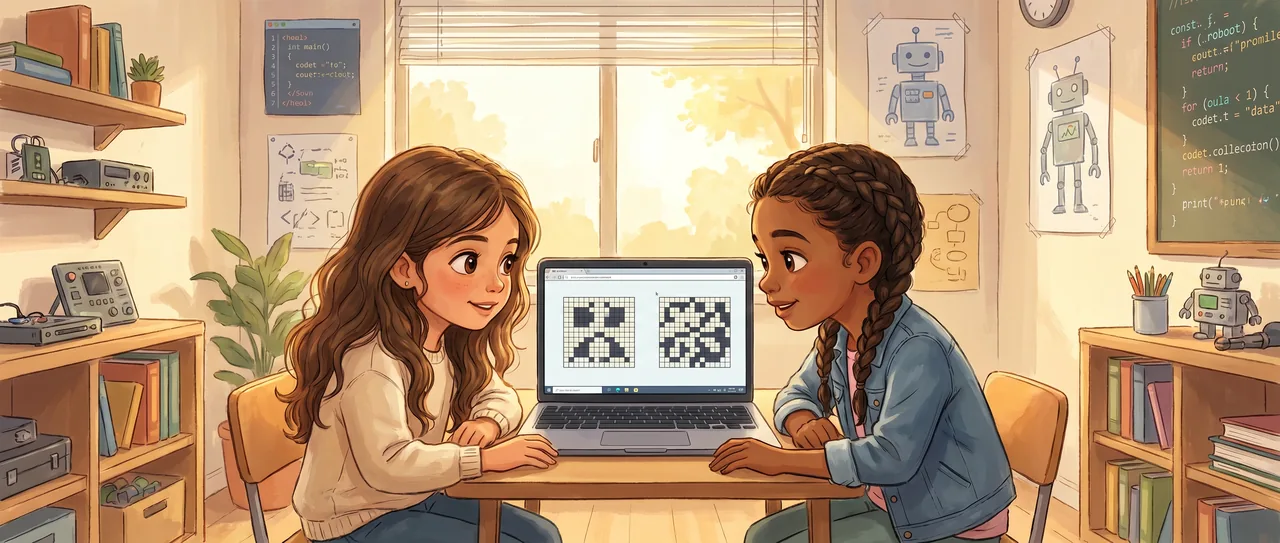
Maya scrolled through the latest batch on the club laptop. Eyes in the wrong places. A mouth floating above a forehead. Skin the color of old chewing gum. Mr. Adeyemi had set up the project before he left, said it would learn to make pictures of people who had never existed, then grabbed his bag and said he had a bus to catch.
Nobody who never existed would want to look like this.
She read the screen. Two parts. One called the generator. One called the discriminator. The generator made a picture. The discriminator looked at it and guessed: real photo, or fake.
Right now the discriminator was winning every round. Fake. Fake. Fake. Obvious.
Maya leaned back. The chair squeaked.
Her first thought was that the generator was broken. You give a machine a job, it does the job badly, you fix the machine. So she opened the generator's settings and started poking. Made it bigger. Made it slower. Fed it more pictures of actual faces to copy.
The faces got worse. Now they had three nostrils.
She sat with that. Three nostrils was a step backward, and she had only tried to help.
Wrong tree. She closed the generator settings.
The thing that bugged her was the discriminator. It was so smug. Every fake, it caught. She watched the log scroll: caught, caught, caught. And the generator just kept throwing mush at it and getting told no.
If the spotter is that good, she thought, why does the forger never get better?
She pulled up how the two were connected. And there it was, in a line of setup code Mr. Adeyemi had rushed through. The discriminator was learning. Getting sharper every round, better at catching fakes.
The generator was not learning at all. He had switched its learning off and forgotten to switch it back on.
So it was a contest where only one side was allowed to practice. One kid getting faster every day. The other kid frozen, throwing the same clumsy punch forever, losing forever, never told why.
Maya found the switch. Turned the generator's learning on. Then she stopped, finger over the key.
Because something about it felt wrong, and she trusted that feeling more than she trusted most facts.
If the discriminator was already a genius at spotting fakes, the poor generator would just lose faster. A beginner against a champion. The beginner needs the champion to be a beginner too. They have to grow up together.
She turned the discriminator's learning down. Not off. Down. Let them start even. Let them climb together.
Then she pressed run and went to find the vending machine.
When she came back, the faces were still bad. But they were bad in a new way. The eyes were in the eye places now. The mouths were mouths. Wrong, but wrong like a child's drawing instead of wrong like a car crash.
She watched the log.
The generator made a face. The discriminator said fake. The generator adjusted. Made another. Fake. Adjusted. And every time the generator got a tiny bit sharper, the discriminator was right behind it, learning the new trick, raising the bar again.
Forger improves. Spotter improves to catch the better forgery. Forger improves to beat the better spotter. Around and around.
Maya stopped chewing.
Neither of them was being taught what a face looked like. Nobody had given either one the answer. There was no answer in the room. There was just the two of them, pushing on each other, and the pushing was making the faces.
The competition was the teacher.
She pulled her knees up onto the chair and watched the batches come.
Batch forty. The faces had cheekbones now. Lopsided ones.
Batch ninety. A face looked at her almost steadily, one ear melting into hair, but a face. A face of a person who was not anywhere. Not asleep somewhere. Not grown up somewhere. Not born.
Batch two hundred. Maya leaned close to the screen and forgot to breathe.
A girl looked back at her. Maybe twelve. A few freckles. A piece of hair that didn't sit right, the way real hair never sits right. A tiny shine on the lower lip. The kind of face you'd scroll past in a photo and never think about, because why would you think about a real person in a real photo.
Except there was no photo. No camera had ever pointed at this girl. No light had ever bounced off her face, because she had no face, because she had never had anything. She had been argued into existence by two machines disagreeing about her in the dark.
Maya checked the discriminator's last guess on that image.
Real.
It had said real. The spotter, the smug one, the one that caught everything, had looked at the made-up girl and could not tell. The forger had finally won a round, not because anyone lowered the bar, but because it had climbed all the way up to where the bar was.
Maya understood why she had felt wrong about the switch. You cannot make something good by beating it while it is weak. You make it good by giving it something exactly as strong, growing at exactly its speed, refusing to let it rest. The generator had never been told that's enough. That was the whole point of it. Something had pushed back on it as hard as it pushed, every single round, and that was not cruelty. That was the only thing in the room that had loved it enough to make it real.
She started a new batch and watched a hundred faces resolve out of static, one after another, strangers all of them, none of them ever born, every one of them looking back at her like they had been waiting.
She reached out and touched the screen where the girl's face had been, and the warmth of the laptop was the only warmth there.
Read the interactive version, listen to the narration, and earn a gold star →
A science-verified short story for curious kids · Curiosity Land