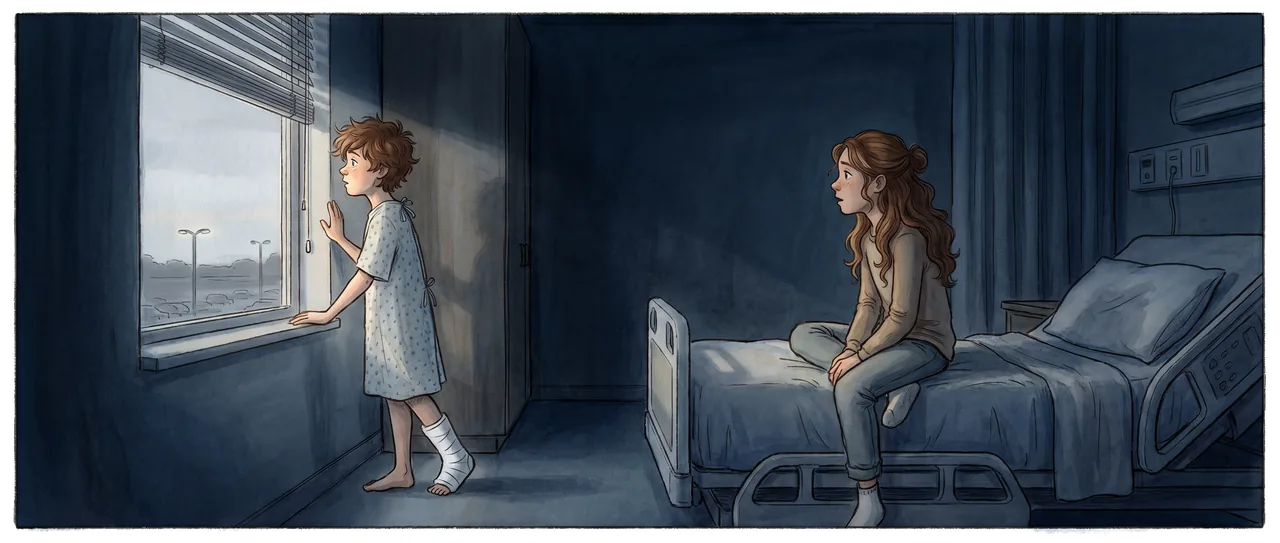
The Cells That Wouldn't Stop Counting
Soren was awake at three in the morning and starving for breakfast.
"Your body thinks it's noon," Maya said. She had snuck in with her mom, who was a night nurse on the floor below and who had decided that one quiet visit would do less harm than Maya pestering her for the whole shift.
"I know what time it is. I just want pancakes," Soren said. The blinds were shut. They had been shut since the surgery two days ago, a small thing, a fixed ankle, but the room had no clock and the lights stayed dim and the meal trays came whenever they came.
He had his notebook open on the blanket. He had been keeping track of when he got hungry, when he got sleepy, when he felt suddenly wide awake. The pattern had drifted. Every day his hunger came about an hour later than the day before.
"Look," he said, turning the page so Maya could see. "My stomach is running slow. Like a watch that loses an hour a day."
Maya looked. She did not say anything for a moment, which was how Soren knew she had seen something.
"It's not your stomach," she said. "It's everything. Watch."
She pointed down the row of times. Hunger drifting. Sleepiness drifting. The wide-awake moments drifting. All of them sliding later by the same hour, all together, like a row of swimmers keeping pace.
"They're all the same clock," Soren said slowly.
"Or they're all separate clocks that agree," Maya said. "And nobody's telling them what time it is anymore."
That stopped him. He had assumed there was one clock somewhere, in his brain maybe, and the rest of him just obeyed it. But a single brain clock should keep good time. It should not drift.
"Why would it drift?" he asked.
Maya was already up, walking the dim room, touching the edges of things the way she did when she was thinking with her hands. "Because it's running on its own. A clock you never set runs a little fast or a little slow. Yours runs slow. About twenty-five hours instead of twenty-four."
"Then what sets it back?"
Maya stopped at the window. She put two fingers on the slat of the blinds.
"Light," she said.
She lifted one slat. Outside it was still black, the parking lot lamps and a thin gray at the edge of the world where morning hadn't started yet.
"You've been in the dark for two days," she said. "Nothing's been setting it. So it's just been counting on its own. Twenty-five hours. Twenty-five. Twenty-five. Falling behind a little every day."
Soren looked at his own list again, and the list looked different now. It was not a record of his stomach misbehaving. It was a record of a clock running free, the way a clock runs when you take the batteries out of the wall and let it tick on whatever's inside it.
"My mom told me something once," Maya said. She came back and sat on the edge of the bed. "She did a thing in school where they grew cells in a dish. Just cells. No brain. No eyes. Nothing. And the cells kept time. They got busier and quieter, busier and quieter, every twenty-four hours. For weeks."
"In a dish," Soren repeated.
"In a dish. On a shelf. In the dark."
Soren sat very still. He was thinking about the cells in his own fixed ankle, under the cast, where no light had reached in two days. He was thinking about the cells in his hand, holding the pen. Each one, he was being told, keeping its own count. Not because his brain whispered the hour to it. Because it had a clock of its own, ticking inside it, the way it had ticked before he was born.
"How many is that," he said. It wasn't really a question. "How many clocks."
"One in every cell," Maya said. "Trillions."
"And they all agree."
"Most days. When the light reaches your eyes in the morning, it goes back to one little clock in your brain, and that one sends the time out to all the others. Sets them. Twenty-four. Everybody back in line." She tilted her head toward the blinds. "But nobody set them here. So they've been drifting. Together. Like an orchestra with no conductor still trying to keep the beat."
Soren looked down at his hand. He spread his fingers. Somewhere under the skin, in every single cell, something was counting, and had been counting his whole life, even in his sleep, even now, even the ones that would never see light and didn't need to.
"They never stop," he said.
"They never stop."
He thought about that. A body that was not one thing keeping time but a crowd of tiny things, each one a clock, each one ticking off the same near-day it had ticked since before he had a name for days. Trillions of small patient counters, mostly agreeing, drifting gently apart in the dark, waiting for morning to call them back.
"That's why I'm hungry at three," he said. "They're all an hour behind and nobody's told them."
"Right."
Soren closed his notebook. Then he opened it again, because there was one more thing and he needed somewhere to put it.
He didn't write. He just held the pen over the page.
"If light fixes it," he said, "then they're not behind. They're just waiting."
Maya grinned at him. That grin was the best thing about telling Maya something, the way she lit up when you handed her the next piece instead of taking one away.
"Open it," she said.
Soren got up carefully, the cast heavy, and crossed to the window with his hand on the wall. The gray at the edge of the parking lot had gone pale. The day was coming whether the room knew it or not.
He took the cord in his fist.
"Ready?" he said.
"They've been counting for two days," Maya said. "Let's tell them what time it is."
Soren pulled. The blinds went up in one long clatter and the cold early light fell straight across his face and into his open eyes, and for a moment he stood there blinking, letting it reach all the way in to the one small clock that would tell all the others.
Read the interactive version, listen to the narration, and earn a gold star →
A science-verified short story for curious kids · Curiosity Land