The Watch That Lied
At the trailhead, Soren held the two watches side by side until the seconds matched.
"Now," he said, and pressed both crowns at the same instant. "They're twins."
Maya took one and looped it around her wrist. "You really think they'll drift apart?"
"My uncle bet me they would. He works on the satellites. He said walk up the mountain and look again at the top."
"Walking shouldn't change a watch."
"That's what I said. He laughed at me."
They climbed. Maya went first, the way she always did, pointing at things and asking questions she didn't wait to have answered. Why does the moss only grow on the wet side. Why does the air smell colder higher up when the sun is brighter. Soren wrote two of the questions down on the second page of his notebook, the pencil bouncing as he walked.
Halfway up they sat on a flat rock and checked the watches.
"Same," Maya said.
"Same," Soren agreed. "To the second."
"So your uncle's wrong."
"My uncle is almost never wrong. It's annoying."
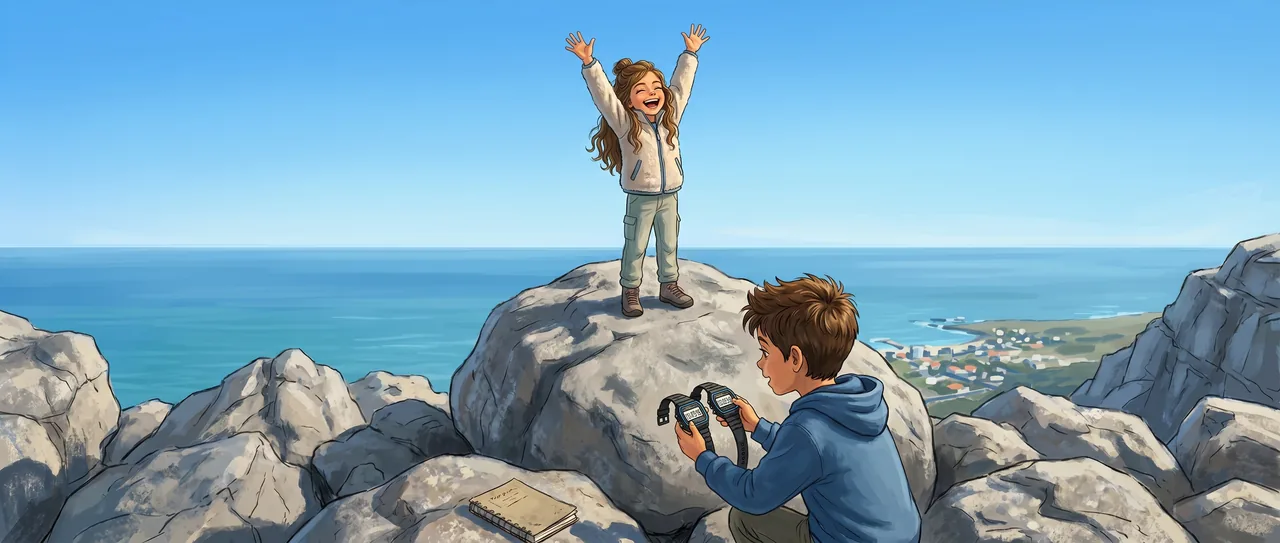
They kept climbing. The trees gave up and turned to bushes and then to bare grey rock. By the time they reached the summit the ocean was a flat blue plate far below them, and Maya was breathing hard and grinning.
"Okay," she said. "Show me."
Soren held the two watches together. They both stared.
"Same," Maya said.
"Same," Soren said.
Maya flopped back against the rock. "Your uncle owes you money."
But Soren wasn't smiling. He was turning the watches over, frowning the particular frown he got when something was supposed to be working and wasn't.
"How fast do these count?" he asked.
"What do you mean, how fast. They count seconds."
"How small a piece of a second can they show?"
Maya looked. "Just seconds. There's no little numbers after."
"Then we wouldn't see it." Soren sat up. "If the difference was tiny. Smaller than one second. These can't show it. They round."
Maya went quiet. Then she sat up too. "How tiny is it supposed to be?"
"He didn't say a number. He said walk up and look. He knew we wouldn't see it on a watch." Soren's voice climbed. "That's the joke. He wanted me to come back and say nothing happened."
"So how does he see it? On the satellites?"
"They have the good clocks. The ones that count billionths." Soren flipped back through his notebook to a page he'd copied months ago. "He told me once. The satellites are way up high, way higher than this mountain. And their clocks run fast. They gain time every single day compared to the ground."
"Gain time how. Like they're wrong?"
"No. That's the part I didn't believe. They're not wrong. Time is actually faster up there."
Maya stared at him. "Up where we're sitting?"
"A little. Up where the satellites are, a lot more."
Maya looked down at the watch on her wrist. Then she looked at the watch on Soren's. Then she looked down the whole long slope of the mountain at the ocean.
"Say that again," she said. "Slowly."
"Time goes faster the higher up you are."
"Why."
"Because of how heavy the planet pulls. Down low, near all the rock, the pull is stronger. Up high it's a tiny bit weaker. And where the pull is weaker, time runs a tiny bit faster." He looked at the watches again. "So your watch and mine, we set them together at the bottom. We carried them up. And the whole climb, up here, mine and yours were both ticking a little bit faster than the people on the beach."
"Both of ours," Maya said.
"Both. We're at the same height. So they still match each other." Soren's eyes went wide. "That's why they say same. Because we kept them together. If I'd left one on the beach with my mum and brought the other up here, then carried it back down and put them together again, the mountain one would be ahead."
"Ahead by how much."
"A nothing. A scrap of a billionth. Way too small for these." He held up the cheap plastic watches. "But not nothing. Not zero."
Maya was on her feet now. "So the people on the beach are younger than us."
Soren actually laughed. "By an amount you couldn't measure with anything in this whole town."
"But the satellites can measure it."
"The satellites live in it. They're so high and the time is so much faster up there that their clocks gain real time, every day, enough that if nobody fixed it the maps would be wrong. Your phone would think you were down the street from where you actually are. More wrong every hour."
Maya turned in a slow circle on the summit. The beach. The town. The little cars. The satellites she couldn't see, way up past the blue, swimming in faster time.
"So my head," she said, and put her hand flat on top of her own hair. "My head is older than my feet."
Soren stopped.
"Your head is higher than your feet," he said slowly. "All the time. Your whole life."
"So my head is older than my feet."
"By a scrap of a billionth of a billionth. But." He looked at her. "Yeah. Yeah. It is."
Maya stood very still with her hand on her head and her feet on the rock, the two ends of her in two different speeds of time, and she started to laugh, the kind of laugh that comes out when something is too big to hold any other way.
"Everybody," she said. "Everybody who ever stood up. The top of them was always older."
"By nothing you'd ever notice."
"But not zero." She pointed at him. "You said it. Not zero."
"Not zero," Soren agreed.
Maya looked down at the matched watches in his hand, both reading the same useless honest seconds, both lying about the billionths they couldn't show.
"Your uncle wins," she said.
"He always wins." Soren was already writing, the pencil moving fast, the notebook braced on his knee against the wind off the sea.
Maya climbed up onto the very highest stone on the summit, lifted both arms over her head, and stretched her fingertips as far up into the faster time as they would go.
Read the interactive version, listen to the narration, and earn a gold star →
A science-verified short story for curious kids · Curiosity Land