The Same Number of Hairs
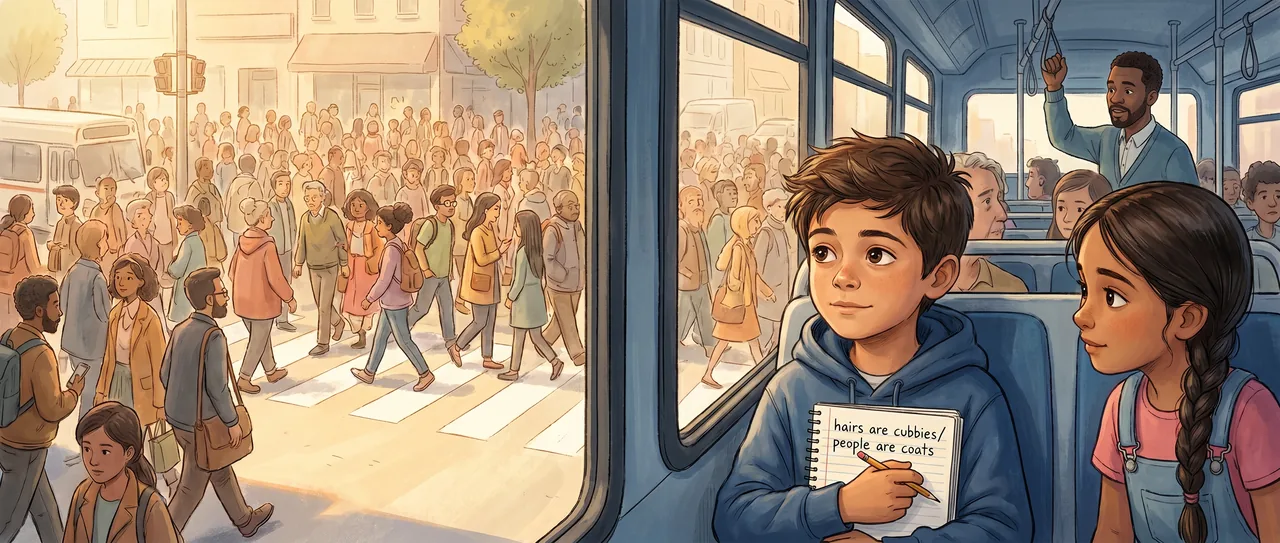
The bus was packed so tight that Soren had to hold his notebook against his chest to keep from dropping it.
Mr. Okafor stood near the front, one hand looped through a strap, counting heads under his breath and losing his place every time the bus braked. He had counted twenty-nine, then thirty-one, then started over. He was the kind of teacher who needed the number to be exactly right before he could relax, and the bus would not let him have it.
"Just count the empty seats and subtract," Soren said.
Mr. Okafor blinked at him like he had suggested cheating. "There are no empty seats."
Soren went back to the window. Outside, the city slid past in its full size, block after block, more buildings than he could hold in his head at once. A woman walked a dog. A man carried two bags of oranges. Thousands of people, and he was only seeing one street of them.
He started counting people on the sidewalk, the way he counted ceiling tiles in the dentist's office. Then he stopped, because the number got too big too fast and there was no point.
That was the thought that stuck. There was no point counting, because there were too many.
The girl next to him, Priya, had her hair in a braid so tight he could see the rows of her scalp between the strands. He thought, without deciding to, about how many hairs were in that braid. A lot. He had read once that a human head holds somewhere around one hundred thousand hairs. Not exactly. Around. Some people more, some fewer, but nobody had a million, and nobody walked around with five.
So every head in the city held a number of hairs between zero and, say, a few hundred thousand.
He got his pencil moving.
The number of possible hair-counts was big, but it was not endless. It stopped somewhere. Maybe one hundred fifty thousand different numbers a head could be. Maybe two hundred thousand to be safe.
And the city had millions of people in it.
Soren sat very still while the bus rattled.
He thought about the cubbies in his old kindergarten room. There had been twenty cubbies and one morning a substitute brought in coats for twenty-two visiting kids and there was nowhere to hang the last two, so two coats had to share. There was no way around it. Twenty-two coats, twenty cubbies. Somebody doubles up. You did not even have to look to know it. You just had to count the coats and count the cubbies.
He wrote: hairs are cubbies. People are coats.
If there were two hundred thousand possible hair-numbers, those were the cubbies. If the city had three million people, those were the coats. Three million coats. Two hundred thousand cubbies.
There was no way around it.
Somewhere in this city, right now, two people had exactly the same number of hairs on their heads. Not about the same. Exactly. The same number, hair for hair.
Not two people. Lots of pairs. With three million people and only two hundred thousand possible counts, you could not even spread them out one to a number. On average more than ten people shared every single count. There were whole crowds of people walking around matched to strangers they would never meet, carrying the identical number on their heads like a name they could not read.
He looked up at the bus.
Forty or so people, crammed shoulder to shoulder. That was not enough. Forty coats, two hundred thousand cubbies, easy to give everyone their own. On this bus probably nobody matched.
But the city. The city did not have a choice.
He pressed the pencil down so hard the lead nearly broke. He did not need to find the two people. He did not need to count a single head. He did not need anyone's permission or any instrument. He knew the matched pairs existed the same way he knew about the coats, by counting two things and noticing one was bigger.
The wonder of it was that he could be certain about millions of people he had never seen, would never see, without checking even one of them.
"Twenty-eight," Mr. Okafor announced, sounding wounded. "No. Hang on." He started again, lips moving.
Soren almost told him. He almost said, you do not have to count us one by one to know things about us. But Mr. Okafor needed the exact number, the real twenty-eight or thirty or thirty-one, and that was a different kind of knowing, the slow kind, the kind that the braking bus kept stealing from him.
Soren had the other kind. The kind you could not lose to a pothole.
The bus stopped at a light. Out the window, the crosswalk filled with people, dozens of them, then a hundred, pouring off both curbs and folding into each other in the middle.
Soren watched the crowd and tried to see it as coats looking for cubbies. Somewhere in that crosswalk, maybe. Almost certainly in the next one. Two strangers passing each other, brushing sleeves, both carrying the same secret number, neither one ever going to know.
He scanned the faces moving past the glass and did not try to pick the pair out. There was no picking them out. That was the whole point and the best part of it.
The light changed. The crowd cleared. A new crowd took its place at the next corner, and he knew the same thing was true of them, and the corner after that, all the way across a city he would never finish counting.
The pencil stayed still in his hand. He let the matched strangers go by, hundreds of them, certain and invisible, and watched the crosswalk fill again.
Read the interactive version, listen to the narration, and earn a gold star →
A science-verified short story for curious kids · Curiosity Land