The House That Floated on Stone
The tire swing was sitting wrong.
Maya noticed it the way she noticed most things, which was all at once and slightly annoyed. "Last week your feet hit the ground when you swung. Now they don't."
"My feet didn't get longer," Soren said.
"No. The ground got higher." She walked a slow circle around the oak. "Or the branch got lower. One of them moved."
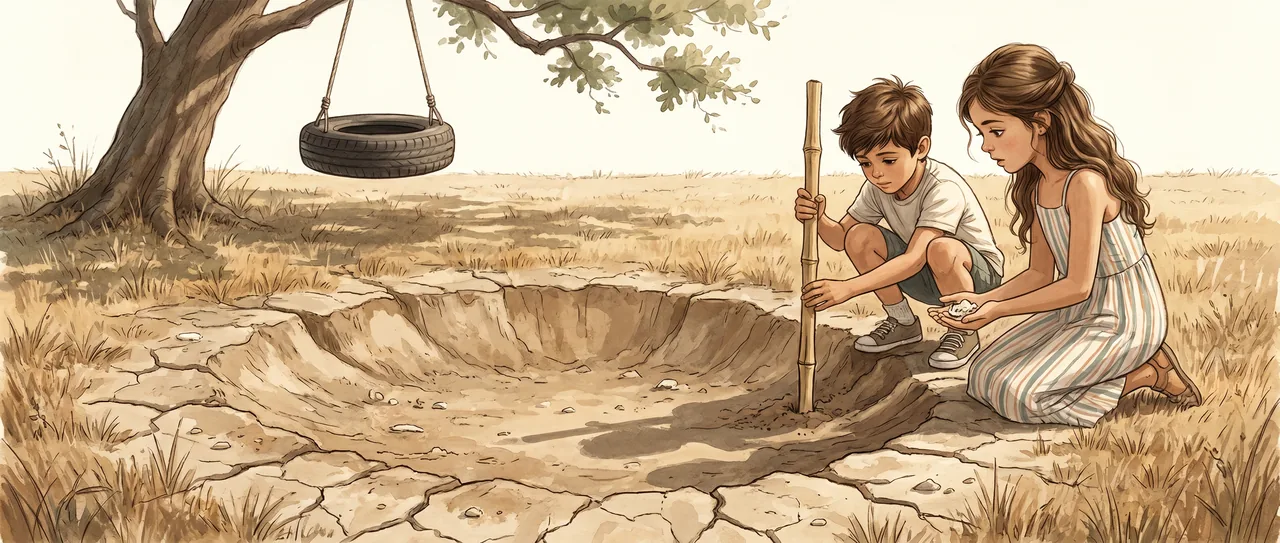
Soren put his hand flat on the grass near the trunk. The lawn had a soft place. Not muddy. The drought had baked everything to a crust two weeks ago and nothing had been muddy since. But here, under the crust, the ground gave a little, like the top of a cake.
"Press here," he said.
Maya pressed. The grass sank a finger's width and stayed sunk.
"That's not water," she said. "There's no water. We haven't had rain."
"That's the part that's wrong," Soren said. He liked finding the part that was wrong. It was usually the door to everything else.
They got down on their knees. There was a dip in the lawn, a shallow bowl about as wide as a kiddie pool, so gentle you wouldn't see it standing up. The oak leaned, just barely, toward the middle of the bowl.
"It's like something's being pulled down," Maya said. "Slowly. From underneath."
Soren's grandfather was on the porch reading the newspaper the way he read everything, which was out loud whether you wanted it or not. "Says here the county's worried about the aquifer," he called. "Pumping too much, water table dropping. Drought." He shook the page. "In my day we just prayed for rain."
"What's an aquifer?" Soren called back.
"Water in the rock," his grandfather said, and turned the page, satisfied that he had answered the question.
Maya looked at Soren. "Water in the rock."
"Rock doesn't hold water," Soren said. "Rock's solid."
"Some rock isn't." Maya was already digging at the soft spot with her fingers, peeling back the crust. Under the brown grass the soil was sandy, pale, and when she pushed her hand in it kept going easier than dirt should.
Soren went and got a length of bamboo from the garden, the kind his grandfather used for tomato plants. He pushed it into the soft center of the bowl. It slid in a foot. Two feet. Then it stopped, knocked against something, and when he wiggled it the something felt hollow underneath, the way a wall sounds hollow when you knock between the studs.
"There's a space," he said. "Down there. The bamboo hit a roof and the roof has nothing under it."
Maya sat back on her heels. "Okay. So the rock holds water. And the water leaves. And then the rock is holding a hole."
"Why would the water leaving make a hole?" Soren asked. "Water leaving a sponge doesn't make a hole. The sponge just stays a sponge."
That stopped her. She picked up a chip of pale stone that had come up with the sand and turned it over. It was soft, chalky, full of tiny shells, the smallest shells she had ever seen, hundreds of them pressed together.
"These are shells," she said. "This whole rock is shells."
"From the ocean," Soren said slowly. "This was the ocean."
"And rain's a little bit sour. Acid. Mr. Patel said so, the carbon thing." Maya was talking fast now, short. "Sour water sits in the shell rock. For a long time. And it eats it."
"Eats it," Soren repeated. He scratched the chalky stone with his thumbnail and it powdered. "Water doesn't eat sand. But this isn't sand. This dissolves."
He looked at the bamboo standing up in the lawn. Then he looked at the house. Then he looked at the whole street, the flat green yards, the driveways, the row of roofs going down toward the road.
"Maya," he said. "How long has the water been sitting in this rock?"
"Forever," she said. "Longer than forever. Since it was the ocean."
"Then it's not one hole."
They both went quiet, "It's everywhere," Maya said. "The water's been eating the rock everywhere. Under the whole yard. Under the road. Under the school." She stood up. "The houses aren't sitting on ground. They're sitting on a roof. The roof of a cave. A bunch of caves, all eaten out, all touching."
Soren stood up too. He felt it before he could say it, the strange new bigness of the place he had lived his whole life. He had always thought the ground was the bottom of things. The ground was where you stopped. You couldn't fall through the ground.
But the ground was a crust. The ground was the top of a cake, and the cake had been hollowed out underneath by water so patient it had started before there were people to stand on top of it.
"The water that's leaving," Soren said, working it out loud, one step at a time. "It was holding the roof up. Pushing up on it. Like the water in a full bottle holds the sides out."
"And now it's draining," Maya said. "The drought. Grandpa's aquifer. The water's going down."
"And the roof has nothing pushing up on it anymore." Soren looked at the gentle bowl in the lawn, the leaning oak, the bamboo that had found the hollow. "So it sags. First it sags."
Neither of them said the next word. They didn't have to. The bowl in the grass said it. The whole flat green neighborhood said it, every quiet lawn the soft top of a held breath.
"We should tell someone," Maya said. "A grown-up who measures things. Not Grandpa. Someone with the right kind of pole."
"Yeah," Soren said. But he didn't move yet.
He crouched and put his ear close to the bamboo, the way you put a shell to your ear, half expecting the ocean.
From somewhere under the lawn, under the street, under the whole bright pretend-solid world, there came a small dry sound of sand running down into a place that had been waiting in the dark a very long time to receive it.
Read the interactive version, listen to the narration, and earn a gold star →
A science-verified short story for curious kids · Curiosity Land