The Triangle That Wouldn't Add Up
The lake had frozen flat enough to argue on.
"A triangle is one hundred eighty degrees," Soren said. "Always. That's not a guess, that's the rule. Mr. Adeyemi made us prove it."
"On paper," Maya said. She was already walking, dragging the long roll of orange surveyor's tape her dad used for fence lines. "Paper's small. The lake isn't."
"Geometry doesn't care how big the paper is."
"That's what I want to find out."
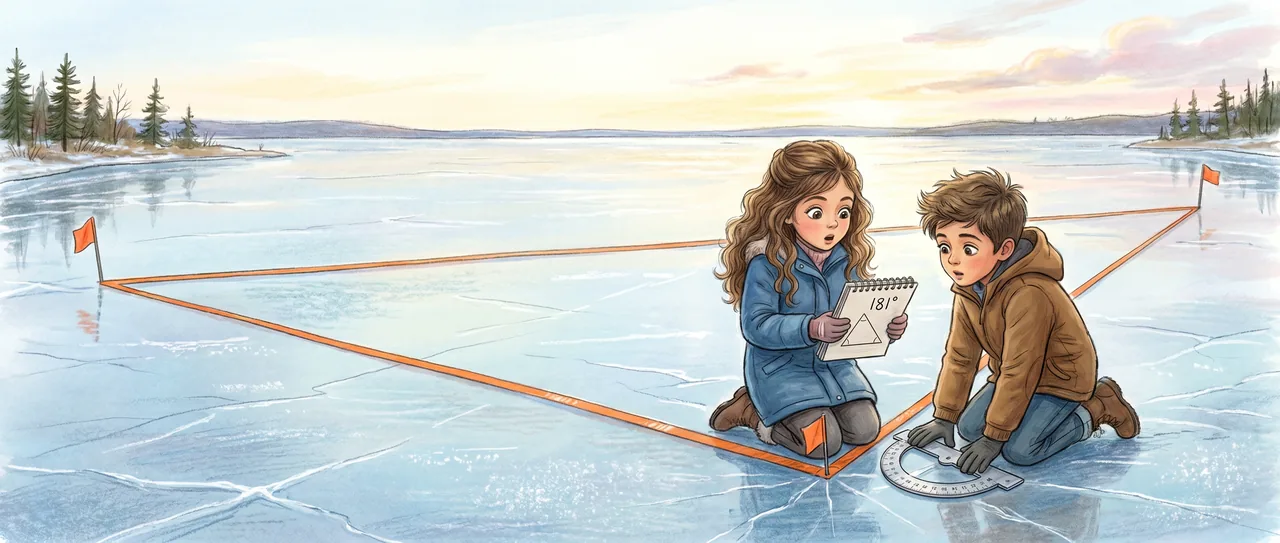
They had three things: the tape, a cheap protractor with a bubble level glued to it, and a fishing compass that pointed wherever it felt like near the metal flags. They planted the first flag where they stood. Maya picked a far tree on the north shore and walked toward it, straight as she could, counting paces, the tape unspooling behind her in a long bright line on the ice.
Four hundred paces. Flag two.
She turned ninety degrees, checked it twice with the protractor, and walked again. Soren stayed at flag one to keep her honest, calling left or right when she drifted.
"You're curving!"
"I am not. I'm following the bubble."
"The bubble's for level, not for straight."
"It's the straightest thing we've got."
Four hundred more paces. Flag three. Now they had two sides meeting at a careful right angle, and the only thing left to measure was the angle back at the start, the corner that would close the triangle.
Soren walked the third side himself, because Maya said he wouldn't believe her numbers unless his own feet made them. He laid the tape back toward flag one and knelt at the corner with the protractor flat against the ice.
He was quiet for a while. He measured it three times. Then he took out the notebook and pressed it open against his knee, and the pencil moved, and he stopped.
"What," Maya said.
"The corners," Soren said. "Add them up."
She crouched next to him. Ninety at flag two. Ninety at flag three. And here, at flag one, the protractor read a hair past ninety. Not a lot. A degree, maybe two.
"That's a hundred eighty-one," Maya said. "Maybe a hundred eighty-two."
"It's measurement error," Soren said, but he said it the way you say a thing to test whether it'll hold weight. "The protractor's cheap. My pacing's bad. The ice tilts."
"Measure it again."
He did. Past ninety. He walked back to flag two and remeasured that corner too, on his hands and knees, breath fogging the ice. Ninety, clean. He came back. Still past ninety here.
"It keeps being too much," he said. "Every corner is either right or a little too big. Never too small. Error should go both ways. This only goes one way."
Maya stood up and looked at the orange lines lying across the lake. Three bright sides. A triangle as wide as a soccer field. She looked at the far tree she'd aimed for, and the shore curving away past it, and she said nothing for a moment, and then she said it.
"The lake isn't flat."
"It's frozen. It's the flattest thing in the county."
"It's the flattest thing on a ball." She held her two hands out, fingers spread, and pressed the heels together to make a curve. "The Earth's a ball. The lake's a tiny piece of the ball's skin. It looks flat because we're ants on it. But it isn't. It bulges. Just a little. Just enough to push the corners out."
Soren stared at his own three numbers.
"Walk it on a real ball," Maya said, fast now, hands moving. "Walk from the top. Go down to the middle. Turn ninety, walk along the middle. Turn ninety, walk back up to the top. Three corners. Every one of them ninety. That's two hundred seventy degrees in one triangle. On a ball, triangles are fat. They have to be."
"And on something that curves the other way," Soren said slowly, "a saddle, a chip shape, they'd be thin. Less than a hundred eighty."
"So the rule isn't the rule."
"No." He looked at the notebook, at the proof Mr. Adeyemi had made them write, the one that ended with one hundred eighty, perfect and closed. "The rule is what flat does. It's not what space does. It's what flat does."
They stood on the lake with that.
"People thought parallel lines could never meet," Soren said. "Ever. It was supposed to be impossible. Lines that start parallel stay parallel forever, that's the whole idea of parallel."
"Two people walking north," Maya said. "Both going straight. Never turning." She started walking, slow, and Soren walked beside her, the same direction, a flag's width apart. "Straight north. Straight north. Both perfectly straight."
"And we'd both reach the North Pole," Soren said. "Same point. Two straight lines that never turned, meeting."
They kept walking, side by side, and the gap between them stayed exactly the same on the ice, and the whole time Maya was watching the place far ahead where two straight people would have to collide on a planet that was round.
"There's a kind of math for this," she said. "There has to be. Where the parallel rule is different."
"There is," Soren said. "Has to be. Somebody worked it out. You could write all of geometry for a ball, or for a saddle, and none of it would match the paper kind, and all of it would be true. Just true somewhere else."
Maya stopped walking.
"Soren. If space itself is curved. Not the lake. Space. The actual nothing between the stars."
He stopped too.
"Then light goes straight," he said, "and still bends. Because straight bends, if the thing it's going through is curved." He looked up. The sky was getting pale and enormous over the frozen lake. "You'd never feel it. You'd think you were going straight the whole time."
Neither of them said anything.
The orange triangle lay on the ice below them, all three corners measured, adding up to a number that was not allowed, and over their heads the sky went on being curved in a way no protractor on Earth was big enough to catch.
Maya picked up the loose end of the tape and started winding it slowly back toward the first flag, and the long bright line came up off the ice behind her, curving as it came.
Read the interactive version, listen to the narration, and earn a gold star →
A science-verified short story for curious kids · Curiosity Land