The Small One in the Back
Maya fell on the backward crossover seventeen times.
Not painful falls. The good kind, where you skid and laugh and your hands sting cold from the rink floor. But seventeen. She counted, because counting was something to do while her legs refused to cross the way the older skaters' legs crossed, smooth as scissors, without looking.
That was the part that itched at her. Without looking.
The girl who taught Tuesday lessons, a college student named Priya who skated like the floor owed her a favor, kept saying the same thing. Stop thinking about it. Just feel where your feet are.
Maya hated that advice. You could not feel where your feet were. You could only see where your feet were, and right now they were tangled.
She sat on the bench and pressed her thumbs against the laces and tried something. She closed her eyes. She lifted her right skate off the floor and held it in the air.
Where was it?
She pointed at the spot with her other hand, eyes still shut. Then she opened them. Her finger was aimed exactly at the toe of her skate, hanging there in the air where she could not see it.
She did it again. Left skate. Eyes closed. Point. Open.
Dead on.
Nobody had told her foot where it was. Her eyes were shut. So something inside her had been keeping track the whole time, quietly, the way you keep your tongue from getting bitten when you chew.
Priya skated past, braking in a spray. You okay?
Maya did not answer the question. She asked her own. How do you know where your feet are when you're not looking?
Priya laughed. You just do. Your brain knows.
Which part, Maya said.
Priya shrugged the shrug of someone who skates beautifully and has never once wondered how. The thinking part, I guess. The brain.
But Maya had heard her mom, who taught anatomy at the college, talk about the brain. The thinking part was the wrinkly gray cap on top, the cortex, the part everybody drew when they drew a brain. And Maya was almost certain the cortex was not the part keeping her foot located in the dark. Because she had not thought about her foot. She had pointed before she thought. The pointing came first.
She got back on the floor.
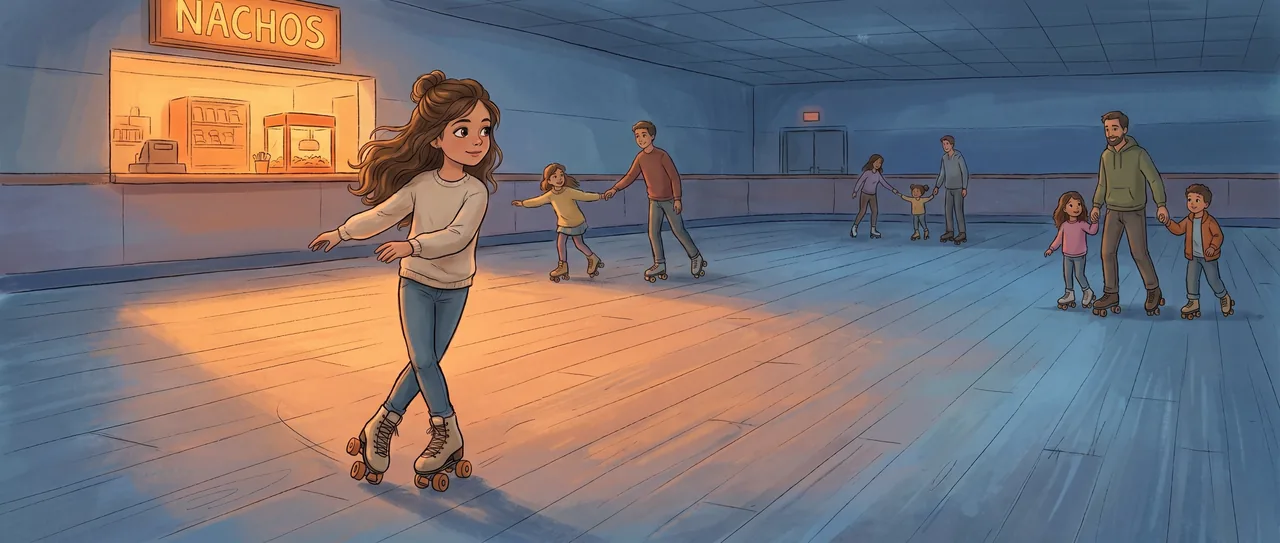
This time she did not watch her feet. She let her eyes go soft and aimed them across the rink at the snack bar, at the cloudy orange of the nacho light, and she let the rest of her body do the crossover blind.
Her left skate lifted, swung, crossed in front of her right, and landed.
It worked. It had never worked when she watched.
She stopped so fast she nearly sat down. The crossover had happened underneath her attention, like a word arriving in your mouth before you decide to say it.
That night she found her mom grading at the kitchen table, the lamp making a yellow island in the dark room.
Mom. When I skate without looking I skate better. Why would not looking make me better.
Her mom capped her pen. Because you got out of your own way. The cortex is slow. Deliberate. It narrates. The part that actually runs the movement is faster than narration.
Which part.
Her mom reached for the scratch paper and drew a brain in three seconds, the wrinkled cap, and then, tucked underneath at the back, a smaller knot, tight and folded like a fist wearing a sweater.
This, she said. The cerebellum. The little brain. Sits in the back, underneath everything, minds its own business.
Maya looked at how small it was. That tiny thing keeps track of my feet?
Her mom smiled the smile she made right before something good. Here is the part that gets me every time, she said. Count up all the neurons in the whole rest of the brain. The cortex, everything. The famous part. Then count the neurons in just that little knot in the back.
Maya waited.
The little one wins. The cerebellum has more neurons than all the rest of the brain put together. More than half of every neuron you own is folded into that small thing in the back you never think about.
Maya sat down across from her. The lamp buzzed.
More than half, she said.
More than half. And it is so densely packed nobody even noticed for the longest time. They thought it just did movement. Balance. Where your feet are.
But, Maya said, and stopped, because there was a but and she could feel it before she could say it.
Her mom waited. This was the thing Maya loved about her mom. She waited.
But if it has more neurons than everything else, Maya said slowly, it can't only be doing feet. That's too many neurons for feet.
Her mom set the pen down all the way.
That, she said, is exactly what the new research is finding. The little brain in the back is not just movement. It shows up in language. In emotion. In thinking itself. Things we always gave the cortex credit for. The fancy wrinkled part got the credit. The small one in the back was doing the work the whole time and nobody looked.
Maya stared at the three-second drawing. The wrinkled cap that everybody draws. And underneath, the little folded fist, more crowded with neurons than the entire rest of her head, sitting where she could not see it, keeping track.
The crossover, she thought. The word before you say it. The foot in the dark.
Does it ever tell you what it's doing, Maya asked. The little one.
No, her mom said. That's the strange part. You almost never feel it. It works best when you leave it alone.
Maya thought about the snack bar light, the soft eyes, the skate crossing on its own. The whole time she had been failing she had been the cortex, watching, narrating, getting in the way. The skating had been waiting for her to stop.
She picked up the scratch paper and held it under the lamp and looked at the small folded knot her mom had drawn at the back of the head, the part you never picture, the part with more of you in it than all the rest.
Then she closed her eyes, lifted her hand, and pointed at her own foot under the table.
When she opened her eyes, her finger was already there.
Read the interactive version, listen to the narration, and earn a gold star →
A science-verified short story for curious kids · Curiosity Land