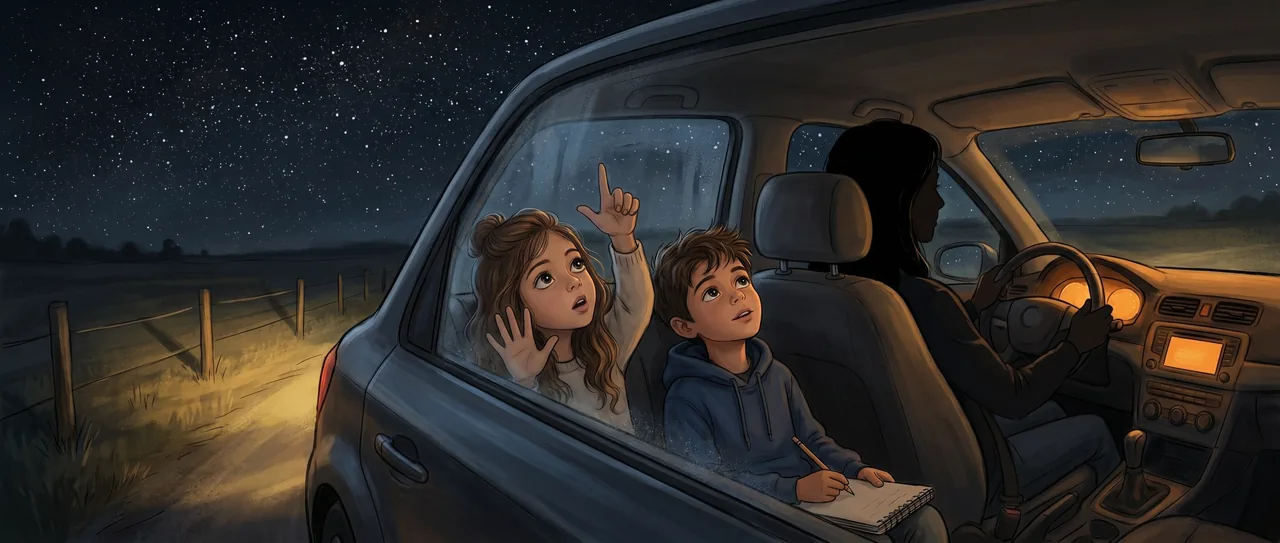
The One That Didn't Light
The radio crackled because they were too far from town for it to behave.
"Turn it up," Maya said.
Maya's mother turned it up without taking her eyes off the dark road. The headlights pulled the fence posts past, one, then the next, then the next.
The woman on the radio was an astronomer, and she was saying a thing that made Soren sit forward against his seatbelt.
"We found one only forty light-years away," the astronomer said. "A brown dwarf. People call them failed stars."
"Failed how?" Soren said, to the radio, which could not hear him.
"Failed how?" the interviewer asked, half a second later.
Maya elbowed him in the dark. He elbowed back.
"A star is a star because it crushes hydrogen in its core," the astronomer said. "That crushing is what makes the light. But you need enough weight pressing down to start it. About eighty times the mass of Jupiter. Below that line, gravity squeezes, and squeezes, and it is just not quite enough. The fire never catches."
"So it stays dark," Maya said.
"So it stays dark," the interviewer said, again half a second behind her, and Maya made a small satisfied noise.
"You keep doing that," Soren said.
"It's an easy interviewer."
"Mostly dark," the astronomer corrected, on the radio. "They glow a little. Leftover heat from forming. A deep dim red, fading over billions of years. You couldn't see it with your eyes. But it's warm. It's still cooling down from trying."
The car went over a cattle grid and everything rattled.
"Wait," Soren said. He got his notebook out of his jacket and held it against his knee, though there was no light to write by. "So it's not a planet."
"Too big to be a planet," Maya said.
"And not a star."
"Too small to be a star."
"So what is it."
They looked at each other, two pale shapes in the back of a dark car, and neither of them had a word for it, and the not-having was the best part.
"It's the in-between thing," Maya said finally.
"That's not a category."
"It is now. The radio just said it exists. Forty light-years. That's the category."
On the radio the interviewer asked the question Soren was already opening his mouth to ask.
"Can something like that have planets?"
Maya grabbed the front seat. "Yes," she said. "Say yes."
"Yes," the astronomer said.
Soren laughed out loud, one surprised bark, and Maya's mother glanced in the mirror.
"We've seen disks around them," the astronomer went on. "The same rings of dust and rock that build planets around real stars. Some brown dwarfs have their own little worlds, going around and around, warmed by a sun that never managed to switch on."
Nobody in the car said anything for a moment. The fence posts kept coming.
"Think about it," Maya said, quietly now, which was rare. "You're a planet. You go around your sun. And your sun is dark."
"Not all the way dark," Soren said. "She said dim red."
"Dim red. So your whole sky, your whole day, is this dim red thing that's barely there." Maya pressed her hand flat against the cold window. "And it never gets brighter. It only ever gets a tiny bit dimmer. Forever."
Soren was working it out in the notebook by feel, his pencil making shapes he wouldn't be able to read tomorrow. "That's not sad," he said.
"I didn't say it was sad."
"You sounded like it was sad."
"I sounded like it was big," Maya said.
The road bent. The headlights swung across a field and for a second lit up the eyes of something standing out there, an animal, watching them pass, and then the dark took it back.
"Here's the thing I can't fit," Soren said. "It tried to be a star. It had everything. It had the hydrogen. It got squeezed for millions of years. And it just missed. By a little."
"By a little," Maya repeated.
"And it didn't disappear. It didn't turn into nothing because it failed. It just became a different thing. A whole other kind of thing with its own planets and its own sky." His pencil stopped. "Forty light-years away there's a thing that didn't light up, and it's still out there being its whole self about it."
Maya turned to look at him in the dark. She couldn't see his face. She didn't need to.
"Mom," Maya said. "How many of them are there? Did she say?"
"Listen," her mother said. "She's about to."
The astronomer's voice came up through the static. "That's what unsettles me, in the best way," she said. "We think there might be as many brown dwarfs as there are stars. Maybe more. Which means half the things out there, or more than half, are these in-between objects we almost never noticed. We spent all of history counting the ones that lit up. We weren't counting the dark ones at all."
"More than half," Maya whispered.
"The sky's mostly the in-between thing," Soren said. "We just couldn't see it."
Maya leaned her head back against the seat and looked up through the window. Out here, away from town, the real stars were thick and close, a smear of them from edge to edge, more than she'd ever bothered to count.
"So all of that," she said, pointing up at the bright ones. "That's not even most of it."
"That's the part that caught," Soren said.
"And in between all of those bright ones."
"Are the ones that almost did."
The radio had moved on to something else. Maya's mother turned it down.
The car kept driving them home under a sky the two of them were now seeing wrong, or for the first time right, every dark gap between the stars suddenly full, suddenly crowded, suddenly the place where most of everything was quietly being warm and red and almost.
Soren closed his notebook on a page he hadn't been able to see. Out the window the dark went on, holding more than it showed, all the way to the edge.
Read the interactive version, listen to the narration, and earn a gold star →
A science-verified short story for curious kids · Curiosity Land