The Long Listening
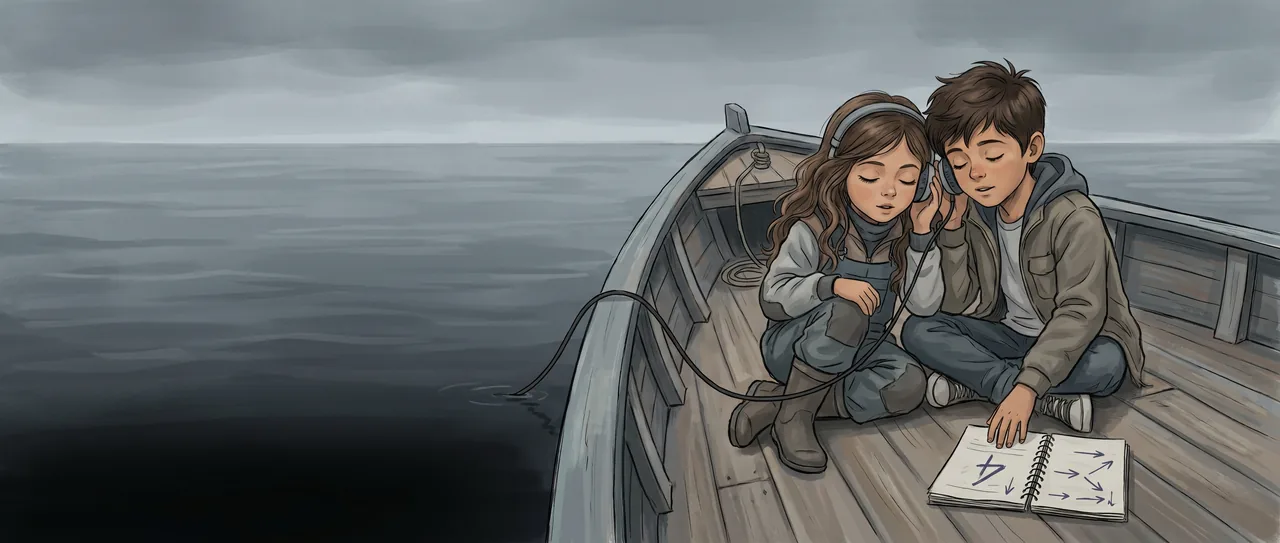
The headphones smelled like rubber and salt. Maya had one cup pressed to her ear. Soren had the other.
"Anything?" she asked.
"Hiss," said Soren. "The boat. My own heartbeat, I think."
The scientists had gone below to eat. They had left the hydrophone dangling on its cable, a black microphone sinking somewhere into water so deep the color stopped being blue and started being nothing. One of them, Dr. Okafor, had said the whales were probably too far away today. She had said it the way grown-ups say a thing to end a conversation.
Then a sound came up the cable.
It was not loud. It was low. So low that Maya felt it in the bone behind her ear before she heard it, a long moan that started under everything and slid downward like a floor tilting.
"You heard that," she said. It was not a question.
"I felt it," said Soren. He had grabbed his notebook off the bench. His pen stopped over the page. "That was way too clear. Dr. Okafor said they were far."
"Maybe she's wrong."
"Maybe." He wrote the time down anyway. "Or maybe far doesn't mean the same thing down there."
Maya took the headphone fully now, both cups, eyes shut. The moan came again. And under it, faint, a second one, lower and slower, like an echo that had taken a different road.
"There's two," she said. "No. The same one, twice."
"That doesn't make sense."
"I know. Write it down."
Soren wrote it down. Then he did the thing he did when something would not sit right, which was to start at the part he was sure of.
"Sound is just stuff bumping into stuff," he said. "In air the molecules are far apart. So the bump takes a while to pass along. In water they're packed tight. So it passes faster. Like, a lot faster. Four times, around."
"Four times." Maya opened her eyes. "So a whale yelling underwater is yelling four times faster than us."
"Farther, too. The sound doesn't fade out as quick." He tapped the cable with one finger, as if he could feel the deep through it. "But that still doesn't explain why we hear it like it's next to us."
Maya looked over the rail at the flat gray water. She was trying to picture down. Not across. Down.
"It got colder as we came out here," she said slowly. "The water. Remember? They had that gauge."
"Colder going down too. Then it stops getting colder, way down, and just stays."
"And the pressure keeps going up the whole way." Maya held her two hands apart, then started bringing them together, then stopped, then frowned, then pulled them apart again. "Wait. Which one makes sound go faster. Cold or pressure?"
"Pressure makes it faster. Cold makes it slower." Soren said it carefully, the way you set down something breakable. "So going down, first the cold wins, and the sound slows down. Then deeper, the cold stops changing but the pressure keeps climbing, and the pressure wins, and the sound speeds back up."
They looked at each other.
"So there's a slow part," Maya said. "In the middle."
"A slowest part." Soren's pen was moving fast now. "Where it's slowest before it speeds up again. A layer."
Maya stood up so quickly the headphone cable pulled taut. "Soren. What does light do when it tries to leave water and hits air?"
"It bends. Back. That's why the pool looks shallow."
"What does sound do when it tries to leave the slow layer and hits the fast water?"
Soren stopped writing.
"It bends back," he said. "Both ways. If it goes up, it bends down. If it goes down, it bends up."
"So it can't leave." Maya was almost whispering, which for her meant she had stopped checking whether anyone was listening. "It's trapped in the slow part. It just keeps bending back into the middle."
"A channel," said Soren. "A pipe made of nothing but the speed of the water. And the sound runs along it."
The moan came up the cable again. Maya pressed the cup to her ear and held the other out so Soren could lean in, their two heads close over the one small speaker.
Low. Long. And then, a slow breath later, the second one. Lower. Slower.
"Same whale," Maya said. "I was right. The sound left going two different angles. They both got bent into the channel. One took a straighter road. One bounced more. So one's a little behind."
"From how far?"
Maya did not answer for a moment. Soren watched her doing the thing where her eyes went to the rail, to the gray, to the place where the water became nothing.
"Dr. Okafor said they were far," Maya said. "She meant too far to hear. But the channel doesn't let go. It barely lets the sound leak out at all." She turned to him. "How far could it carry. If it almost doesn't fade."
Soren looked at his own number on the page, the four, the speed, the long slow leak of a sound that refused to spread out and die. He felt the size of the answer arrive before he could write it.
"Across the ocean," he said. "A whale on one side. Heard on the other side. Thousands of kilometers."
The two of them sat very still with one headphone between them.
"So when we hear it next to us," Maya said, "it isn't next to us."
"It could be anywhere along the whole channel." Soren put his pen down. "We can't tell. That's the thing. The channel carried it so well we lost the distance. It sounds close because it didn't get weaker. We have no idea where it actually is." Below deck a chair scraped. Dr. Okafor was coming back up. Maya did not move toward the stairs.
The moan came up the cable one more time, low under everything, and they both leaned down to the one speaker, listening for the second one to follow.
Read the interactive version, listen to the narration, and earn a gold star →
A science-verified short story for curious kids · Curiosity Land