The Bird That Wouldn't Be Lost
The compass needle would not hold still. It swung, settled, then drifted left as if it had changed its mind.
"Yours is broken," Maya said.
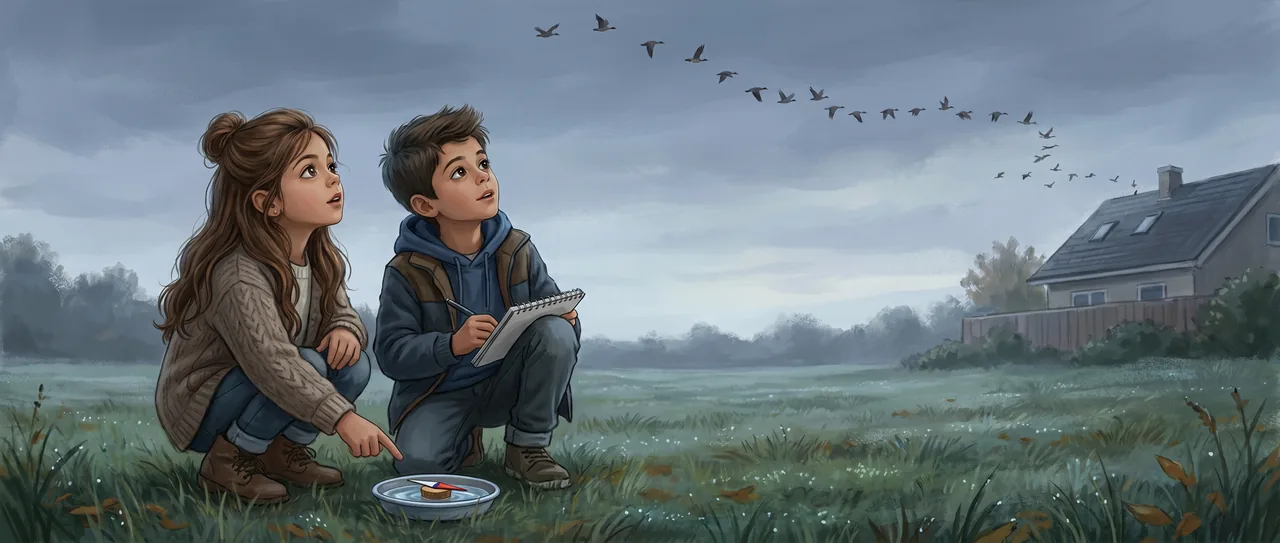
"It's not broken," Soren said. "It's near the fridge magnet on the windowsill. Watch." He carried the little dish of water and the floating needle out into the yard, away from the house, and set it on the cold grass. The needle swung once and pointed steady.
"North," he said.
"How does it know?"
"The whole Earth is a magnet. The needle lines up with it." He crouched, satisfied, the way he got when a thing finally behaved.
Maya was not looking at the needle. She was looking up. A loose ribbon of small birds was crossing the gray sky, all of them going the same way, none of them stopping.
"Where are they going?"
"South. They do it every fall."
"In the dark, though. They started before the sun." She watched the ribbon thin and vanish over the neighbor's roof. "How do they know which way is south at night, with no needle, no fridge, no anything?"
Soren opened his mouth to say stars, then closed it. "Some of them fly on cloudy nights. No stars."
"So." Maya pointed at his floating needle. "They have one of those. Inside."
"A compass needle? In a bird?"
"Not a needle. Something. They feel it." "They feel which way is north the way you feel which way is down."
Soren picked up the needle dish and tilted it. The needle held its direction even as the water sloshed. "Okay. But a needle is iron. It's heavy. It swings. If a bird had iron in it, you could feel the bird trying to turn." He thought about that. "Birds don't get yanked around when they turn their heads."
"So it's not a needle."
"Then it's nothing like my compass," he said, and that bothered him, because the birds clearly had a north and his compass clearly had a north and two true things ought to fit together.
Maya was quiet, watching the place in the sky where the birds had been. "What if they don't feel it. What if they see it."
"See magnetism."
"You can't see the wind either," she said. "But you see the grass move. What if north makes a... a smudge. A shape in the light. And they just fly toward the smudge."
Soren laughed, but it was the laugh he did when something was too strange to dismiss. He got out his notebook. His pencil drew an eye, then stopped over the page.
"That's a real guess," he said. "That's testable. If it's in their eyes, then they'd need light to do it. A bird in a totally dark box couldn't point south."
"Is that true?"
"I don't know. I'm guessing." He committed to it anyway, which was the only way he knew how to guess. "And if it's in their eyes, then north isn't a feeling for them. It's a sight. Like a stain on everything they look at."
They both looked at the floating needle, then up at the empty sky, then at each other.
"That's so much weirder than a needle," Maya said, delighted.
Later, inside, Soren's aunt was at the kitchen table grading papers, a teacher who taught chemistry and was tired of being asked things on a Saturday. They asked anyway.
"Birds and magnets," she said, not looking up. "There's a protein. In their eyes. Cryptochrome." She wrote it on the corner of a worksheet and slid it across without slowing her red pen. "Light hits it, knocks an electron loose, makes a pair. The pair is sensitive to the magnetic field. That part is genuinely strange and I am genuinely busy."
"Strange how?" Maya said.
The red pen stopped. "Quantum strange. The two electrons stay connected even when they're apart. The angle of the Earth's field tips the odds of which way the chemistry goes. So the protein responds differently depending on which direction the bird is facing." She looked at them for the first time. "Nobody's fully sure how a tiny smear of chemistry holds itself together long enough in a warm wet eyeball to do that. That's an open question. People are still arguing about it." She went back to grading. "Now go be amazed outside."
On the back step, Soren had the notebook open and was not writing in it. He was holding it the way you hold something you forgot you were holding.
"It's in their eyes," he said slowly. "So when a warbler looks at the sky, it isn't just gray clouds. There's a pattern laid over it. Brighter or darker depending on which way is north."
"A picture of the direction," Maya said. "Painted on the air." She turned her head left, then right, the way the bird would. "And it changes when they turn. So they turn until the picture looks right, and that's south."
"And nobody really knows how the chemistry survives long enough to make the picture." Soren said it carefully, the way you set down something that might still be alive. "That's not a fact yet. That's a hole."
"A hole the bird flew through anyway," Maya said. "This morning. Over your roof."
They sat with that. The strange part was not that the birds had something they didn't. The strange part was that the birds were doing something with their eyes that the smartest grown-ups on Earth could not yet fully explain, and had been doing it, every autumn, for longer than there had been anyone to be confused by it.
"I keep trying to imagine it," Soren said. "Looking at the sky and seeing which way to go."
"You can't imagine it," Maya said, not unkindly. "That's the point. We don't have the eye for it."
The floating needle was still on the grass where they'd left it, holding north in its dish of water, a clumsy heavy thing that only knew one trick.
Above it, a second ribbon of birds came over the fence, all of them tilted the same way, sliding down a slope in the air that Maya and Soren could not see, and the birds turned together, and were gone.
Read the interactive version, listen to the narration, and earn a gold star →
A science-verified short story for curious kids · Curiosity Land