The Word in the Apple
The thing growing in the compost was not a tomato.
Soren's grandmother had said it was a tomato, because everything that came up in the compost was a tomato. But the leaves were wrong. Too narrow. Too waxy. Maya had pulled one between her fingers and frowned the way she frowned when a thing did not fit.
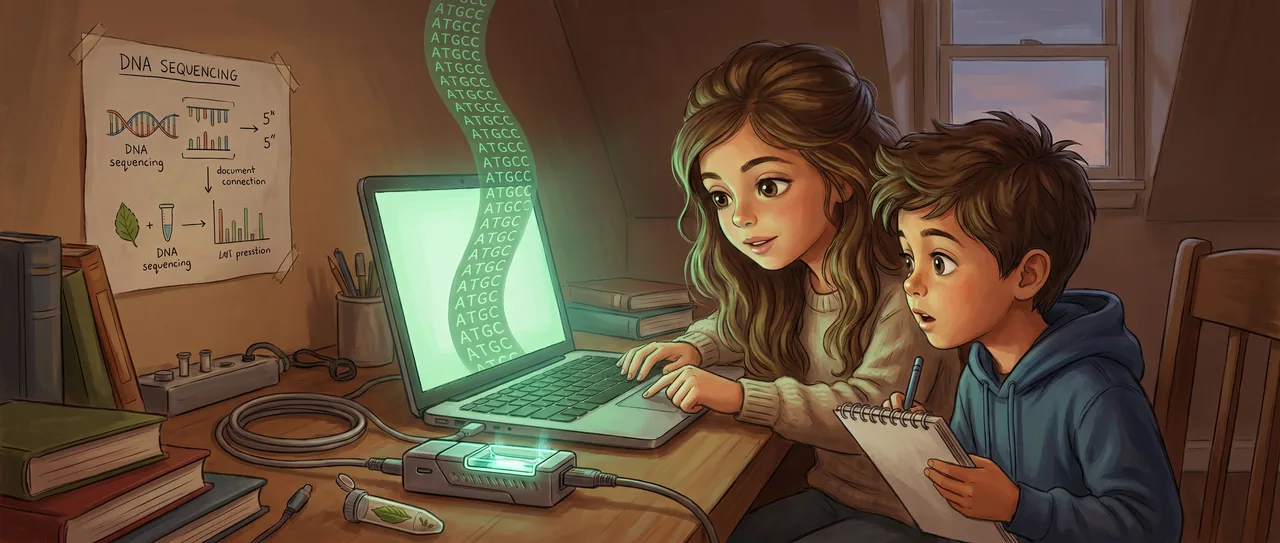
So now there was a leaf in a tube, and the tube was in a machine the size of a candy bar, and the machine was plugged into Soren's laptop with a cable that cost more than the laptop.
"It's reading," Soren said.
"It's not doing anything."
"It's reading." He pointed at the screen, where a line of green light trembled along, flat and then dipping, flat and then jumping. "That's current. There's salt water in there, and a tiny hole, and the current flows through the hole. When a piece of DNA goes through, it plugs the hole. A little."
Maya leaned in until her nose nearly touched the screen. "And the line moves."
"The line moves."
The line moved. It was the least dramatic thing either of them had ever stared at this hard.
"How small is the hole," Maya said. It was not really a question. It was the first item on her list.
Soren checked the page he had printed and taped to the wall. "One molecule. The hole is a protein. They borrowed it from a bacterium. The DNA strand goes through it one piece at a time, single file, like thread through a needle."
"One piece. You mean one letter."
"One base. A, T, G, or C." He tapped each letter on the printout. "Every one is a different shape. A different size. So every one blocks the hole a different amount. So the current dips a different amount."
Maya went quiet. This was the quiet that meant something was arriving.
"Soren," she said. "It's not counting them."
"What?"
"The machine. It's not looking at the letters. It can't see the letters. There are no letters in there." She straightened up. "It's listening to how much they get in the way."
Soren opened his mouth to correct her and then did not, because she was right, and the rightness of it was crawling up the back of his neck.
"It's measuring the shadow," he said slowly. "Not the thing. The shadow the thing makes in the current."
"And from the shadow it knows the letter."
They both looked at the green line, which was no longer the least dramatic thing they had ever seen.
The screen filled, slowly, with letters. Not pictures of molecules. Not photographs of the leaf. Just letters, scrolling, faster now, a long unspooling ribbon of A and T and G and C, thousands of them, then tens of thousands, each one a guess about how deep a single dip had been.
GAATTCCGGATCGATCGTAGCTAGGGCAT
"That's the leaf," Maya said. "That's what the leaf is made of saying itself."
"That's part of one cell of one leaf."
"Saying itself." She put her finger on the moving text and the text moved out from under it. " "
"Different order." Maya said it like she was tasting it. "That's the only difference between a worm and a person. The order of the letters."
Soren had read this. He had read it three times. He had not understood it until exactly now, watching it scroll, watching the machine pull a single thread out of the soft green leaf and listen to it pass through a hole the width of one molecule and turn the listening into words.
He reached for his notebook. His hand found the page and he wrote, fast, the green light reflecting off the paper.
"Okay," Maya said. "So what is it."
"What's what?"
"The plant. We can read it. So read it. What does it say it is."
That part was less magic and more work. Soren copied the long ribbon of letters into the program that compared it against every sequence anyone had ever uploaded, a library of millions of living things, each one having said itself into some other machine in some other room.
The program thought. A little wheel turned.
Apple, it said. Malus domestica. A match, ninety-nine point six percent.
Maya sat back. "An apple tree."
"In the compost." Soren laughed. "She threw an apple core in there. Somebody ate an apple and threw the core in, and a seed grew, and we just read the whole thing out of one leaf to find out."
"Not the whole thing."
"Enough of it."
Maya was already somewhere else. He could tell because she had stopped looking at the screen and started looking at the window, at the garden, at the dark square of compost out there in the dusk.
"Soren. Every apple seed is different. That's why you can't grow a good apple from a seed. The seed is a mix. It's a new thing nobody's tasted."
"That's true," Soren said carefully. "That's actually true. The tree out there isn't the apple somebody ate. It's its child. New order of letters. Never existed before."
"Never existed before," Maya repeated. "And we just read the first sentence of it."
They looked at the little machine. Inside it the salt water glowed faintly, the current still running, the protein hole still open, still waiting, ready to pull more thread through itself one molecule at a time and turn it into something a person could read.
"We could read anything," Maya said. Her voice had gone low. "The dirt. A drop of pond water. Everything that ever lived left this behind. The letters don't rot. The order's still in there."
Soren wrote one more line. Then he stopped, because the next thought was too big to fit on the page, and he knew it, and he let it stay unwritten.
"The pond's still warm," he said. "From today."
Maya was already pulling on her shoes.
They went out into the garden with a clean tube and a flashlight, past the apple seedling that had never existed before, down toward the black shine of the pond where a thousand things too small to see were busy spelling themselves out in an alphabet four letters long, and not one of them knew it could be read.
Read the interactive version, listen to the narration, and earn a gold star →
A science-verified short story for curious kids · Curiosity Land