The Line That Only Goes Back Through Mothers
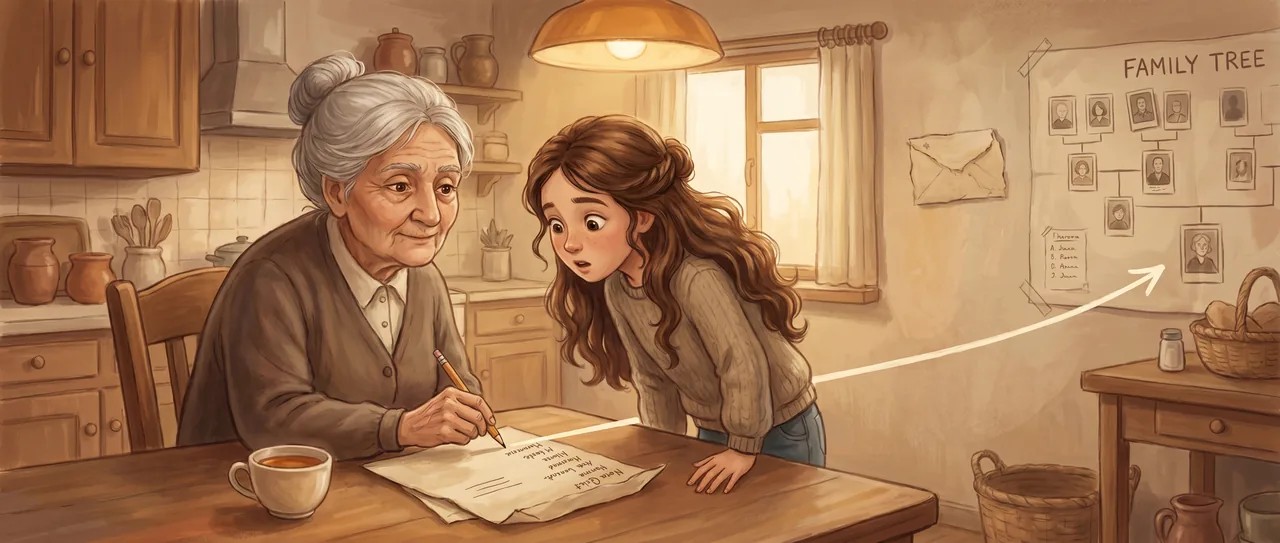
The family tree on the kitchen wall was wrong, and Maya could feel it before she could say why.
It was drawn in her cousin's careful handwriting, branches going up and out, husbands and wives in little boxes joined by lines. Names she half knew. Great-uncles. A grandfather who fished. The whole reunion was in that tree somewhere, all the people now eating cake in the next room.
"You're staring at it like it owes you money," said her great-grandmother, who everyone called Nana Quiet because she said about one thing an hour and the thing was always worth it.
"It's even," Maya said. "Every person has two lines going up. A mother and a father. Two and two and two."
"That's how people come," Nana Quiet said. "In twos."
Maya nodded, but the feeling stayed. She had learned a thing in science that did not match the tree, and she could not yet line them up. Her teacher had said it fast, near the end of a Friday. There is a second set of genes in you. A tiny one. Thirty-seven genes, living in little engines inside your cells, the mitochondria. And those, she had said, you get only from your mother.
Only from your mother. Maya had written it down because it sounded like a rule with no exceptions, and rules with no exceptions were her favorite kind.
She looked at the tree again. Two lines up from every box. But the little engines did not come in twos. They came in ones.
"Nana," Maya said slowly. "Some of these lines don't carry the same thing."
"Mm."
Maya took the pencil off the table. She did not draw on the tree, because it was her cousin's. She turned over an old envelope instead and started a new line, a single line, going straight up.
Herself at the bottom. Then her mother, only her mother, no father this time. Then her mother's mother. Then her mother's mother's mother. No husbands. No second branches. Just women, one above the other, like a single thread pulled out of the wide cloth of the real tree.
"What are you making?" Nana Quiet asked.
"The line the engines took," Maya said. "To get to me."
She drew it up past her grandmother. Past a name she only knew from a photograph, a woman in a stiff collar. The thread did not branch. It could not. Every mother handed down the same tiny set of thirty-seven genes, copied and copied, and the fathers, all of them, every single one, handed down none of it. The fathers built half of everything else. The eyes, the height, the rest of the great library. But not the engines. The engines came down one road only, and the road was mothers.
"Keep going," Maya said, mostly to herself. The pencil moved up the envelope and ran out of paper.
She got another envelope.
Because here was the thing turning over in her now. The line did not stop at the photograph. The woman in the stiff collar had a mother. And that mother had a mother. The thread went up and up, never branching, never doubling, behind every name there was exactly one more name, all the way back before photographs, before the kitchen, before the country they were sitting in.
"Nana," she said, and her voice came out smaller than she meant. "This line doesn't have a top."
Nana Quiet set down her tea.
"There's a mother above every mother," Maya said. "And I have the engines from all of them. Not just their faces in pictures. The actual genes. The same ones, handed down, the whole way." She pressed the pencil flat. "It goes back further than anybody wrote anything down."
"How far," said Nana Quiet. Not a question. An invitation.
Maya tried to picture it and the picture would not fit inside the kitchen. Her mother's mother's mother, and keep saying it, a thousand times, ten thousand. Women she would never have a name for, in places she would never see, each one carrying the same little engines in her cells and handing them forward without knowing she was doing it. None of them had a tree on a wall. None of them knew about the thirty-seven genes humming inside them. And every one of them was on Maya's single line, real, necessary, unbroken. Take one of them out and the thread snapped and Maya was never born.
The cake noise from the other room went quiet in her ears.
Because it kept going. The thread did not stop at the first humans either. It just kept being mothers. Further back than people. The engines were that old. "I'm holding the end of it," she said. "The whole line. It runs all the way down to me and then it stops, here, until I'm somebody's mother, maybe."
"Or until you're not," Nana Quiet said, gently, "and it runs out at a girl with a pencil. That's allowed too."
Maya looked at the wide family tree, even and balanced, husbands and wives in their tidy boxes. It was true. It was just not the only true thing on the wall now.
"Everybody in there," Maya said, pointing toward the cake and the noise, "thinks they came from two lines. They came from thousands of lines. But there's one line in each of them that only ever went through mothers. And mine" she touched the envelope "is the same as yours. The exact same engines. You handed them to my grandmother who handed them to my mother who handed them to me."
Nana Quiet was very still.
"Say that again," she said.
"The engines in you," Maya said, "and the engines in me. The thirty-seven. They're the same line. Nobody in between could change them. Not the fathers. Not anybody. It's just us, and everyone above you, going back past the top of the wall."
Nana Quiet reached out and took the pencil from Maya's hand. She turned the envelope over to its last clean corner. Above the highest name Maya had written, in handwriting that shook only a little, she drew one short line going up, and at the end of it, instead of a name, she drew an arrow, pointing off the paper, off the table, out past the kitchen wall.
Read the interactive version, listen to the narration, and earn a gold star →
A science-verified short story for curious kids · Curiosity Land