The Animal That Feeds You Itself
The jar had no label. That was the first thing Maya noticed.
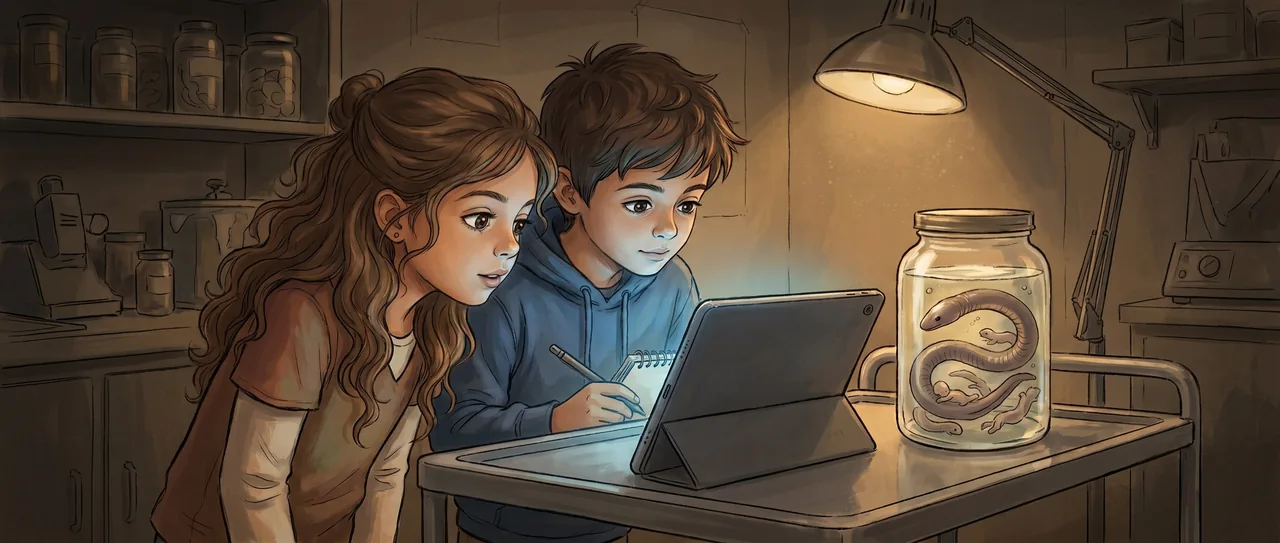
Every other jar on the steel cart wore a typed tag tied with string. Toad. Toad. Skink. The unlabeled one held something pale and ropey, coiled in cloudy fluid, looking exactly like the biggest earthworm Maya had ever seen, except that worms do not have faces, and this had a small blunt face with a closed eye under the skin.
"That's not a worm," she said.
Soren leaned in until his nose nearly touched the glass. "It has a jaw. Worms don't have jaws."
Dr. Okafor was three tables away, hunched over the camera, swearing gently at a lens that would not focus. She had recruited them an hour ago with the words you two have steady hands and I have a deadline, and since then she had said almost nothing.
"Dr. Okafor," Maya called. "What's the one with no tag?"
"The what?" The herpetologist did not look up. "Oh. Caecilian. Don't shake it."
"A what?"
"Caecilian. Amphibian. Like a frog's strange cousin that gave up on legs." She adjusted the lens. "Lives underground. Almost nobody's ever seen one. Now please, the toads."
Soren had already pulled his notebook from his back pocket. He wrote the word, sounding it out, see-SILL-yun, and drew the blunt face.
Maya was not looking at the face. She was looking at a second, smaller shape behind the adult, half hidden in the coil. Then a third.
"There are babies in here," she said.
That got Dr. Okafor to turn around.
She came over wiping her hands, took the jar, tilted it toward the lamp. "Well. So there are. This is a brooding female. We didn't even know we had her young in here." Something in her face had changed. The deadline left her voice. "You want to see something almost nobody alive has watched?"
She set a tablet on the cart and pulled up a video, a dim clip shot through a glass tank, narrated by no one.
In it, a caecilian mother lay in a knot of her own babies. The babies were swarming her. Climbing her, mouths working at her sides. Maya's stomach tightened. It looked, for a second, like something terrible.
"Are they hurting her?" Soren asked. His pen had stopped.
"Watch the skin," said Dr. Okafor.
Maya watched. The babies were tearing strips from the outside of their mother's body. Peeling her. And the mother lay still and let them.
"She's letting them eat her," Maya whispered.
"Eat her skin," Dr. Okafor said. "Just the outer layer. She grows it thick and fatty on purpose, special skin, richer than the rest of her. It's not an accident they're peeling. It's a meal. She made the meal out of herself."
Soren's mouth was open. "But then she's, she's smaller. She gave them part of her body."
"Here's the part that gets me," said Dr. Okafor, and she leaned on the cart. "She grows it back. Every few days, the whole nursing time, she builds that skin again so they can take it again. Over and over."
Maya was quiet. She was running something in her head, the way she did, faster than she could say it.
"The babies," she said slowly. "How do they peel it? Skin doesn't just come off."
Dr. Okafor smiled like a person handing over a secret. "Teeth."
"Babies have teeth?"
"Special ones. Shaped like little spoons and hooks, nothing like adult teeth. Made for exactly this, for scraping their mother. And then," she paused, "the teeth fall out as they grow up. They lose them. Replace them with ordinary teeth for ordinary food."
Soren wrote teeth that fall out, then stopped and stared at his own handwriting.
"So the teeth only exist," he said carefully, "for the part of life where your mother is your food."
"That's exactly right."
Maya stepped back from the jar. She was looking at the coiled adult, smaller than her young deserved, and she felt the whole thing rearrange.
"Everybody thinks it's a worm," she said. "You'd walk right past it. You'd think it was nothing. A bit of nothing in the dirt."
"Most people do," said Dr. Okafor. "That's why it has no label. Nobody requests them. Nobody films them. There are species we've literally only seen do this once."
"Once," Soren repeated.
"Once. Ever. By human eyes." She set the jar down gently, as if it had become heavier. "There is more we don't know about this animal than we know. That's not a flaw in the science. That's just where the edge is right now."
Maya pressed her thumbnail against the glass, lining it up with the smallest baby. The baby was a comma of pale flesh with a closed eye and a mouth built for one job it would outgrow.
"It looks like the most ordinary thing in the world," she said. "And it's doing the strangest thing in the world. And almost nobody has ever looked."
"Plenty of things are like that," said Dr. Okafor, and she said it to Maya specifically, the way you say a thing you have waited a long time to say to someone who would get it. "The animal that looks like nothing usually isn't. You have to be the kind of person who stops at the jar with no tag."
Maya did not answer. She was thinking about how many jars there were in the world. How many drawers. How many ropey nothing-shapes coiled in dirt under gardens and roads, each one possibly doing something no person had ever watched.
Soren turned to a clean page. He drew the mother. He drew the babies. Between them he drew the strip of skin coming away, and under it he wrote three words and underlined them twice: she rebuilds it.
Then he looked up. "Dr. Okafor. If she regrows the whole outer skin every few days, how does her body know when to stop? When the babies are grown and the teeth are gone, how does she know to stop making the food?"
Dr. Okafor opened her mouth. Closed it. Opened it again.
"I don't know," she said. "Nobody knows that one."
The room was very quiet. On the cart, in cloudy fluid, the mother lay coiled around her young, smaller than she had been born to be, and not one of them had a label.
Read the interactive version, listen to the narration, and earn a gold star →
A science-verified short story for curious kids · Curiosity Land