The Thing That Wasn't Behind the Glass
Maya's aunt Priya had said one thing before disappearing into the back room: don't touch the gold one.
So Maya was looking at the gold one.
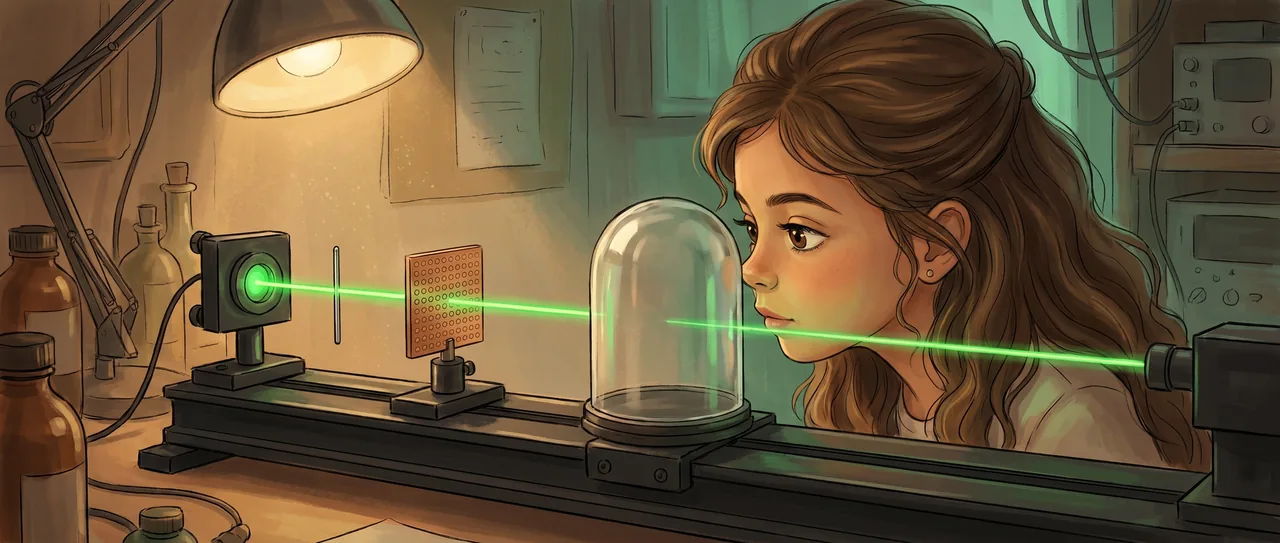
It sat under a glass dome on a black bench, a little coppery tile no bigger than a postage stamp. Up close it wasn't smooth. It had a pattern on it, rows and rows of tiny rings, too small to count, like the surface of something built by very patient insects. A green laser ran across the bench on a track, pointed straight at the tile.
Behind the tile, propped up, was a thin steel pin.
Maya leaned sideways until her nose nearly touched the dome. The laser hit the tile. And the pin behind it was gone. Not in shadow. Not blurry. Gone, the way a word is gone when you erase it cleanly.
She straightened up. The pin was there again, a little steel line standing in its clip.
She leaned back down. Gone.
Up. There.
Maya did this seven times. She was not impatient about it. She was the opposite of impatient. She had found a thing that broke when she looked from one angle and fixed itself when she looked from another, and that was the most interesting kind of thing there was.
It only vanished in the green light. When she shifted so she saw the pin in the ordinary lamp glow, it stayed solid. Green erased it. Yellow lamplight didn't.
That was the part that didn't fit. A wall hides everything behind it. A curtain hides everything. This tile only hid the pin from one color.
"You found my favorite mistake," Priya said, coming back with a coffee and a tired face. She was the kind of busy where she talked to you and to her own thoughts at the same time. "Don't breathe on the dome."
"Where did the pin go," Maya said. It wasn't really a question. It was Maya putting the problem on the table between them.
"Nowhere. It's right there."
"In green it isn't."
Priya glanced over, sipped, and her eyes did something. "Huh. Track's drifted. The wavelength's tuned a little off but it's still working. Good. Means the lattice held up."
"What lattice."
Priya set the coffee down and forgot it immediately, which Maya respected. "Okay. You know light is a wave."
"Waves have a size."
"They have a size. Green light, the wave from one peak to the next, is smaller than a speck of dust. Tiny. Now look at the pattern on the tile."
"The rings."
"The rings are smaller than that. Smaller than the wave itself. That's the whole trick. We built something with parts finer than the light that lands on it."
Maya looked back down at the gold tile, at the rows she couldn't count. Smaller than light. She had never once thought of light as a thing you could be smaller than. Light was the thing that showed you how big everything was. And here was a pattern that ducked underneath it.
"When the structure is finer than the wave," Priya said, "the light stops seeing edges. It stops bouncing off things the normal way. Instead the pattern steers it. We can write the rings so the light slides around the pin like a river going around a rock and comes out the far side going the same direction it started. Your eye gets the light. It just never touched the pin. So your brain says, nothing there."
"A river around a rock," Maya said slowly. "But the river's bent. The middle of it went around something."
"And straightens back out. You can't tell from downstream that the rock was ever there."
Maya leaned down again. Green. The pin gone. She thought about the light arriving at her eye after curving around a steel pin it had been steered past, carrying no news of the pin at all, completely innocent.
"So my eye is lying," she said.
"Your eye is doing its job perfectly. It catches the light that arrives. Always has. We just sent it light that took a detour and didn't mention it."
Maya was quiet. This was the part she would carry out of the room. Not because anyone was tricking her with mirrors. Because light could be guided, and a guided light tells you only where it ended up, never where it went.
"It's only green," Maya said suddenly, sitting up. "You said the rings are sized for the wave. The green wave."
"Right."
"So the rings only fit green. Yellow's a different size wave. It doesn't fit, so it doesn't get steered, so yellow still sees the pin." She was talking fast now, the way she did when the pieces were landing. "You didn't make the pin invisible. You made it invisible to one color. You'd need a different tile for every color of light at once to really hide it."
Priya stopped with the coffee halfway up. "That," she said, "is the exact problem that's keeping forty laboratories awake at night."
"Forty?"
"At least. Hiding a thing from one wavelength, we can do. You're looking at it. Hiding it from all of them, from every color your eye catches, all together, on something bigger than a postage stamp." She shook her head, and she was almost smiling. "Nobody has done that yet."
Nobody had done it yet.
Maya heard the word yet land. Not impossible. Not magic. Just a thing with the size of light on one side and rooms full of awake people on the other, and an unfinished space in the middle where the answer wasn't standing.
"Can I see it in another color," she said. "Do you have a red one."
"I have a red one," Priya said, and went to get it, and left her coffee, and didn't tell Maya not to lean in close.
Maya put her face back to the glass. She moved her head a slow inch to the left, into the edge of the green beam, and watched the steel pin thin out to nothing. She held her head there, in the one exact place where the river closed over the rock, and did not move.
Read the interactive version, listen to the narration, and earn a gold star →
A science-verified short story for curious kids · Curiosity Land