The Stuff That Wasn't There
The chemistry set in the attic was older than anyone alive. The wood was the color of strong tea, and inside, the little glass bottles still had labels written by hand in brown ink. Maya read one out loud.
"Calx of mercury," she said. "What's a calx?"
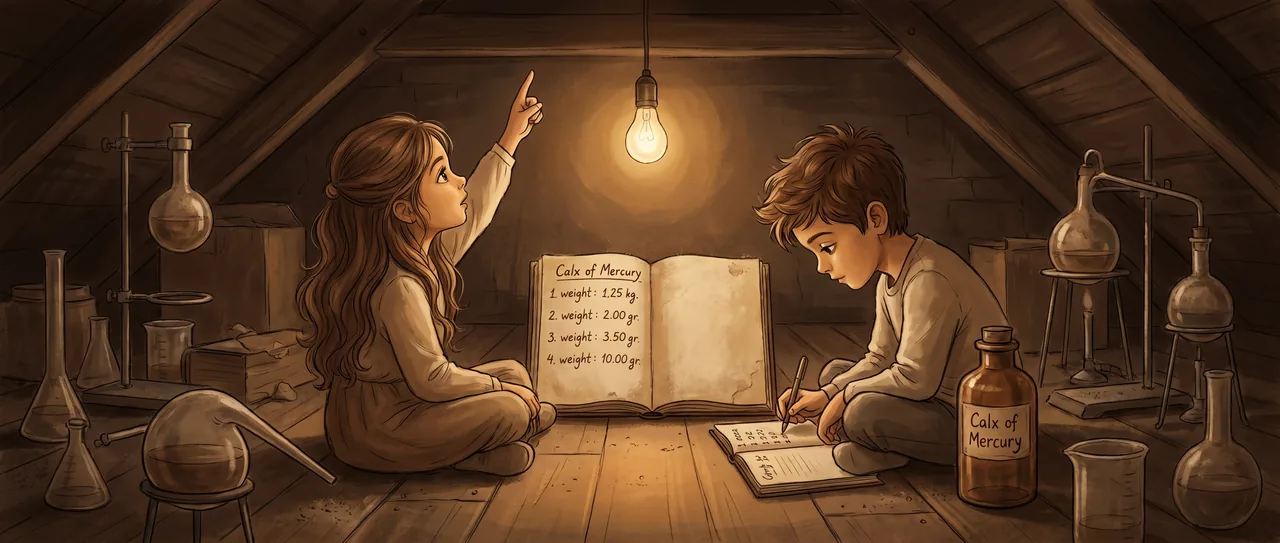
"No idea," said Soren. He had found something better. Tucked under the bottles was a notebook, the pages soft as cloth, the writing slanted and old. The first page said, in faded letters, the property of T. Halloran, his investigations into the nature of fire.
"That's Gran's great-grandfather," Maya said. "Or his great-grandfather. There's a lot of greats."
They sat under the one bare bulb and read T. Halloran's investigations into the nature of fire. He had very neat handwriting and he was completely sure of himself, and he was wrong about almost everything.
He believed, the notebook said, that everything that could burn contained a substance called phlogiston. When a thing burned, the phlogiston flowed out of it into the air. Wood was rich in phlogiston, which was why a log left so little behind. The leftover ash was the true wood, the wood with its phlogiston gone.
"Okay," said Soren slowly. "That actually kind of makes sense."
Maya tilted her head. "It does."
It did. A burning candle shrinks. A log becomes a handful of ash. Something leaves. You can watch it leave, the flame and the smoke pouring upward off the thing. T. Halloran thought he was watching phlogiston go.
"He's got an experiment," Soren said, turning the page. "He's trying to weigh the phlogiston."
That was the part that had gone wrong. T. Halloran had a logical idea. If burning released phlogiston into the air, then a burned thing should weigh less afterward. The phlogiston had left. He burned things and weighed the ash and yes, the ash weighed less than the wood. He was pleased. He underlined it.
Then he tried it with metals.
He heated a metal until it crumbled into a powder, a calx, and he weighed the powder, expecting it to be lighter, because phlogiston had left it too.
The powder was heavier.
Maya stopped. "Wait. Read that again."
Soren read it again. The calx weighs more than the metal. He had weighed it four times. He wrote each weight down. They were all the same, all heavier, and you could feel the man's frustration coming up off the page two hundred years later.
"If something left," Maya said, "it should be lighter."
"Right."
"It got heavier."
"Right."
Maya pulled her knees up and looked at nothing, which Soren knew meant she was looking at everything. "So something didn't leave," she said. "Something arrived."
Soren felt the back of his neck go cool. He read the rest of the page. T. Halloran had not written that. T. Halloran had decided that phlogiston, in metals, must have negative weight, so that losing it made a thing heavier. He had invented a kind of nothing that weighed less than nothing rather than give up his idea.
"He didn't want to be wrong," Soren said.
"Nobody wants to be wrong." Maya took the notebook gently and held it under the light. "But look. He wrote down the number anyway. Even though it ruined everything. He wrote it down."
That was the thing about T. Halloran. He was wrong, and he was stubborn, and he kept honest weights. The number that broke his whole world was sitting right there in his own neat hand, recorded four times, because he could not make himself fake it.
Soren got out his own notebook. He drew two little diagrams, the metal before and the calx after, with arrows. He stared at them.
"If it got heavier," he said, "the extra weight came from somewhere. There's only one place it could come from."
Maya pointed straight up. Not at the ceiling. At the air.
"The air," she said.
"Something in the air," said Soren, "stuck to the metal."
They looked at each other in the dusty light, and the attic felt suddenly enormous, because the air did not feel empty anymore. It felt full. It felt like an ocean they had been standing at the bottom of their whole lives without once thinking about what it was made of.
"It's invisible," Maya said. "It's all around us, it's going in and out of us right now, and you can't see it, and it has weight, and it sticks to things when they burn." She breathed in on purpose, slow, feeling it. "We're breathing the thing he couldn't find."
Soren wrote the word oxygen on his page, then crossed a line under it, then sat with the strangeness of it. T. Halloran had been looking for something leaving. The answer was something joining. He had the whole arrow pointing backward.
"He could have figured it out," Soren said. "He had the number. The number told him. He just couldn't believe the number more than he believed his idea."
"That's the hardest thing," Maya said, and she said it quietly, like she already knew it about herself. "Believing the number more than the idea."
Soren thought about all the times he'd checked a measurement six times hoping it would change. About how much easier it was to invent a nothing with negative weight than to tear down the thing you were sure of. T. Halloran felt, right then, less like a stranger from two hundred years ago and more like someone sitting in the attic with them, stubborn and careful and so close.
"People had to invent the whole idea of what stuff even is," Maya said. "Before this. Nobody knew the air was made of different things. They thought it was just air. One thing." She turned in a slow circle, looking at the ordinary attic air as if it had just confessed something. "Somebody had to find out that nothing is one thing."
Soren picked up the little brown bottle. Calx of mercury. The label that had meant nothing twenty minutes ago. He understood now that T. Halloran had been holding a piece of the answer in his hand the entire time, in a bottle, labeled, on a shelf. The metal that had eaten part of the air.
Maya held the notebook open to the heavier-not-lighter page and set it on the floor between them, under the light, so they could both see the number.
Soren leaned over it. The brown ink. The four matching weights. The careful, honest hand of a man who wrote down the thing that proved him wrong and never knew it.
He lifted his pen and copied the number onto his own page, exactly as Halloran had written it, weight for weight.
Read the interactive version, listen to the narration, and earn a gold star →
A science-verified short story for curious kids · Curiosity Land