The Pattern That Won't Be Watched
Mr. Okafor's garage smelled like solder and old paper. He had taught physics for forty years, and now his daughter was moving him to a smaller place, and Maya and Soren had been promised pizza for carrying boxes.
Soren found the box that did not want to be carried.
It was heavy and lopsided, and through a gap in the cardboard he could see a glass tube wrapped in foil, a small green circuit board, and a hand-lettered label that said DO NOT BUMP, STILL ALIGNED.
"This one's a machine," he said.
Mr. Okafor came over slowly, holding his coffee. He looked at the box the way people look at an old photograph of themselves.
"That," he said, "is a headache I built in nineteen eighty-eight. Took me a whole summer. Plug it in if you like. The screen still glows. I never could explain it well enough to satisfy myself, so I stopped trying."
That was all the permission Maya needed.
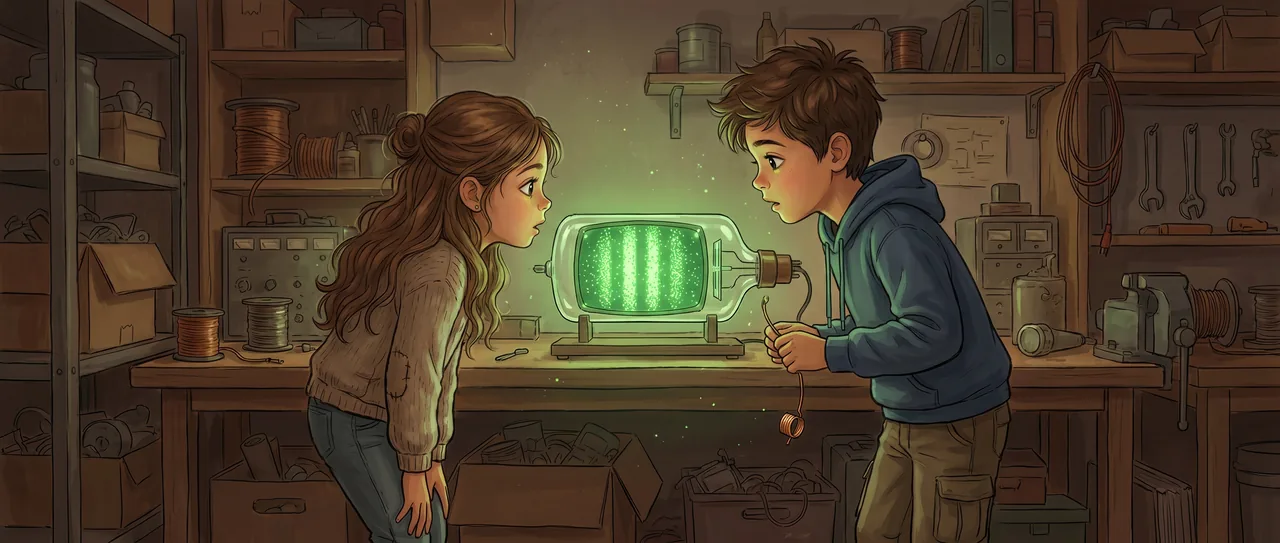
They set it on the workbench. Soren found the power cord. There was a phosphor screen at one end, a faint round window of glass that lit up a dim green when the machine warmed up. In front of the screen, almost too thin to see, was a metal plate with two slits cut into it, side by side, close as two pencil lines.
"It fires electrons," Mr. Okafor said from across the garage, not coming closer. "One at a time, if you turn the dial all the way down. Slow enough that you could shake hands with each one. They go through the slits and land on the screen."
Maya turned the dial all the way down.
For a while nothing happened. Then a single speck of light blinked on the green screen. Then another, somewhere else. Then another. Random, scattered, like the first drops of rain on a dry sidewalk.
Soren had his notebook open. He drew a dot for each flash.
"They're landing anywhere," he said. "No pattern."
"Keep watching," Mr. Okafor said. "You have to be patient with it. I was never patient enough."
The dots kept coming, one lonely electron at a time. Maya stopped trying to track each one. She let her eyes go soft and looked at the whole screen at once, the way you look at a crowd instead of a face.
"Soren," she said. "It's stripes."
He looked up. She was right. The scattered dots were not scattered anymore. Where there had been chaos, bands were forming. Bright stripes of crowded dots, and between them dark stripes where almost no electron ever landed.
"That's an interference pattern," Soren said slowly. "But that's wrong. That's what waves do. Water waves, when they go through two gaps and the ripples cross. We did it in the tank at school."
"These aren't waves. They're one at a time." Maya pointed at the screen. "One electron. One dot. There's never two in the machine at once."
"Then what's it interfering with?"
They looked at each other.
"Itself," Maya said. The word came out before she had decided to say it. "It goes through both slits. The one electron. Both at the same time, and it crosses itself, and that's why the stripes."
Soren wanted that to be impossible. He looked at the two slits, two thin lines in the metal. A thing the size of one dot. It could go through the left. It could go through the right. Those were the choices. Those were the only choices.
"Prove it," he said. "If it really goes through both, then we should be able to catch it. Watch one slit. See which one it actually picks."
Mr. Okafor made a sound that was almost a laugh. "There's a little detector coil in the drawer," he said. "I built it to do exactly that. Clip it on one slit and it'll tell you when an electron passes through that side. I warn you. That is the part I never made peace with."
Soren found the coil, a tiny ring of copper wire on a clip. He fixed it carefully over the left slit. A small red light on it would blink, Mr. Okafor said, every time an electron went through the left.
Maya turned the dial. The electrons started again, one at a time.
The red light blinked. Did not blink. Blinked. Half the electrons going left, half going right, exactly as Soren expected. He wrote it down. Left. Right. Right. Left. Honest and simple.
"Now look at the screen," Maya said.
Soren looked.
The stripes were gone.
Not faded. Gone. The dots were piling up in two plain blurry heaps, one behind each slit, the way marbles would pile up if you threw them through two gaps. No bright bands. No dark bands. Just two dull clumps.
"Take the coil off," Maya said. Her voice had gone very quiet.
Soren unclipped it. They waited. The dots came. Maya let her eyes go soft again.
The stripes came back.
Soren clipped the coil on. The stripes vanished. He took it off. They returned. He did it again, and again, six times, his hands steady and his face not steady at all, because each time it was the same. When the machine could be caught going through one slit, it went through one slit and made no pattern. When no one was checking, it went through both and made the stripes.
"It's not the coil bumping it," Soren said. He had checked the gentleness of it, the tiny copper ring touching nothing. "It's not knocking it off course. It's just. Knowing. The pattern only happens when nobody can tell which way it went."
Mr. Okafor had come closer now without either of them noticing. He stood looking at the green screen over their shoulders, his cold coffee forgotten in his hand.
"Forty years," he said softly. "I taught the equations. I could get the equations exactly right on the board. The equations have never once been wrong." He shook his head. "But the equations don't tell you why it cares whether you're looking. Nobody knows that. I always told my students somebody would figure it out. I am eighty years old and nobody has."
Maya was not listening to him. She had turned the dial down as low as it would go, slower than slow, so the screen sat dark for long seconds between flashes.
Then one speck of green light appeared. One electron, somewhere out in the machine right now, with no coil on either slit, no one able to say which way it had gone.
She leaned in close to the dark glass and waited for the next one.
Read the interactive version, listen to the narration, and earn a gold star →
A science-verified short story for curious kids · Curiosity Land