The Cat Detector That Knew Too Much
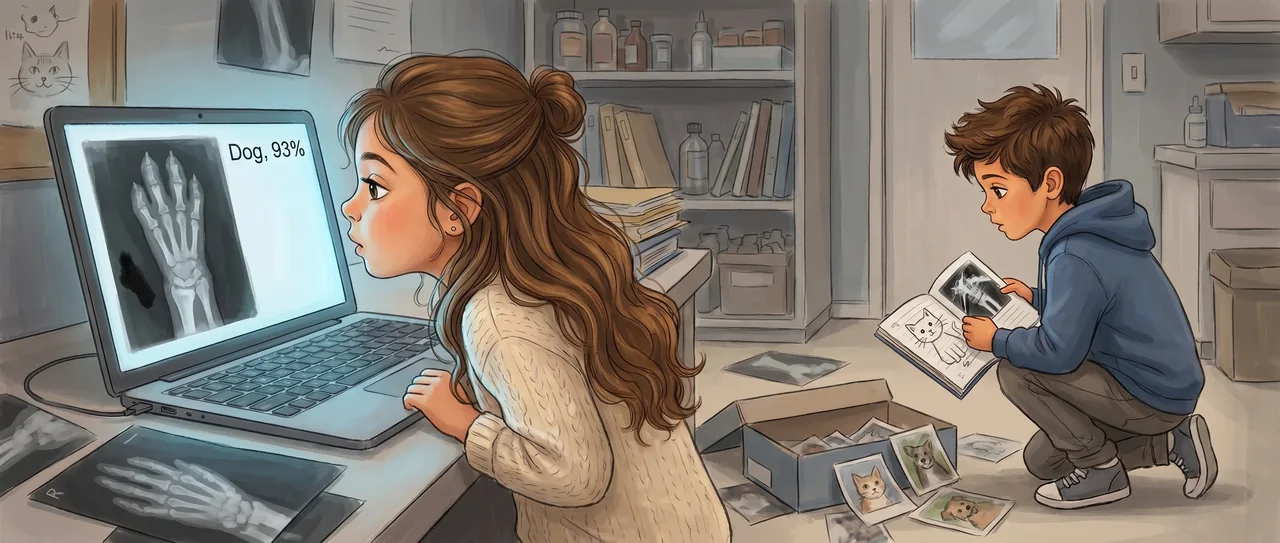
The vet clinic let Soren's mom volunteer on Saturdays, which meant Soren and Maya got the back room, a slow laptop, and a shoebox of photos nobody had sorted.
"Cats on the left, dogs on the right," Soren read off the sticky note. "There are four hundred of them."
Maya was already not sorting them. She had found an app on the laptop, something a college student had left behind two summers ago, half finished. You fed it a picture. It told you cat or dog, and how sure it was.
"This will do the four hundred in a minute," she said.
"It's not ours."
"It's bored. Look at it."
They fed it the shoebox. It worked. Cat, ninety-eight percent. Dog, ninety-five. Cat, cat, dog. Maya watched the little number climb and fall and felt that small satisfaction of a machine doing exactly what it was built for.
Then Soren knocked the folder off the desk and a different stack of pictures slid out across the floor. Not pets. Gray ones. X-rays, scanned flat, somebody's filing job from before the clinic went digital. Dog hips, dog chests, the curl of a spine.
"Those go back," Soren said, gathering them.
Maya picked one up and looked at it for a second too long. Then she scanned it into the laptop and dropped it into the app.
The app thought. The little bar crawled. It had never seen a thing like this in its life. It had been built on cats and dogs, photographs, fur and whiskers and wet noses.
Dog, it said. Eighty-nine percent.
Maya laughed. "Lucky. It's a dog X-ray."
"Try another."
She tried a chest. Dog, eighty-four. She tried a spine. Dog, seventy-six. She tried one that even Soren couldn't identify, a smear of gray with a bright white line through it.
Dog, ninety-one.
Soren stopped gathering the floor. "That's too good," he said. "It's never seen an X-ray. There's no fur. There's no nose. There's nothing it learned on."
"So it's guessing."
"Then it should be at fifty. Coin flip. Cat or dog, half right." He set the pictures down. "It's not at fifty. It's at ninety."
Maya went quiet, which for Maya meant she was running ahead of the words.
"It knows something," she said. "From cats. It's using something it learned from cats."
"On a bone."
"On a bone."
They looked at each other across the gray pictures.
Soren got out his notebook and drew a cat, badly, and an X-ray, worse. Then he stared between them. "What does a cat photo and a dog X-ray have in common? Nothing. One's a fluffy orange thing in a sunbeam. The other's the inside of a hip."
"Edges," Maya said.
"What?"
"Where the cat stops and the sunbeam starts. That's an edge. Where the bone stops and the dark starts. That's an edge too." She was pointing at the orange cat now. "To find a cat in a photo you have to find where things turn into other things. Lines. Curves. Where light goes to dark."
Soren found the student's notes folded under the laptop, pages of diagrams. He flattened them. The thing was built in layers, the notes said. The first layers, the early ones, did the small dumb work. They looked for edges. Corners. A patch of dark next to a patch of light. The notes even had a name for them. Low level feature detectors.
"It built those for cats," Soren said slowly. "To find cats it had to learn to find edges first. You can't see a whisker until you can see a line."
"And bones," Maya said, "are made of edges. The bright line against the dark. The curve of the hip." She picked up the smear with the white line. "It can't tell what this is. But it can see the shapes. It learned to see shapes on cats, and the shapes are still here."
Soren felt the room get bigger around him in a way he couldn't have explained to his mom.
"So the cat part is useless," he said. "But the seeing part. The seeing part doesn't care what it's looking at."
"It learned how to look," Maya said. "That's separate from what it looked at."
They ran more. The chest scans. The spines. The app kept guessing dog and kept being weirdly, impossibly sure, and Maya finally understood why the certainty didn't bother her anymore. It wasn't certain about dogs. It was certain about edges. It had found the edges, every time, on things it had never seen, in a body it didn't know was a body.
Soren wrote a line in the notebook and underlined it. The hand pressed hard enough to dent the next page.
"My mom sorts the X-rays herself," he said. "Every week. She holds them up to the window. It takes her an hour." He looked at the laptop. "What if you didn't start from nothing. What if you took the part that already knows how to see, the cat part, and you only taught it the last little bit. Bone, not bone. Sick, not sick."
"You'd skip the whole beginning," Maya said. "It already did the hard part. On cats."
"On cats," Soren repeated, and the absurdity of it made him grin.
Maya was thinking about something else now, the way she did, three rooms ahead. "Then it's not really about cats," she said. "Or dogs, or bones. Anything that learns to see one thing learns a little bit of how to see everything. The seeing carries over."
"To things it was never meant for."
"To things that didn't exist when it was made."
They sat with that. A machine taught on house pets, holding inside it some quiet general talent for finding the line where one thing becomes another, a talent that didn't know or care that it had wandered out of the world of cats and into the inside of a dog's chest, and could keep wandering, into faces, into galaxies, into storms, into anything with an edge.
Soren scanned the next X-ray. Maya leaned in close to the screen so her nose nearly touched it.
The little bar crawled. The number climbed. Ninety-three percent dog, it said, on a picture of a thing that had never once been a dog.
Read the interactive version, listen to the narration, and earn a gold star →
A science-verified short story for curious kids · Curiosity Land