The Broken Letter
The goat would not stop eating oranges, and that was the whole problem.
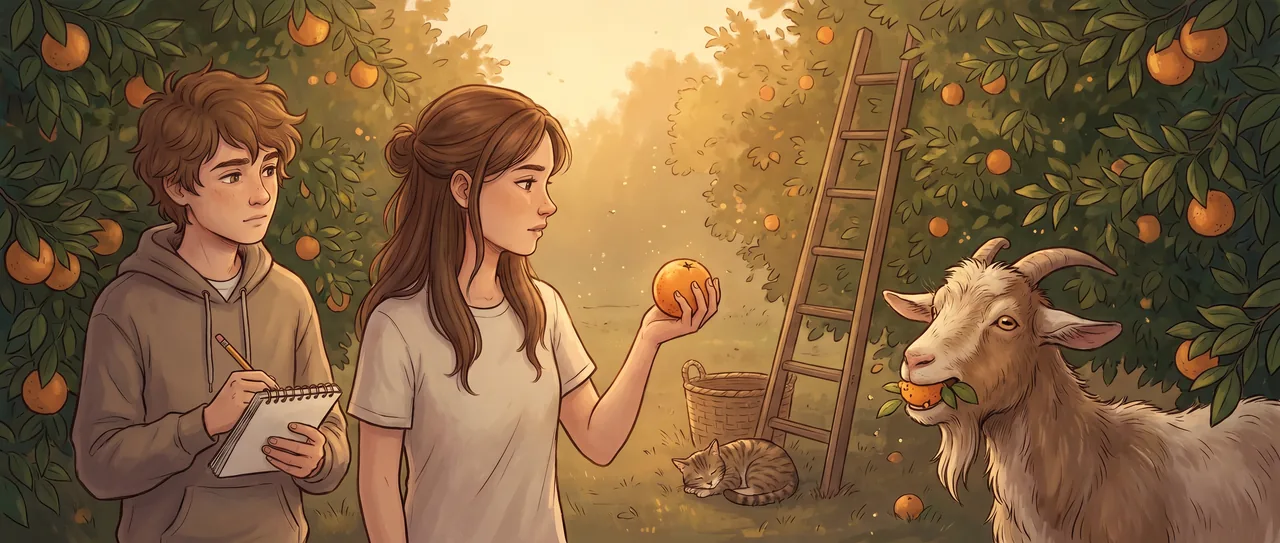
Maya watched it work through the windfall pile under Gran's tree, peel and all, while the cat beside her licked one paw and wanted nothing to do with fruit. Soren was up the ladder picking the high ones because Gran said the high ones were sweetest and Gran was usually right about her own trees.
"Gran," Maya called. "Does the goat need oranges?"
"The goat needs nothing," Gran said from the shade, fanning herself with a seed catalog. "The goat is a bottomless pit with hooves. It eats oranges because they're there."
"But does it need them. Like, would it get sick without them."
Gran laughed. "That goat could live on cardboard and spite."
Maya filed that. It went onto her list, the list in her head of things that did not fit yet. The goat ate oranges and didn't need them. She ate oranges and Gran always said you must, especially in winter, especially when she had a cold.
"Soren," she said. "Why do people get scurvy and goats don't?"
The ladder creaked. Soren came down two rungs to think where she could see his face. "Scurvy is the vitamin C one. Sailors. Limes." He paused. "I don't actually know why it's only people."
"It's not only people," Maya said, surprising herself. "It can't be only people. The goat's full of oranges and it never read a single book about vitamins."
Soren came the rest of the way down. He had the look he got when something wasn't working, and the thing that wasn't working was a fact he'd accepted his whole life without turning it over.
"Wait," he said. "If the goat needed vitamin C from oranges, every goat that didn't live near oranges would be dead. And goats live everywhere. On mountains. In deserts."
"So the goat makes its own," Maya said.
"From what?"
"From grass. From cardboard and spite." She was almost laughing but her brain had gone very quiet underneath the laughing, the way it did right before something landed. "Soren. The goat makes its own vitamin C. The cat makes its own. The dog makes its own. They don't eat oranges and they're fine."
Soren had his notebook out. His pencil stopped over the page.
"Then why don't we," he said.
That was the question. It sat in the orchard with them, between the basket and the ladder and the goat chewing with its whole flat face.
"Every animal makes it," Maya said slowly, feeling along the edge of the thing. "Grass-eaters. Meat-eaters. The cat hasn't eaten fruit in its life. We're the weird ones. We're the ones who break."
"Gran," Soren called. "Did people always get scurvy? Like, far back?"
"Farther back than ships, you mean." Gran lowered the catalog. "I suppose so. Anyone who stopped eating fresh things long enough. It's quick, scurvy. Few weeks. The body sort of comes unstitched."
"Comes unstitched," Soren repeated, and wrote it.
Maya was looking at the goat now like it had a secret. "It's not that we forgot how to make it," she said. "You can't forget a thing your body does on its own. The cat doesn't try. It just happens inside the cat. So if it doesn't happen inside us, it's because the inside part is broken."
"A broken part," Soren said. "In all of us. Every single person."
"Every single person who ever lived."
They looked at each other. The orchard was very loud with bees and very quiet underneath.
"That can't be right," Soren said, which was what he said when something was right and enormous. "A broken thing doesn't last. Broken things die out. If we couldn't make vitamin C, the first person it broke in should've just. Come unstitched. And had no kids. And that would be the end of it."
"Unless," Maya said.
She picked up an orange. Turned it in her hand. The goat watched her with rectangular eyes.
"Unless they were already eating these," she said. "Unless whoever it broke in first lived somewhere full of fruit. So it broke and it didn't matter. The orange covered for it." She looked up. "The break didn't kill anybody because the food was already doing the job. So nobody ever noticed. And it just. Got passed down. Forever. Because it never cost anything."
Soren stopped writing.
"How long," he said quietly. "How long would something have to be passed down to reach every person on Earth."
Neither of them knew the number. But they both felt the size of it, the way you feel the size of the ocean standing at the edge with your feet in one inch of it. Something had broken in one animal, in one warm green place full of fruit, so long ago there were no people yet, only something on its way to becoming people. And the break had been harmless because the trees were generous. And that one harmless broken thing had been handed down, parent to child, parent to child, through everything that happened after, through all the cold and all the ships and all the winters, all the way down into Maya's own blood, standing here in her grandmother's orchard holding an orange she could not live without.
"That's why Gran says you have to," Maya said. Her voice had gone small. "In winter. With a cold. It's not just being careful. We actually can't."
"The goat can," Soren said. "The cat can." He looked at the cat, which had fallen asleep, magnificently able to make a thing inside itself that Soren's body had not made in eleven years and never would.
"We've been borrowing it," Maya said. "This whole time. From the trees. Every person, the whole time, just. Borrowing."
Gran's voice drifted over, warm and unbothered. "Are you two going to stand there philosophizing or are you going to bring me an orange?"
Maya looked at the one in her hand. The thing her body could not make and the goat made for free out of grass. The repair her ancient cousins had never needed because the world had been holding it out to them all along, on a branch, in the sun.
She walked it over to Gran and put it in her open hand and watched her grandmother's thumb push into the peel.
Read the interactive version, listen to the narration, and earn a gold star →
A science-verified short story for curious kids · Curiosity Land