What the Mushroom Knew
The oak log was hard as a doorstep. The pine log next to it had gone soft and stringy, like a sponge left in the sink too long. They had been sitting in Gran's woodshed for the same three winters, in the same damp corner, under the same leaks. Maya poked them both with the same finger.
That was the thing she could not let go of. Same corner. Same wet. Same time. Two completely different ruins.
"They rot at different speeds," Gran said, stacking kindling without looking up. "Pine's softwood. Oak's hardwood. Everybody knows that."
Everybody knowing a thing was, in Maya's experience, the fastest way to stop anybody from looking at it.
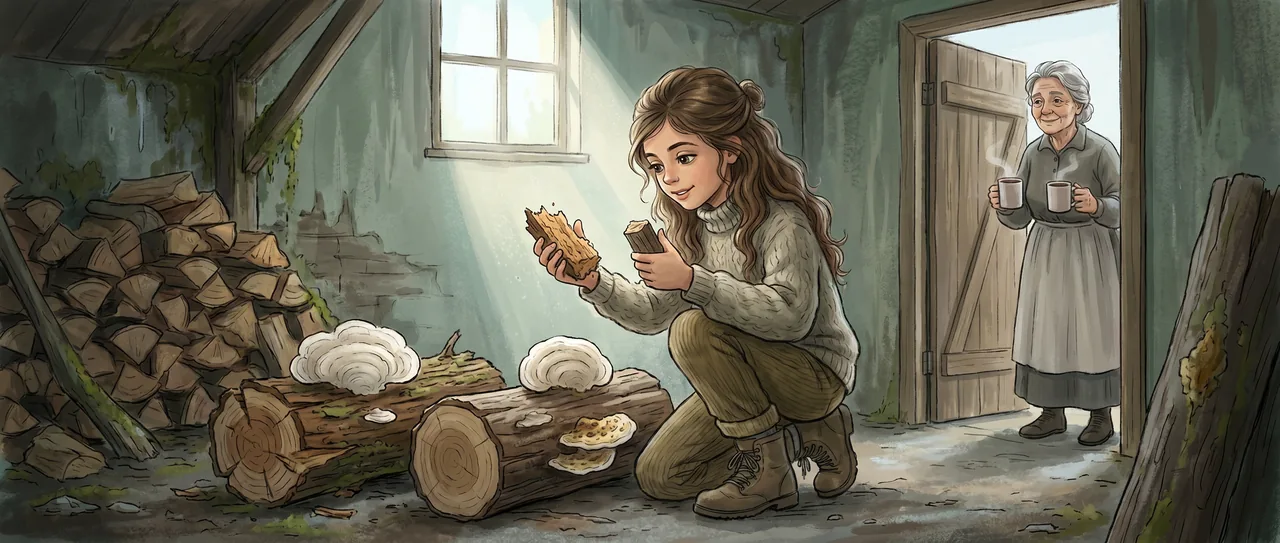
She crouched. The same white fungus was on both logs. She was sure of it. Same fan-shaped shelves, same papery edges, the same fungus growing out of the oak and growing out of the pine. One animal, sort of. One thing, anyway. And the oak it had barely touched in three years. The pine it had eaten halfway to nothing.
"If it's the same mushroom," Maya said slowly, "why is it winning on one log and losing on the other?"
"Because oak is tougher," Gran said. "I just told you."
But that was an answer about the wood. It said nothing about the fungus. And the fungus was the part doing the work.
Maya pulled a shelf of it off the pine. It came away wet, and underneath, the wood was pale and crumbly and smelled sweet, almost like cut grass left in a pile. She pulled a shelf off the oak. Underneath, the wood was barely changed. It smelled like nothing. Like a closed book.
Two smells. Same fungus.
She carried both pieces into the kitchen and put them on a paper towel under the window light. Gran's voice followed her in, fond and unbothered. "You're going to tell me something about those logs, aren't you."
"I don't know anything yet," Maya said, which was true and also the most exciting sentence she knew.
She thought about it the way she thought about everything she couldn't explain, by stacking up the facts that wouldn't fit. The fungus had no brain. She was certain of that. Mushrooms didn't have a single nerve in them. They didn't have a single anything you could call a deciding part. A mushroom couldn't taste a log and think, this one's pine, I'll work harder.
And yet the pine log was halfway gone.
She knew, from a book she'd read twice, that fungi don't bite wood. They can't. They dissolve it. They leak out chemicals, tools too small to see, and the tools take the wood apart into pieces small enough to drink. She knew that much. What she didn't know was why the same fungus would do so much more to the pine.
Maya turned the oak chunk over in her fingers. Oak was full of one tough thing. Pine was full of a different mix. Different woods, she thought. Different locks.
And then she stopped turning it.
If the woods were different locks, the fungus couldn't be carrying one key. One key would open one and not the other. The pine was open. So the fungus had a key for pine. And the oak was still locked, which meant either the fungus had no oak key, or it had one and wasn't using it yet.
She sat very still with that.
Because to use the right key, the fungus would have to know which lock it was touching. It would have to somehow tell oak from pine. Not guess. Tell. And then make the right tool for that specific wood, the exact mix, leak out one recipe on the pine and a different recipe on the oak.
With no brain. With no nerve. With nothing you could point to and call the part that knew.
Maya's skin went cold and bright at the same time.
She got up and went back to the shed, fast, the way she walked when explanation was lagging behind her. There was a third log in the corner she'd half noticed. Maple. Gran burned it for the smell. Maya found it and turned it over and there, sure enough, was the same white fungus, and underneath it the wood was breaking down in a third way, neither sweet like the pine nor stubborn like the oak. A different ruin. A third recipe.
Three logs. Three different chemistries coming out of one fungus that had no way to think about chemistry at all.
It wasn't deciding. It couldn't decide. There was nothing in it to do the deciding. And it was still matching the right tools to the right wood, every time, in the dark, in the wet, in three winters of patience, getting the answer right without anything inside it that could be said to know the answer.
That was the part that made her sit down on the cold shed floor. Not that the fungus was clever. That it wasn't clever, and got it right anyway.
She had always been the kid who needed to know how a thing knew. Teachers wanted the answer; she wanted the part before the answer, the part where the knowing happened. People found that exhausting. She found it like air.
And here was a living thing solving a harder chemistry problem than anything on her hardest test, solving it correctly, with no inside at all. No head full of questions like hers. Just a body leaking exactly the right thing onto exactly the right wood.
The knowing was happening somewhere. It had to be. It was happening in the fungus the way a song happens in a string, not in any one part but in all of it at once, the recipe written somewhere she couldn't point to and couldn't open and couldn't ask.
Gran appeared in the shed doorway with two mugs of cocoa. "You've gone and found something," she said. "I can tell by the floor."
Maya didn't take the mug right away. She had all three logs lined up now, oak and pine and maple, each one being unmade in its own particular way by the same brainless white edges.
She pressed her thumb into the pine and it gave like bread, and she pressed it into the oak and it didn't give at all, and she held both thumbs up in the cold light to compare.
Read the interactive version, listen to the narration, and earn a gold star →
A science-verified short story for curious kids · Curiosity Land