The Wrong Ice
The thermometer on the porch said eleven below. Soren's dad had told them to fill the tray molds for the backyard rink and leave them out, and he would come check before bed. Then he went inside to deal with the woodstove and did not come back out.
"Cold water," Maya said. She was already filling a tray from the outdoor tap, which ran so cold it ached. "Cold water is closer to freezing. So it freezes first. Obviously."
Soren had the kettle. He had brought it out without quite knowing why, except that his hands were cold and the kettle was warm and carrying it felt good. "My grandmother fills the bird bath with hot water in winter," he said. "She says it ices over faster. I always thought she was wrong."
"She's wrong," Maya said. "Hot water has more heat in it. More heat means more time to lose it. That's just true."
"That is just true," Soren agreed. And then, because the inside of his head felt itchy, he said, "Let's race them."
Maya looked up. She liked racing things better than agreeing about them.
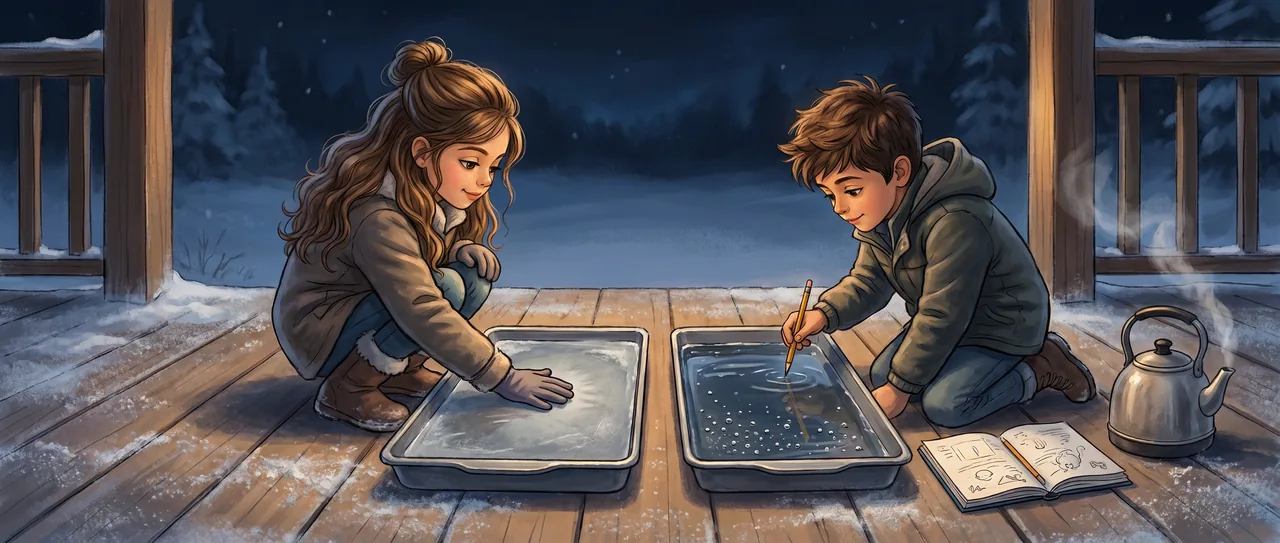
They filled two identical trays. Maya's from the freezing tap. Soren's from the kettle, the water still steaming, fogging up the porch light. They set them side by side on the cold boards, exactly the same distance from the railing, and Soren wrote the start time in his notebook with a pencil because pens froze.
"It's going to be cold," Maya said. "Cold finishes first. I'll go get cocoa while we wait."
But she didn't go. She crouched down with her chin on the railing and watched, because something about Soren's tray bothered her, and she had learned not to walk away from the bothering.
The hot tray was doing something. Steam poured off it in sheets. The surface rippled and shrank, like the water was throwing itself into the air.
"It's losing water," she said. "Look. The hot one is getting shallower."
Soren leaned in. She was right. The kettle tray had less in it now than when they poured it. "Evaporation," he said slowly. "It's boiling itself smaller. Less water left to freeze."
"That's cheating," Maya said, delighted. "That's not the water freezing faster, that's there being less of it."
"Maybe," Soren said. He wrote it down. He drew two trays and an arrow and the word LESS with a question mark, because something in him would not let the question mark go.
They waited. The porch light hummed. Inside, the woodstove door clanked.
And the hot tray skinned over first.
Maya saw it before Soren did, a dull gray film creeping across the surface where a minute ago there had been steam. She reached out and touched it. Solid. A thin shell of ice across the whole tray.
The cold tray, her tray, was still dark and liquid, with only a fringe of crystals along one edge.
"No," Maya said. Not upset. Just stating that the universe had made an error and she expected it to correct itself.
Soren tapped both trays with the pencil. Tick on the hot one, ice. Plip on the cold one, water. He tapped them again to be sure. He always needed to be sure.
"It can't just be the evaporation," he said. "Your tray has more water, yeah. But not that much more. Not enough to lose a whole race."
Maya sat back on her heels. She was running the list in her head, the list of things that did not make sense yet, and this had just jumped to the top.
"Okay," she said. "Then what made mine slow?"
They both stared at the cold tray. And Soren, who paid attention to the thing behaving wrong, noticed the bubbles. The cold water was full of them, tiny silver beads clinging to the bottom of the tray, trapped gas that had come straight out of the freezing tap.
The hot water had almost none. Boiling had driven the gas out.
"Yours has air in it," he said. "Mine got the air cooked out."
"Does air matter?" Maya asked.
"I don't know." He said it honestly. "Maybe dissolved gas changes how it lets go of heat. Maybe the hot one stirs itself while it cools, all that steam moving, so it loses heat evenly instead of just at the top." He stopped. "I'm guessing. I have three guesses and I don't know which one is right."
"Pick one," Maya said.
"I can't. That's the thing." He looked up at her, and his face had the open look it got when something was bigger than he expected. "I think it might be all of them. I think it might be different ones on different nights."
Maya went very still.
"You're saying nobody knows," she said.
"I'm saying I just watched it happen and I have four reasons and not one of them is for sure." He flipped back through the notebook, all the neat experiments where the answer had clicked shut at the end like a lid. This one would not click. "People have a name for it. Mpemba. A kid noticed it, in a cooking class, with ice cream. Grown scientists argued for years. They still argue."
"A kid noticed it," Maya repeated.
"A kid noticed it and the scientists couldn't agree on why and they still can't." Soren laughed, a little shaky. "It's water. It's the most ordinary thing there is. We freeze it every single day."
Maya looked at the two trays. The hot one, solid and gray and finished. The cold one, dark and patient and full of trapped silver air, still deciding.
She pressed her palm flat against the wrong ice, the warm water that had won, and felt how cold it had become. Behind her the porch door opened and Soren's dad called out asking if they had filled the molds yet.
Neither of them answered. Maya kept her hand on the ice that should not have been there, and counted the bubbles in the tray that should have won.
Read the interactive version, listen to the narration, and earn a gold star →
A science-verified short story for curious kids · Curiosity Land