The Thing You Can't Quite Throw Away
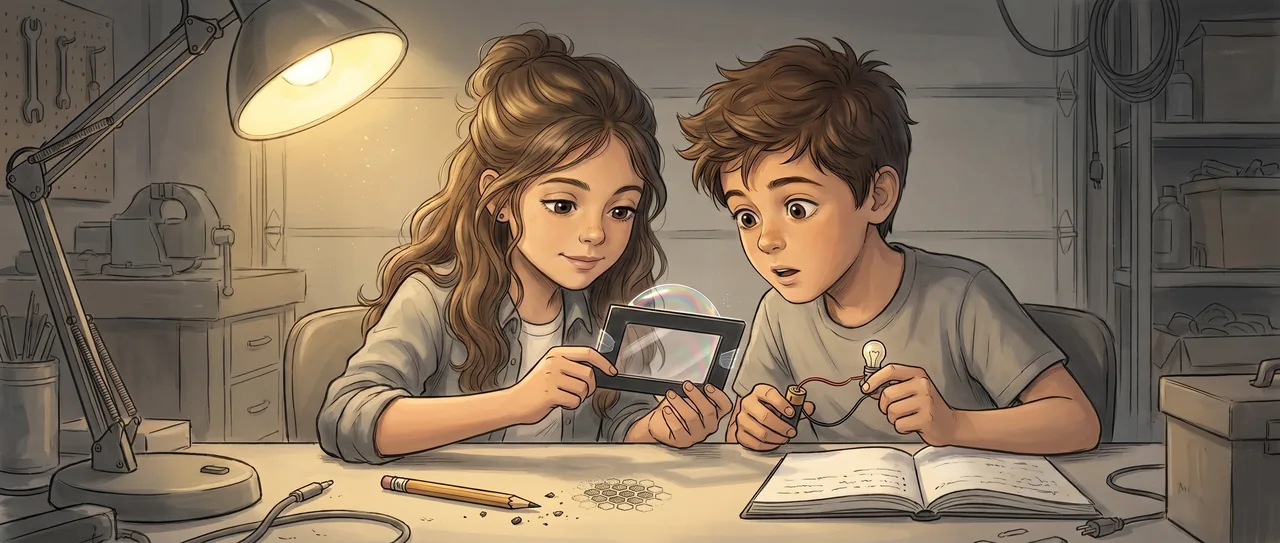
Soren's aunt left a card on the workbench before she flew to Singapore. It was the size of a playing card, black plastic, with a clear window in the middle and a label that said DO NOT BEND. Behind the window there was nothing. Or almost nothing. When Maya tilted it under the lamp, a faint smudge of color slid across the empty space, like the ghost of an oil slick.
"It's empty," Maya said.
"It's not empty. She wouldn't laminate empty." Soren turned it over. On the back, in his aunt's tiny handwriting: one layer. carbon. don't waste it.
Maya held it up to her eye and looked through the window at the garage light. "I can see the bulb," she said. "Right through it."
"Carbon's black, though." Soren pulled a pencil from the jar of pens. "Pencil lead is carbon. Charcoal is carbon. Both black. Both you can't see through."
This was the kind of thing that got stuck in Maya's head and would not leave. Carbon was black. The card was clear. Same word, two opposite things. She did not like it, and she liked that she did not like it.
She took the pencil and scribbled a dark patch on a scrap of paper. "Look. Solid black."
"Rub it."
She rubbed the patch with her thumb. It smeared. Some of it came off gray and shiny on her skin.
"Pencil lead comes apart in layers," Soren said slowly. He was watching her thumb. "That's why it writes. Sheets of it slide off onto the paper."
"Sheets." Maya looked at the card. At the smudge of color that was barely there. "So how thin can a sheet get?"
They both went quiet. The lamp hummed.
Soren got his notebook and a battery and two wires, because the only way he knew to test whether something was nothing was to ask it a question and watch for an answer. He clipped the wires to a small bulb. Then he touched the two bare ends to a fresh pencil mark on paper, pressing hard.
The bulb glowed. Dim, but it glowed.
"Carbon carries electricity," he said. "Even the pencil does."
Maya took the card. "Then ask it." She wanted to press the wires to the window, to the nothing behind the glass.
"We can't. It's sealed. And she said don't waste it." Soren held the card flat under the lamp again, very still, and tilted it by tiny amounts. The color slid. A whisper of rainbow, there and gone. "That's the only reason we can see it at all. It's so thin that light barely notices it. It catches just a little. Like a soap bubble."
"A soap bubble is water," Maya said. "This is carbon. The black stuff."
"Same atoms. Different arrangement." Soren said it and then stopped, because he had said something true before he understood it, which was Maya's trick, not his.
Maya was already ahead of him. She grabbed the smeared paper and held it next to the card. "Pencil is a stack. A million sheets piled up, all dark, you can't see through a stack. But peel them apart. One sheet. Off by itself."
"One layer," Soren read off the back of the card again. "One layer. Carbon."
"That's why it's clear." Maya's voice had gone fast and certain. "It's not a different stuff. It's the same stuff but there's almost none of it. One atom thick. Light just walks through because there's hardly anything to stop it."
Soren wrote one atom thick and then sat looking at the words. He had written plenty of impossible things in the notebook before. This one made his hand feel strange. "One atom," he said. "You can't get thinner than that. One atom is the floor. There is no half an atom of carbon."
"So it's the thinnest thing that can exist and still be a thing." Maya pressed the card flat to the workbench and laid her whole hand over it, gently, the way you cover something to keep it from blowing away. "And you can hold it."
"Don't bend it."
"I'm not." But she lifted her hand and looked at the window and frowned, because something still did not fit, and the not-fitting was the most interesting part. "If it's that thin, it should tear like a cobweb. One atom. A breath should break it."
Soren turned the card so the DO NOT BEND faced up. "She laminated it in hard plastic. You only protect something like that if it's fragile."
"Or," Maya said, "if it's the opposite."
She set the card down. She picked up the pencil and snapped it in half without trying. The wood split, the lead crumbled. Carbon, falling apart in her fingers, gray dust on the bench.
"That's carbon when it's a stack," she said. "The sheets slide. That's why it breaks easy and writes easy, same reason."
Soren looked at the broken pencil. Then at the window of nothing. "But inside one sheet," he said, working it out a step at a time, the way he had to, "every atom is holding hands with the ones around it. Locked in. A pattern. Nothing to slide. Nothing to let go."
"Hexagons," Maya said. She didn't know how she knew. She drew one on the dusty bench with her fingertip, six sides, then another joined to it, then another, until there was a little honeycomb in the pencil dust. "Like that. Has to be like that."
Soren stared at her honeycomb. He pulled the bulb-and-battery rig over and, very carefully, touched the two wires to the edge of the plastic where it was thinnest, not to break the seal, just to be near it. The bulb did nothing, of course. Plastic in the way. But he was already imagining it without the plastic, the same dim glow the pencil gave, only not dim, brighter than the copper wires themselves carried it. "Stronger than diamond," Maya said. "Diamond's just carbon too."
The garage was the same garage. The lamp still hummed.
Maya picked up the card one more time and tilted it, slow, until the faint rainbow slid across the empty window and caught the light, the whole impossible sheet of it announcing itself for half a second before it vanished again into clear.
Read the interactive version, listen to the narration, and earn a gold star →
A science-verified short story for curious kids · Curiosity Land