The Spoonful That Doesn't Run Out
Soren's uncle Petros pried a dented metal canister off the underside of a dead station wagon and tossed it into Soren's lap.
"That one's worth money," Petros said. "More than the whole rest of the car. People steal these right off the street."
Soren turned it over. It was about the size of a loaf of bread, rusted on the outside, heavy in a strange way. It rattled faintly.
"What's in it?"
"Honeycomb. Ceramic. And a little smear of platinum." Petros was already crawling under the next car. "Tiny amount. You could fit all the precious metal in there into a spoon."
Soren did not believe him. A spoon of metal could not be worth more than a car. He shook the canister near his ear, the way he shook things when the answer wasn't adding up.
"Then why's it worth anything?"
"Because of what it does, not how much there is." Petros's voice came out muffled. "Engine spits out poison. Goes in one end of that, comes out the other end mostly harmless. Carbon monoxide turns into carbon dioxide. The bad stuff into the okay stuff."
"How much platinum does it use up doing that?"
"None."
Soren stopped shaking the canister.
"That can't be right," he said. "If it changes the poison, it has to get used up. Everything that does a thing gets used up. Batteries. Matches. Soap."
Petros slid out from under the car, wiped his hands, and shrugged in the way that meant he was telling the truth and didn't care if it sounded impossible.
"Lasts the whole life of the car. Hundred thousand miles. Same spoonful of metal, start to finish."
Soren sat down on a tire with the converter in his lap. This was the kind of thing that felt wrong in his chest, and when something felt wrong in his chest he had to take it apart.
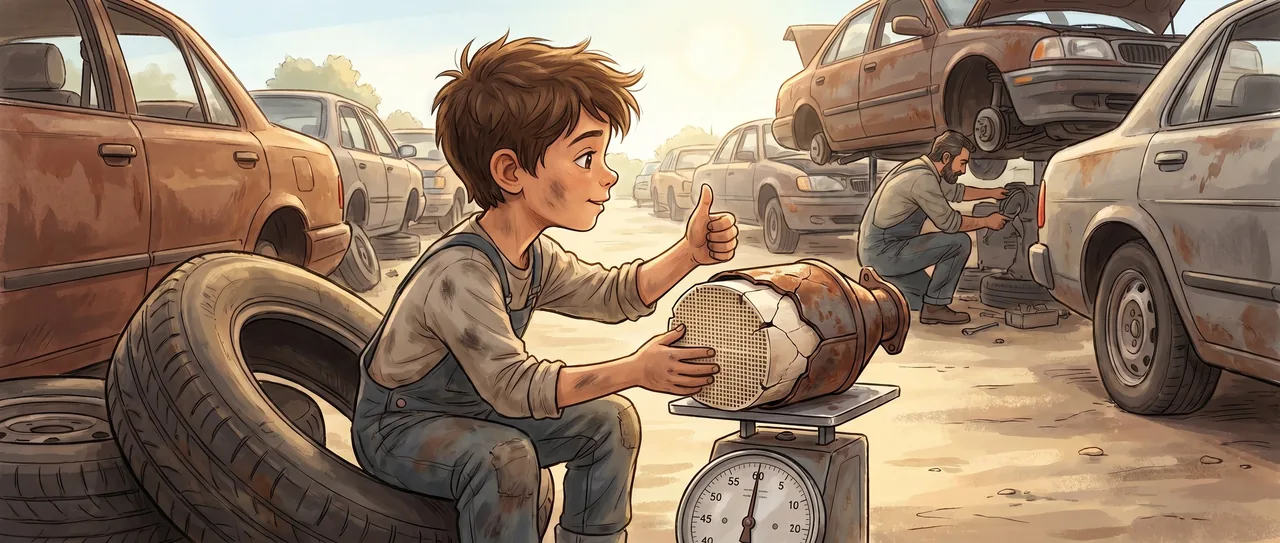
He found a broken one in the scrap pile and worked at the seam with a screwdriver until the casing split. Inside was exactly what Petros said. A block of pale ceramic, full of hundreds of tiny square channels, like looking at the end of a bundle of straws. He held it up to the light. Every wall of every channel had a faint dull shimmer, thinner than paint.
That was the spoonful. Smeared across a surface so folded up on itself that the inside of this one small block had more area than a tennis court.
Soren thought about matches. A match gives up everything it has. The wood burns, the head is gone, you cannot light it twice. He thought about the platinum smear, thin as a breath, cleaning poison for a hundred thousand miles and still being there at the end.
The difference, he decided, had to be that the platinum wasn't joining the reaction. It was doing something else. Something more like holding the door.
He pictured a gas molecule, carbon monoxide, drifting along one of those channels. On its own it would float right past an oxygen molecule and nothing would happen, the way two people can pass in a hallway a thousand times and never speak. But if the molecules landed on the platinum surface, the metal held onto them. Pinned them in place. Pulled them close enough that they had no choice but to react. And the instant they joined and the new molecule lifted away, the platinum let go, unchanged, ready for the next one. And the next. And the next.
It wasn't part of the reaction. It was the place the reaction was allowed to happen.
Soren got out his notebook and drew the channels, then drew one molecule sitting on a surface with an arrow showing it leaving again. He wrote one line under it. The metal doesn't change. It changes what's possible.
Petros leaned over his shoulder, frowning at the drawing.
"You drew it bigger than it is," Petros said. "Real one, you'd never see a single molecule."
"I know. I just wanted somewhere to put it."
"Funny kid." Petros went back to the wagon.
Soren stayed on the tire. There was a second thing the rattling block had handed him, and it was bigger than the first, and he turned it over carefully the way he'd turned over the canister.
If one spoonful of metal could keep working forever, doing the same job a million times without wearing down, then the question was never how much of something you had. A whole highway of cars, all their poison made harmless, by a smear you could scrape into a teaspoon, over and over, never running low.
He thought about the inside of his own body. Something Petros wouldn't know and Soren only half knew. That there were things in there doing the exact same trick, billions of times a second, surfaces that grabbed and held and let go and never wore out, that the food he ate and the breath he took ran on the same impossible idea as the rusted block in his lap. The body did it warm and wet and silent. The car did it hot and roaring. The same move. The holding of the door.
He looked down the row of dead cars stretching across the junkyard, every one of them with a spoonful inside, and he tried to add up how many reactions had happened in all of them and could not make the number stop growing.
Soren wanted to test it. You couldn't watch a molecule. But you could feel the weight. He put the cracked block on his uncle's scale, wrote down the number, then pressed his thumb against the pale shimmer, hard, as if he could rub some of it off.
He weighed it again.
The number had not changed.
He pressed harder, dragged his thumb the full length of the block, and held his thumb up in the sunlight to look. There was nothing on it. No silver. No dust. Whatever was on those walls had not come off on him at all.
Soren set the block back on the scale, watched the needle settle to the very same place it had been, and held his thumb still in the light a long time, looking at the clean skin where the metal should have been and was not.
Read the interactive version, listen to the narration, and earn a gold star →
A science-verified short story for curious kids · Curiosity Land