The Sound of Something Leaving
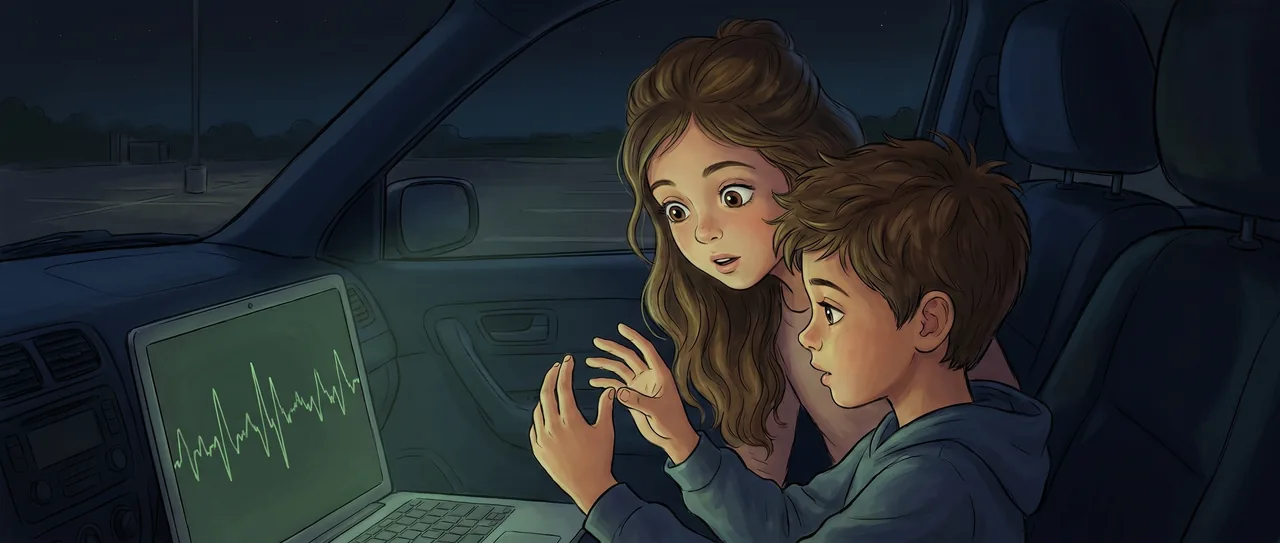
Maya's aunt had said the same thing four times. The dish is listening to a black hole. Then she'd walked back inside the observatory and left them in the car with a laptop, a thermos, and a screen full of slow green waves.
"It's not listening to anything," Soren said. "You can't hear a black hole. Nothing comes out. That's the whole point of it."
"Then why is she pointing the dish at it." Maya wasn't really asking. She was watching the green line crawl.
Soren opened his notebook. He had written down what the aunt said before she left. A black hole is a place where gravity is so strong that nothing escapes. Not rocks. Not light. He underlined not light twice, because that was the part that bothered him.
"If light can't get out," he said, "it's the one thing in the universe you can never actually see. You can only see the stuff falling in. The screaming around the edge."
"The edge," Maya repeated. She liked that word. She pulled the laptop closer. There was a second window behind the green waves, a physics paper her aunt had left open, full of equations like fences. But there was one line of plain English at the top, and Maya read it out loud slowly.
"Black holes are not entirely black."
Soren stopped writing.
"Read it again," he said.
"Black holes are not entirely black. They evaporate."
The two of them looked at each other in the dim light from the screen.
"That's wrong," Soren said. But he said it carefully, the way he said things he wanted to be wrong about. "Nothing gets out. You said so. The aunt said so."
"Maybe nothing gets out from inside," Maya said. She was already somewhere ahead of her own words. "But what about exactly at the edge?"
Soren scrolled. The paper talked about empty space. It said empty space is never truly empty. It said pairs of particles are flickering in and out of existence everywhere, all the time, even in the car they were sitting in, even in the dark between his fingers. Pairs. One a little bit positive, one a little bit negative. They appear together and vanish together before anyone can catch them.
"They cancel each other," Soren read. "They borrow energy for a flicker and pay it back instantly."
Maya held up two fingers, close together. "Born together. Gone together. Always." Then she spread her fingers apart. "Unless something gets between them."
She stopped. She looked at the green waves on the screen, then at her own two fingers.
"Right at the edge," she said. "Right at the edge of the black hole. A pair flickers into being. And one of them is born just inside, and one just outside."
Soren felt the cold go up his arms before he understood why. "The inside one falls in. It can't ever come back."
"And the outside one," Maya said.
"Has nothing to cancel against anymore." Soren was writing now, fast, his pen pressing too hard. "Its partner is gone. It can't pay back the energy. So it's just real. It's a real particle and it flies away."
They sat with that.
"So something does come out," Maya whispered. "Just not from inside. From the edge. From the empty space right next to it."
"And the energy to make it real," Soren said slowly, doing the arithmetic out loud the way he always did, needing every step, "the energy has to come from somewhere. It comes from the black hole. So every time a particle escapes like that, the black hole gets a tiny bit smaller."
Maya turned and stared at him.
"It's leaking," she said.
"It's evaporating," Soren said. "One stolen particle at a time. The blackest thing in the universe is slowly turning into light at the seam, where it can't hold the pair together."
The green line on the screen kept crawling, patient and dull. Maya pointed at it.
"That's why she pointed the dish."
"She's not going to hear it," Soren said, and he looked at the paper again to be sure. The glow it gives off is unimaginably faint. Fainter than the faintest thing the dish could ever catch. For a black hole the size of a star, the trickle was so slow it would take longer than the whole age of the universe, many times over, to evaporate away.
"So no one has ever seen it," Maya said.
"No one has ever seen it," Soren agreed. He checked twice. The word the paper used was predicted. Not observed. Predicted. "A man worked it out with math. Everybody thinks he's right. But nobody has ever actually caught one of those particles coming off a black hole. Not once. Not ever."
Maya sat very still. A man had imagined the emptiest, darkest place in existence, and then imagined the empty space pressed against its edge, and from pure thinking he had decided that even that would glow. And the whole world had agreed he was probably right. And still, still, nobody had ever held the proof in their hands.
"Soren," she said. "Somebody figured out that black holes glow without ever seeing one glow."
"Yeah."
"They just sat somewhere and thought about the edge." Her voice did something it didn't usually do. "The edge of the darkest thing there is. And they thought about it so hard they found light there."
Soren looked at his notebook, at his own cramped handwriting filling the inside of his too small head, and for once it didn't feel too small. It felt like the right size of tool for the job. Somebody had used nothing but this. Pen, and the edge of a thing, and the refusal to stop wondering.
The observatory door opened. The aunt was coming back across the lot, thermos lid in hand, ready to tell them, for the fifth time, that they wouldn't hear anything tonight.
Maya rolled down the window before she reached it.
"We know you can't hear it," she called out into the dark. "We want to know who's going to be the first."
Soren held up two fingers, close together, and pulled them slowly apart.
Read the interactive version, listen to the narration, and earn a gold star →
A science-verified short story for curious kids · Curiosity Land