The Shell That Wouldn't Break
The chalk snapped the moment Maya pressed it against the cutting board. One little push and it crumbled into white dust.
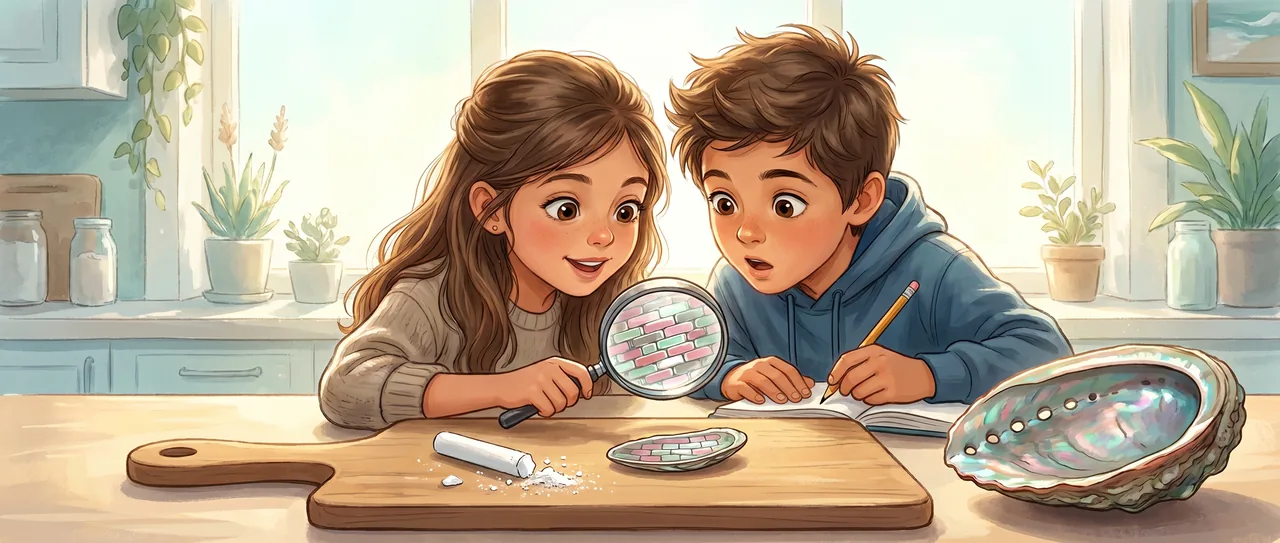
"Calcium carbonate," Soren read off the box. "Same stuff as that." He pointed his pencil at the abalone shell sitting in the middle of the table, glowing pink and green and silver where the light hit it.
"Same stuff," Maya said. "Okay. So the shell should crumble too."
It did not crumble. They knew, because they had been trying for twenty minutes.
Grandma had brought the shell back from the tide pools and set it down like a trophy. Maya had asked if she could break it open to see inside, and Grandma, halfway out the door with a basket of kelp, had said, "You can try," in the voice of someone who already knew how it would go.
Maya had hit it with a wooden spoon. Nothing. Soren had wrapped it in a dish towel and leaned on it with both hands. Nothing. They dropped it on the tile floor from chair height and it bounced, actually bounced, and skittered under the fridge.
Now it sat on the board between them, undented, while the chalk lay in pieces around it.
"That doesn't make sense," Maya said. "Chalk is calcium carbonate. Shell is calcium carbonate. One breaks if you breathe on it. The other one bounced."
"Same ingredient," Soren said slowly. "Different something."
He picked up a chip that had flaked off one edge when it hit the floor. It was the only piece they had managed to break off the whole time, a sliver the size of a fingernail. He turned it in the window light.
"Look at it edge on," he said.
Maya leaned in. The sliver was not solid color. It was made of layers, hundreds of them, stacked thinner than paper, and each layer threw back a different shimmer of color as she tilted it.
"It's not one thing," she said. "It's a stack."
Grandma had a magnifying glass in the junk drawer, the big round kind. Soren held the chip under it while Maya angled the lamp.
Under the glass the layers broke apart into something stranger. Each layer was not smooth. It was tiled, like a floor, with flat little blocks fitted edge to edge. And the layer above it was tiled too, but the blocks did not line up with the ones below. They sat offset, like bricks in a wall.
"Bricks," Maya whispered. "It's a brick wall. A really, really small brick wall."
"Chalk isn't bricks," Soren said. He crushed a piece between his fingers and looked at the powder. "Chalk is just… grains. All jumbled. No pattern."
They looked at the two things side by side. The dust, loose and random. The shell, stacked and fitted and offset, brick over brick over brick.
"Same ingredient," Maya said again, but slower now, like the words were turning into something. "It's not about what it's made of. It's about how it's stacked."
Soren set the chip down. He pressed his thumbnail into the broad flat face of the shell and dragged it, hard. He could feel it wanting to start a crack. He felt the tiny line begin.
"Watch," he said. "A crack has to go somewhere, right? In the chalk it just rips straight through, because it's all the same and there's nothing to stop it."
"But in here," Maya said, and she put her finger over his, on the spot, "the crack hits a brick. And it can't go through the brick. So what does it do?"
They both stared at the offset rows under the magnifying glass.
"It has to go around," Soren said. "Around the brick. Then it hits the next brick. So it goes around that one. It can't ever go straight."
"It zigzags," Maya said. Her voice was climbing. "Every brick it hits, it has to turn. Turning takes energy. Going around a thousand bricks takes a thousand times the energy of ripping straight through."
Soren picked up the wooden spoon they had hit it with earlier. He didn't hit anything. He just held it, thinking.
"The shell isn't strong because of what it's made of," he said. "The chalk proves that. The shell is tough because of the arrangement. The animal built a maze. A crack can get in, but it can't get through, because every step it takes, the wall sends it sideways."
Maya sat back. "An animal made this. A snail, basically. No hands. No oven. No glue."
"It grew the crystals," Soren said. He flipped his notebook open to check a thing he had written down weeks ago and never understood until right now. "It grew each little brick in exactly the right size and laid it down offset from the last one. On purpose. Out of seawater."
"Out of seawater," Maya repeated.
She held the whole shell up to the window. The light came through the thinnest edge of it, and the pink and the green and the silver were not paint and not magic. They were the layers. The colors were the bricks, hundreds of layers thick, bending light the same way they bent cracks.
" "And the animal knows the order," Soren said. "It's never read a single page about materials. It just knows."
Maya looked at the chalk dust on the cutting board, then at the unbroken shell in her hands, then out the window toward the tide pools where Grandma was a small figure bending over the rocks.
"There are millions of them out there," she said. "Right now. Building."
Soren put down his pencil. For once he had nothing he needed to write. He reached over and ran his thumb across the inside of the shell, the smooth side, where ten thousand offset rows lay locked together in the dark under his fingertip.
Maya picked up a fresh stick of chalk, set it on the board, and pressed.
It crumbled.
She looked at the dust, then at the shell, and pressed her palm flat against the cool curved face of the thing that would not break.
Read the interactive version, listen to the narration, and earn a gold star →
A science-verified short story for curious kids · Curiosity Land