The Salt Under the Sea
The tile their grandfather wanted laid by the back door was the color of dirty honey, and it would not stop sweating.
Maya pressed her thumb against it. The surface gave back a film of damp, even though the afternoon was dry and the cicadas were going like sprinklers.
"It's been in the sun an hour," she said. "It should be bone dry. It's wetter than the sea."
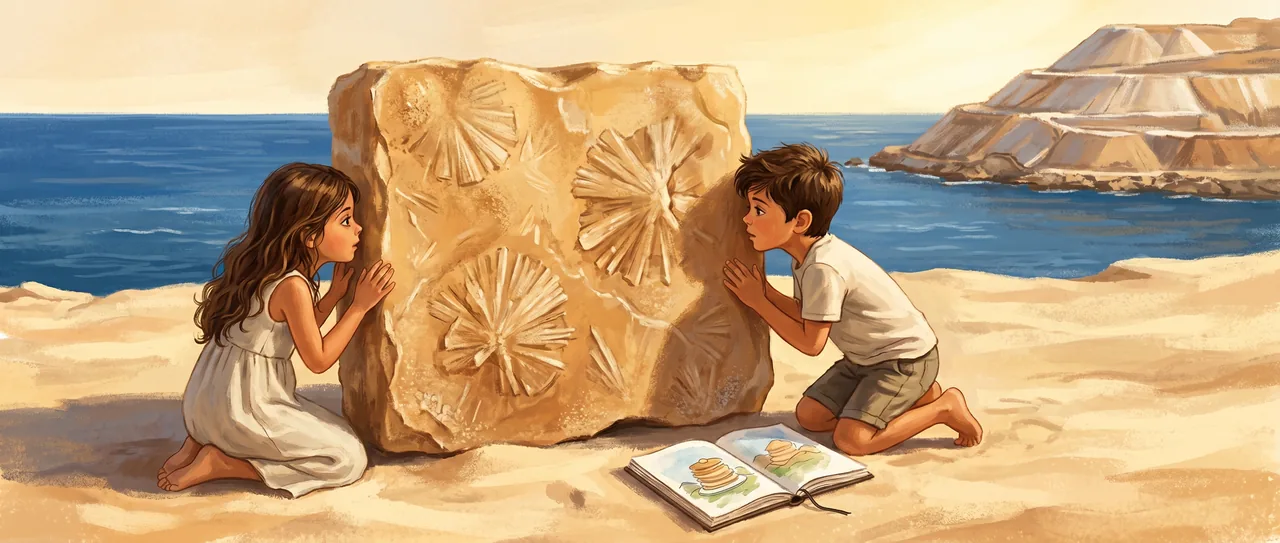
Soren crouched and tilted the slab. Inside it, frozen, were thin blades of crystal, fanned out like the spokes of broken umbrellas. He had a name for the feeling he got looking at them, which was that the rock was older than rocks were supposed to be allowed to be.
"Nonno says it's from the quarry up the hill," Soren said. "He says the whole hill is this. Layers of it, thicker than a house."
"Layers of what, though."
Soren licked his finger, touched the damp film, touched his finger to his tongue. He made a face.
"Salt," he said. "And something bitter under the salt."
Maya looked up the hill, then down at the water. The Mediterranean sat there being blue and enormous and ordinary, slapping at the rocks the way it had every single day of her life.
"A hill," she said slowly, "made of salt. Above the sea."
"Salt comes from seawater drying up," Soren said. "That's how you get it. You boil it or you let it bake."
"You'd need a lot of seawater to dry up to make a whole hill."
They both went quiet. The cicadas filled the quiet for them.
"How much sea," Maya said. It was not really a question. It was the thing on her list that had just moved to the top.
Nonno was up by the house, mixing mortar in a bucket with a trowel, getting more on his arms than in the bucket. He was a retired ferry engineer who believed every job took exactly twice as long as you planned and was usually right.
"Nonno," Maya called. "Where does the salt hill come from?"
"From the bottom," he said, not looking up. "The quarry men cut down and down. The deeper they go, the more salt. My grandfather said the mountain was the floor of a sea that wasn't there anymore." He shrugged, the shrug of a man who had heard a hundred such stories and laid tile through all of them. "Old talk. Hand me the level."
Maya did not hand him the level. She was looking at the blades of crystal in the slab.
"Soren. To make crystals this big, the water has to dry slow. Really slow. Fast drying makes tiny crystals. Slow makes big ones."
"How slow," Soren said.
"Slower than a summer. Slower than a hundred summers." She turned the slab in the light and the umbrella-spokes caught it. "And then there's more layers under it. More salt. More crystals."
Soren had his notebook out now, balanced on his knee, because the inside of his head had gone too small again. He drew the hill. He drew it as a stack of pancakes, each pancake a drying. Then he stopped, pencil in the air.
"You can't dry a sea this big once and get a hill that thick," he said. "One drying isn't enough salt. The water's only so salty. You'd dry the whole sea and get a thin crust. Not a mountain."
"So you do it again," Maya said.
"You can't do it again. It's gone. It dried up."
"Unless," Maya said, and stopped, because the idea was bigger than her mouth.
The sea slapped the rocks. She looked at it. Blue, full, endless, lapping at her grandfather's land. She tried to picture it not there. Not lower. Gone. A hole in the world three kilometers deep where the water should be, the floor of it cracked and white and blinding under a sun with no sea to soften it. A desert below where ships now sailed.
"It filled and dried," she said. "And filled and dried. Over and over. That's the layers. Every layer is the sea coming back and leaving again."
Soren stared at his pancake drawing. "Where would all the water go each time. Where does a whole sea go."
"Out," Maya said, and pointed west, past the headland, toward the place she knew from maps was the narrow gate at the far end, the strait, the only door between this sea and the ocean. "If you shut the door, the sun does the rest. The sea evaporates faster than the rivers can fill it. It just bakes away."
"And to fill it again you open the door."
They looked at each other. They had arrived at the same place at the same time, which was the only way they ever liked to arrive anywhere.
"The Atlantic," Soren said quietly, "on the other side of the door. Higher. Waiting." He swallowed. "If the door opened all at once."
Maya pressed her palm flat against the salt slab, against the sweating, ancient, patient crystal that had grown so slowly in a sea that wasn't there.
"It wouldn't trickle," she said. "A door that big, with an ocean behind it, three kilometers of empty below. It would come down like the end of the world. A waterfall taller than any mountain, filling a desert the size of a sea."
Nonno had stopped mixing. He was watching them with the trowel dripping, the way you watch something you used to know being found again by someone small.
"My grandfather," he said, "used to say you could hear it, if you put your ear to the deep stone. The sea coming home."
Maya did not say that was old talk. She knelt on the warm beach and she put her ear flat against the salt slab, against the cool damp blades of a sea that had died and come back more times than there were summers in a life.
Soren knelt beside her and did the same, his cheek against the stone, his notebook open and forgotten in the sand, both of them listening to a hill that had once been the floor of nothing, under a sea that was only the latest one to fill the hole.
Read the interactive version, listen to the narration, and earn a gold star →
A science-verified short story for curious kids · Curiosity Land